Choosing the correct pond liner size is essential for building a leak-free, long-lasting pond. Our Pond Liner Calculator instantly calculates the recommended liner dimensions, overlap allowance, underlay coverage, and estimated liner cost based on your pond’s measurements.
Whether you’re building a koi pond, garden pond, backyard water feature, or wildlife pond, simply enter your pond’s length, width, depth, and shape to receive accurate liner recommendations in seconds. The calculator supports rectangular, square, circular, oval, kidney-shaped, and irregular ponds, helping you avoid costly sizing mistakes and unnecessary material waste.
Built using industry-standard pond liner sizing formulas, this calculator provides reliable estimates for homeowners, DIY pond builders, landscapers, and pond professionals. Instead of relying on manual calculations, you can confidently plan your project with accurate liner dimensions, material estimates, and installation guidance.
Why Thousands of Pond Owners Use This Calculator
✔️ Accurate Pond Liner Size Calculation – Calculates the correct liner length and width using your pond dimensions, maximum depth, and recommended overlap.
✔️ Instant Material & Cost Estimates – Estimate total liner area, underlay coverage, and project costs in seconds without manual calculations.
✔️ Supports All Common Pond Shapes – Works for rectangular, square, circular, oval, kidney-shaped, and irregular ponds.
✔️ Built on Industry-Standard Formulas – Uses trusted pond liner sizing methods for dependable and consistent results.
✔️ Reduces Costly Measurement Errors – Prevents buying a liner that’s too small while minimizing unnecessary material waste.
✔️ Perfect for DIY & Professional Projects – Ideal for backyard ponds, koi ponds, water gardens, waterfalls, and professional landscaping installations.
✔️ Better Installation Planning – Includes overlap recommendations and material calculations for a smoother, hassle-free installation.
Enter your pond measurements below to instantly calculate the recommended pond liner size, overlap allowance, underlay coverage, and estimated project cost—free, fast, and accurate.
💧 Pond Liner Size & Cost Calculator
Standard Mode - Quick & Easy
Pond Dimensions
Material & Rates
Seaming & Rolls
Example Test Data (QA)
Length: 12ft, Width: 8ft, Depth: 3ft, Overlap: 18in, Irregularity: 10%
Results
Enter pond dimensions and click Calculate to see results.
Understanding Your Pond Liner Calculator Results
Once you enter your pond measurements, the Pond Liner Calculator provides several important results to help you choose the correct liner, estimate project costs, and plan your installation with confidence.
📏 Required Liner Length
This is the minimum liner length needed to fully cover your pond from one edge to the other, including the pond’s depth and recommended overlap.
A correctly sized liner length helps prevent shortages during installation and ensures enough material is available for secure edge anchoring.
📐 Required Liner Width
The calculator also determines the recommended liner width based on your pond’s width, maximum depth, and overlap allowance.
Choosing the proper liner width helps create full sidewall coverage, reduces installation stress, and minimizes the risk of exposed pond edges.
🟦 Total Liner Area
Your results include the total liner area required, typically displayed in square feet (sq ft).
This value helps you:
Estimate how much liner material you’ll need
Compare different liner products
Calculate overall project costs more accurately
🔒 Recommended Overlap
Every pond liner should extend beyond the pond’s edges to allow for secure anchoring and future settling.
The calculator recommends an appropriate overlap allowance, helping prevent the liner from slipping while making installation easier and more reliable.
🛡️ Underlay Coverage
The calculator estimates the amount of pond underlay needed beneath your liner.
Installing an underlay protects the liner from rocks, roots, sharp objects, and ground movement, helping extend its lifespan and reduce the risk of punctures or leaks.
💲Estimated Liner Cost
Based on your calculated liner size and material price, the calculator provides an estimated project cost.
This estimate helps you compare liner options, plan your budget, and avoid unexpected material expenses before purchasing.
🌿 Material Recommendation
Depending on your pond size and project type, the calculator may recommend the most suitable liner material.
Typical recommendations include:
EPDM – Best for koi ponds and long-term durability.
PVC – A budget-friendly option for smaller decorative ponds.
RPE – Lightweight, strong, and ideal for larger ponds.
HDPE – Suitable for specific commercial or containment applications.
Pro Tip: While the calculator estimates the correct liner size, always choose a high-quality, UV-resistant, fish-safe pond liner that matches your pond’s intended use and expected lifespan.
📊 How to Use the Pond Liner Calculator – Step-by-Step Guide
Our Pond Liner Calculator lets you quickly determine the exact liner size, underlay area, seam allowances, and total project cost for any pond. Ideal for DIY builders, koi pond enthusiasts, and landscaping professionals, this step-by-step guide ensures accurate results without guesswork.
Follow these simple steps to plan your pond liner perfectly and save time, money, and effort.
- Step 1
- Step 2
- Step 3
- Step 4
- Step 5
- Step 6
- Step 7
Select Your Pond Shape
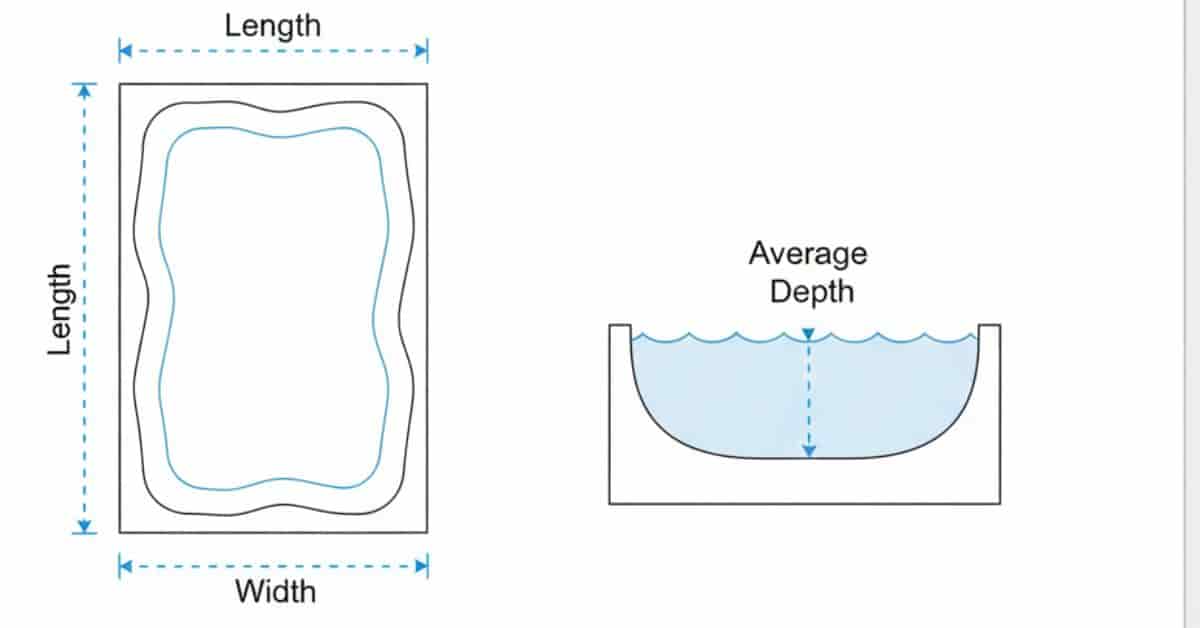
Choose the shape of your pond: Rectangle, Oval, Kidney, or Irregular.
Selecting the correct shape ensures accurate liner sizing.
Pro Tip: If your pond has an unusual shape, use the “Irregular” option for more precise calculations.
Enter Pond Dimensions
Enter the Length, Width, and Average Depth of your pond in feet.
The calculator uses these numbers to determine the base liner area.
Pro Tip: Measure the pond depth at several points and use the average to account for slopes.
Add Liner Overlap & Seam Allowances
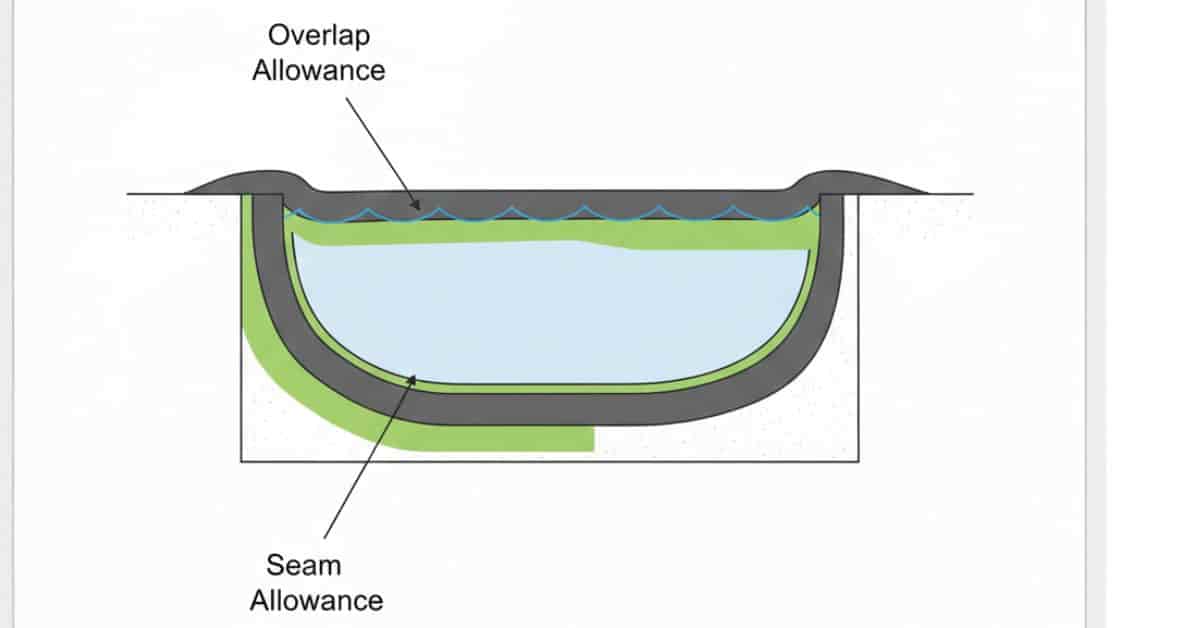
Enter Overlap (typically 12–18 inches) for secure edge coverage.
The calculator automatically adds seam allowance if needed.
Pro Tip: Add a little extra overlap for irregular pond edges to avoid shortages during installation.
Include Underlay & Waste (Optional)
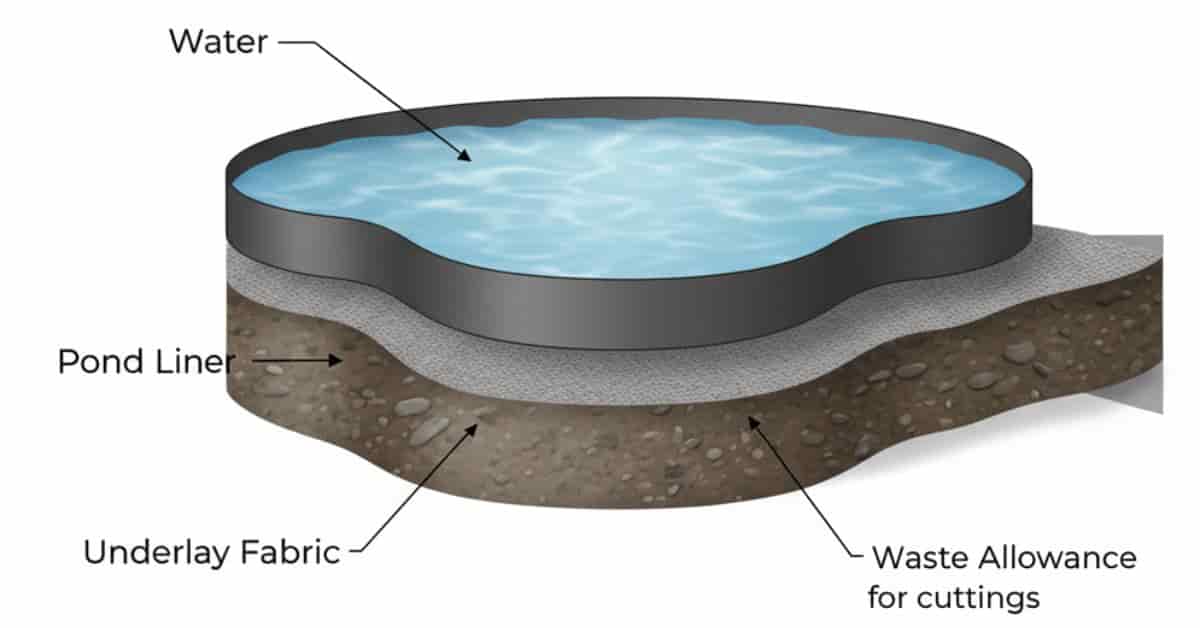
If you want, select Underlay for pond protection.
The calculator can also add extra material for waste or uneven pond edges.
Pro Tip: Always include 5–10% extra material for irregular ponds to prevent shortages.
Calculate Cost
Enter the material cost per square foot (optional).
The calculator will estimate:
Total liner material needed
Approximate project cost
Pro Tip: Compare EPDM and PVC liner prices before finalizing your budget.
View Results
The calculator displays:
Exact liner cut size
Recommended liner width
Total material needed
Estimated project cost
Pond volume in gallons
Pro Tip: Save the results for reference when ordering materials or consulting suppliers.
Export or Save Your Calculation
Print the calculation summary for your records.
Download a CSV file to share with contractors or suppliers.
Pro Tip: Keep a digital copy to reuse for future pond expansions or repairs.
Why Use This Pond Liner Calculator?
Choosing the correct pond liner is one of the most important steps in building a durable, leak-free pond. Our Pond Liner Calculator eliminates guesswork by calculating the recommended liner size, overlap allowance, underlay coverage, and estimated material costs in seconds.
Key Benefits
✅ Accurate Pond Liner Sizing – Calculates the correct liner length and width using your pond dimensions, maximum depth, and recommended overlap for a precise fit.
💲 Instant Cost Estimation – Estimate liner area, underlay requirements, and overall project costs before purchasing materials, helping you stay within budget.
♻️ Reduces Material Waste – Prevents ordering a liner that’s too small while minimizing unnecessary excess material and costly mistakes.
📐 Works for Every Pond Shape – Supports rectangular, square, circular, oval, kidney-shaped, and irregular ponds for accurate calculations across virtually any design.
🛠️ DIY-Friendly & Easy to Use – Simply enter your pond measurements to receive instant results—no manual formulas or technical experience required.
👷 Trusted by Professionals – Suitable for homeowners, koi pond builders, landscapers, contractors, and water garden professionals.
⏱️ Saves Time & Money – Eliminate manual calculations, improve project planning, and purchase the right amount of liner the first time.
🛡️ Supports Better Installation – Includes recommended overlap and underlay estimates to help create a secure, long-lasting, and leak-resistant pond installation.
How to Measure Your Pond
Accurate measurements are the foundation of choosing the correct pond liner. Before using the Pond Liner Calculator, measure your pond’s maximum length, maximum width, and maximum depth. Taking accurate measurements ensures the calculator recommends the correct liner size, overlap, and underlay coverage.
📏 Rectangle Pond
Measure the longest length and widest width from edge to edge, then record the maximum depth at the deepest point.
Best for: Formal garden ponds and raised ponds.
⬜ Square Pond
Measure one side of the pond and the maximum depth. Since all sides are equal, the same measurement is used for both length and width.
Best for: Compact decorative ponds and small water features.
🥚 Oval Pond
Measure the longest point from end to end and the widest point across the center. Then measure the pond’s maximum depth.
Best for: Natural-looking backyard ponds and water gardens.
⚪ Circular Pond
Measure the pond’s diameter (the widest distance across the center), along with the maximum depth.
Best for: Decorative ponds, fountains, and small landscape features.
🪨 Kidney Pond
Measure the maximum overall length, the widest point, and the deepest section of the pond. Ignore small curves when taking measurements—always use the largest dimensions.
Best for: Koi ponds and natural-style landscapes.
🌿 Irregular Pond
For ponds with uneven shapes, measure the maximum length, maximum width, and maximum depth. Using the largest dimensions ensures enough liner material is available to cover the entire pond safely.
Best for: Custom ponds, wildlife ponds, and complex landscape designs.
Measurement Tips
✔️ Always measure the maximum length, width, and depth.
✔️ Measure from the inside edges of the pond, not the surrounding landscape.
✔️ Include shelves and planting ledges when determining the maximum depth.
✔️ Measure twice before ordering your liner to avoid costly mistakes.
✔️ Allow the calculator to include the recommended overlap for secure edge anchoring.
✔️ For irregular ponds, round measurements up slightly to ensure adequate liner coverage.
Pro Tip: The more accurate your pond measurements are, the more accurate your pond liner size, underlay estimate, and material cost will be.
Pond Liner Formulas
Our Pond Liner Calculator uses industry-standard formulas to calculate the correct liner size, overlap allowance, underlay coverage, and estimated project cost. These formulas help ensure your pond has enough liner material for a secure, long-lasting installation.
📏 Main Pond Liner Size Formula
The standard formula for calculating the required pond liner size is:
Liner Length = Pond Length + (2 × Maximum Depth) + Overlap
Liner Width = Pond Width + (2 × Maximum Depth) + Overlap
Where:
Length (L) = Maximum pond length
Width (W) = Maximum pond width
Depth (D) = Maximum pond depth
Overlap (O) = Extra liner left around the edges (typically 1–2 ft or 30–60 cm)
This formula ensures the liner fully covers the pond bottom, side walls, and edges for secure anchoring.
📐 Overlap Formula
A proper overlap is essential for anchoring the liner and allowing for natural ground settling.
Total Liner Size = Calculated Liner Size + Recommended Overlap
Typical overlap recommendations:
Small ponds: 1 ft (30 cm)
Medium ponds: 1.5 ft (45 cm)
Large or koi ponds: 2 ft (60 cm)
Adding the correct overlap helps prevent the liner from pulling into the pond over time.
🟦 Liner Area Formula
To estimate the total amount of liner material required:
Liner Area = Liner Length × Liner Width
The result is measured in square feet (sq ft) or square meters (m²) and is used to estimate both material requirements and project costs.
🛡️ Underlay Coverage Formula
The underlay should generally match the liner dimensions to provide complete protection.
Underlay Coverage = Liner Length × Liner Width
Using a full-size underlay protects the liner from rocks, roots, sharp objects, and ground movement, helping extend its lifespan.
💲Material Cost Formula
Estimate your total liner cost with the following formula:
Estimated Cost = Liner Area × Price per Unit Area
Example:
Liner Area = 288 sq ft
Price = $1.50 per sq ft
Estimated Cost = 288 × $1.50 = $432
This calculation helps you compare different liner materials, plan your budget, and estimate total project expenses before purchasing.
Pro Tip: Always round up to the next available liner size when purchasing. A slightly larger liner is easier to install and far safer than one that’s too small.
Real-Life Pond Liner Size Examples
The following examples show how the Pond Liner Calculator determines the correct liner size for different pond types. These real-world scenarios can help you estimate your liner requirements before starting your project.
🏡 Small Backyard Pond
Pond Dimensions
Length: 6 ft
Width: 4 ft
Depth: 2 ft
Overlap: 2 ft
Calculation
Liner Length = 12 ft
Liner Width = 10 ft
Recommended Liner Size: 12 × 10 ft
Perfect for small decorative ponds, patios, and beginner DIY projects.
🌿 Medium Garden Pond
Pond Dimensions
Length: 10 ft
Width: 8 ft
Depth: 3 ft
Overlap: 2 ft
Calculation
Liner Length = 18 ft
Liner Width = 16 ft
Recommended Liner Size: 18 × 16 ft
Ideal for most residential garden ponds with aquatic plants and small fish.
🌊 Large Pond
Pond Dimensions
Length: 15 ft
Width: 12 ft
Depth: 4 ft
Overlap: 2 ft
Calculation
Liner Length = 25 ft
Liner Width = 22 ft
Recommended Liner Size: 25 × 22 ft
Suitable for larger landscape ponds, natural water features, and recreational gardens.
🐟 Koi Pond
Pond Dimensions
Length: 20 ft
Width: 15 ft
Depth: 5 ft
Overlap: 2 ft
Calculation
Liner Length = 32 ft
Liner Width = 27 ft
Recommended Liner Size: 32 × 27 ft
Koi ponds benefit from durable liners such as 45 mil EPDM for long-term performance and fish safety.
💧 Water Garden
Pond Dimensions
Length: 12 ft
Width: 10 ft
Depth: 2.5 ft
Overlap: 2 ft
Calculation
Liner Length = 19 ft
Liner Width = 17 ft
Recommended Liner Size: 19 × 17 ft
A great choice for ponds featuring water lilies, marginal plants, fountains, and decorative landscaping.
🪨 Irregular Pond
Pond Dimensions
Maximum Length: 18 ft
Maximum Width: 14 ft
Maximum Depth: 4 ft
Overlap: 2 ft
Calculation
Liner Length = 28 ft
Liner Width = 24 ft
Recommended Liner Size: 28 × 24 ft
For irregular-shaped ponds, always use the maximum length, maximum width, and deepest point to ensure the liner fully covers curves, shelves, and uneven edges.
Pro Tip: These examples are intended as general references. For the most accurate liner dimensions, overlap allowance, underlay coverage, and material cost, use the Pond Liner Calculator with your own pond measurements.
Pond Liner Size Chart (Quick Reference)
The table below provides general pond liner size recommendations for common pond dimensions. These estimates include a standard overlap allowance for secure installation. Actual liner requirements may vary depending on your pond’s shape, depth, shelves, and edge design, so use the Pond Liner Calculator for the most accurate results.
| Pond Size (L × W × D) | Recommended Liner Size | Standard Overlap | Approx. Liner Area |
|---|---|---|---|
| 6 × 4 × 2 ft | 12 × 10 ft | 2 ft | 120 sq ft |
| 8 × 6 × 2 ft | 14 × 12 ft | 2 ft | 168 sq ft |
| 10 × 8 × 3 ft | 18 × 16 ft | 2 ft | 288 sq ft |
| 12 × 10 × 3 ft | 20 × 18 ft | 2 ft | 360 sq ft |
| 15 × 12 × 4 ft | 25 × 22 ft | 2 ft | 550 sq ft |
| 18 × 14 × 4 ft | 28 × 24 ft | 2 ft | 672 sq ft |
| 20 × 15 × 5 ft | 32 × 27 ft | 2 ft | 864 sq ft |
How to Use This Chart
📏 Match your pond’s length, width, and maximum depth with the closest example above.
🛡️ The recommended liner sizes include a 2-foot overlap for secure edge anchoring.
🌿 If your pond has planting shelves, waterfalls, streams, or irregular edges, choose the next larger liner size.
💧 For custom pond designs, use the Pond Liner Calculator to calculate the exact liner dimensions, underlay coverage, and estimated project cost.
Pro Tip: When you’re between two liner sizes, always choose the larger one. A slightly oversized liner is much easier to install and far better than discovering your liner is too small after excavation.
Pond Liner Thickness Guide
Choosing the right pond liner thickness is just as important as selecting the correct liner size. Thicker liners generally offer better puncture resistance, durability, and lifespan, while thinner liners are often more affordable for small decorative ponds.
| Liner Thickness | Best For | Typical Lifespan* |
|---|---|---|
| 20 mil | Small decorative ponds, temporary water features, and light-duty applications | 5–10 years |
| 30 mil | Backyard garden ponds, water gardens, and moderate-use ponds | 10–15 years |
| 45 mil | Koi ponds, large garden ponds, waterfalls, and long-term residential installations | 20–30+ years |
| 60 mil | Commercial ponds, high-traffic areas, large water features, and maximum durability | 30+ years |
*Actual lifespan depends on the liner material, UV exposure, installation quality, climate, and ongoing maintenance.
Which Pond Liner Thickness Should You Choose?
🌿 20 mil – A budget-friendly option for small ornamental ponds and temporary installations where heavy durability isn’t required.
🏡 30 mil – A good balance of flexibility, strength, and cost for most backyard ponds and water gardens.
🐟 45 mil – The most popular choice for koi ponds thanks to its excellent durability, puncture resistance, and long service life.
🛡️ 60 mil – Best for large or commercial ponds where maximum strength and long-term performance are the top priorities.
Pro Tip: For most homeowners, a 45 mil EPDM pond liner provides the best combination of flexibility, durability, UV resistance, and long-term value, making it the preferred choice for koi ponds and permanent garden ponds.
Pond Liner Material Comparison
Selecting the right pond liner material is just as important as choosing the correct liner size. Each material offers different levels of durability, flexibility, UV resistance, and cost. The comparison below will help you choose the best liner for your pond project.
| Material | Typical Lifespan* | Flexibility | UV Resistant | Fish Safe | Cost |
|---|---|---|---|---|---|
| EPDM | 20–30+ years | ⭐⭐⭐⭐⭐ Excellent | ✅ Excellent | ✅ Yes | $$$ |
| PVC | 10–20 years | ⭐⭐⭐⭐ Very Good | ✅ Good | ✅ Yes (Fish-safe grade) | $$ |
| RPE | 20–40 years | ⭐⭐⭐ Good | ✅ Excellent | ✅ Yes | $$$ |
| HDPE | 15–25 years | ⭐⭐ Moderate | ✅ Excellent | ✅ Yes | $$–$$$ |
*Actual lifespan depends on installation quality, climate, UV exposure, and maintenance.
🛡️ EPDM Pond Liner
Best for: Koi ponds, garden ponds, waterfalls, and long-term residential installations.
Advantages
Extremely flexible and easy to install.
Excellent UV and weather resistance.
Highly resistant to punctures and cracking.
Safe for fish, aquatic plants, and wildlife.
Long service life with minimal maintenance.
Considerations
Typically costs more than PVC.
Heavier to transport and install.
🌿 PVC Pond Liner
Best for: Small garden ponds, decorative ponds, and budget-friendly DIY projects.
Advantages
Affordable and widely available.
Lightweight and easy to handle.
Flexible for simple pond shapes.
Suitable for many residential installations.
Considerations
Shorter lifespan than EPDM.
More susceptible to UV damage and punctures over time.
💪 RPE Pond Liner
Best for: Large ponds, commercial water features, irrigation reservoirs, and projects requiring a lightweight but durable liner.
Advantages
Extremely strong for its weight.
High puncture and tear resistance.
Excellent UV stability.
Easier to transport than heavy rubber liners.
Long service life.
Considerations
Less flexible than EPDM around tight curves.
Installation can require more careful planning.
🏗️ HDPE Pond Liner
Best for: Commercial ponds, containment systems, and large engineered water projects.
Advantages
Excellent chemical and UV resistance.
Very durable in demanding environments.
Suitable for large-scale applications.
Considerations
Less flexible than EPDM or PVC.
More difficult to install on ponds with complex shapes.
Professional installation may be preferred for larger projects.
Expert Tip: For most homeowners and koi pond owners, 45 mil EPDM is considered the best all-around choice because it combines outstanding flexibility, durability, UV resistance, and fish safety. If you’re building a very large pond and want a lighter material with excellent strength, RPE is also an excellent option.
Recommended Pond Liner Overlap Guide
Adding the correct pond liner overlap is essential for a secure, long-lasting installation. The overlap is the extra liner that extends beyond the pond’s edge, allowing you to anchor the liner properly and accommodate natural ground settling.
Choosing too little overlap can cause the liner to slip into the pond, while excessive overlap may increase material costs unnecessarily.
| Pond Type / Depth | Recommended Overlap |
|---|---|
| Small Ponds (up to 2 ft deep) | 1 ft (30 cm) on each side |
| Medium Ponds (2–4 ft deep) | 1.5 ft (45 cm) on each side |
| Large Ponds (over 4 ft deep) | 2 ft (60 cm) on each side |
| Ponds with Waterfalls or Streams | 2–3 ft (60–90 cm) on each side |
Why Overlap Matters
✅ Keeps the liner securely anchored around the pond edges.
✅ Allows for natural soil settling without pulling the liner.
✅ Makes it easier to hide liner edges with rocks, gravel, or landscaping.
✅ Helps reduce the risk of leaks caused by liner movement.
✅ Provides extra material for future adjustments or maintenance.
Expert Tips
📏 Always measure the maximum pond depth before calculating overlap.
🌿 Increase the overlap if your pond includes waterfalls, streams, planting shelves, or uneven edges.
🛡️ If you’re unsure, choose a slightly larger overlap—it’s much easier to trim excess liner than to fix a liner that’s too small.
📐 Use the Pond Liner Calculator to automatically include the recommended overlap in your final liner dimensions.
Pro Tip: For most residential garden and koi ponds, a 2-foot overlap provides the best balance of installation flexibility, secure anchoring, and long-term performance.
Pond Underlay Guide
A pond underlay is a protective layer installed beneath your pond liner to shield it from rocks, roots, sharp objects, and ground movement. While it may seem optional, using the correct underlay can significantly extend your pond liner’s lifespan and reduce the risk of punctures and leaks.
When Is Pond Underlay Required?
Although some ponds can be installed without underlay, it’s highly recommended in most situations.
Use pond underlay if your pond has:
🪨 Rocky or uneven soil
🌳 Tree roots or buried debris
🐟 A permanent koi or garden pond
🌊 Waterfalls, streams, or heavy landscaping
📏 A large pond with increased liner weight
🛡️ An EPDM, PVC, or RPE liner that needs extra protection
For ponds built on smooth, soft sand or a prepared base, underlay may be optional—but it still provides valuable long-term protection.
Benefits of Using Pond Underlay
Installing a quality underlay offers several advantages:
✅ Protects the liner from punctures caused by rocks and roots.
✅ Extends the lifespan of your pond liner.
✅ Reduces the likelihood of leaks and costly repairs.
✅ Cushions the liner against ground movement and settling.
✅ Improves the overall durability of your pond installation.
✅ Provides extra peace of mind for long-term pond projects.
Underlay Coverage Calculation
In most cases, your underlay should match the same dimensions as your pond liner.
Formula:
Underlay Coverage = Liner Length × Liner Width
Example:
Recommended Liner Size = 18 × 16 ft
Underlay Required = 18 × 16 ft
Total Coverage = 288 sq ft
Using full-size underlay ensures complete protection beneath the entire liner, including the pond bottom and side walls.
Common Pond Underlay Materials
Different underlay materials are available depending on your budget and pond type.
Geotextile Underlay
Best for most garden ponds and koi ponds.
Excellent puncture resistance.
Durable, lightweight, and easy to install.
Needle-Punched Polypropylene
Strong and long-lasting.
Provides excellent cushioning beneath the liner.
Ideal for permanent pond installations.
Heavy-Duty Landscape Fabric
Suitable for small decorative ponds.
Offers basic protection on prepared ground.
Budget-friendly for DIY projects.
Recycled Protective Underlay
Made from recycled synthetic fibers.
Provides good protection while being environmentally friendly.
Commonly used beneath EPDM and PVC liners.
Pro Tip: Never rely on old carpet, cardboard, or plastic sheeting as a substitute for a proper pond underlay. A purpose-made geotextile underlay offers significantly better protection and helps maximize the lifespan of your pond liner.
Common Pond Liner Sizing Mistakes
Even a small measuring mistake can result in purchasing the wrong pond liner, leading to installation problems, wasted materials, and unnecessary expenses. Avoid these common mistakes to ensure your pond liner fits properly the first time.
❌ Using the Wrong Pond Depth
Many people measure only the average depth instead of the maximum depth.
Always use the deepest point of the pond when calculating liner size to ensure the liner reaches the bottom and covers both side walls completely.
❌ Forgetting to Add Overlap
A pond liner should always extend beyond the pond edges for secure anchoring.
Without sufficient overlap, the liner may shift, pull into the pond, or become exposed over time. Most residential ponds require 1–2 feet of overlap on each side, while waterfalls and larger ponds may require even more.
❌ Taking Incorrect Measurements
Measuring from the water surface or estimating dimensions often results in buying the wrong liner.
Always measure the maximum length, maximum width, and maximum depth after excavation and double-check every measurement before ordering.
❌ Ignoring Shelves and Planting Ledges
Planting shelves, shallow ledges, waterfalls, and streams all increase the amount of liner required.
If these features are ignored, your liner may not fully cover the pond, making installation difficult and increasing the risk of leaks.
❌ Choosing the Wrong Liner Thickness
Selecting a liner based only on price can lead to premature damage.
Thin liners may work for small decorative ponds, while 45 mil EPDM is generally the preferred choice for permanent garden ponds and koi ponds because of its durability and puncture resistance.
❌ Choosing the Wrong Liner Material
Not every pond liner material is suitable for every project.
Consider factors such as pond size, fish, UV exposure, climate, flexibility, and expected lifespan before choosing between EPDM, PVC, RPE, or HDPE.
❌ Buying a Liner That’s Too Small
Purchasing the exact calculated dimensions without allowing for overlap or future adjustments is one of the most common and expensive mistakes.
When your measurements fall between standard liner sizes, always choose the next larger size. A slightly oversized liner is much easier to trim than trying to stretch one that is too small.
Pro Tip: The easiest way to avoid these mistakes is to use the Pond Liner Calculator. It automatically calculates the recommended liner size, overlap allowance, underlay coverage, and estimated material requirements, helping you order the correct liner with confidence.
Pond Liner Installation Tips
Installing your pond liner correctly is just as important as choosing the right size. Proper preparation helps prevent leaks, reduces the risk of punctures, and extends the lifespan of your pond liner. Follow these best practices for a smooth, long-lasting installation.
🏗️ Prepare the Pond Base
Before laying the liner, remove loose soil and level the pond base. A smooth, compact surface reduces stress on the liner and creates a more stable foundation.
🪨 Remove Rocks and Sharp Objects
Inspect the entire pond for rocks, roots, sticks, broken concrete, or any sharp debris that could puncture the liner. Even small stones can damage the liner over time.
🛡️ Install Pond Underlay
Lay a quality pond underlay across the pond bottom and side walls before installing the liner. The underlay protects against punctures, ground movement, and root growth, helping maximize the liner’s lifespan.
📏 Position the Pond Liner Carefully
Unfold the liner gently and place it in the center of the pond. Allow it to settle naturally into the contours instead of pulling or stretching it tightly. Smooth out large folds while leaving enough slack for the liner to conform to the pond shape.
💧 Fill the Pond Gradually
Begin filling the pond with water slowly while adjusting the liner as needed. As the water level rises, gently smooth wrinkles and ensure the liner sits evenly against the pond walls and bottom.
🌿 Secure and Anchor the Edges
Leave the recommended overlap around the pond perimeter, then anchor the liner with rocks, edging stones, gravel, or paving. Trim any excess liner only after the pond is completely filled and the liner has fully settled into place.
Pro Tip: Never cut excess liner before the pond is full. Allow the liner to settle naturally for 24–48 hours, then make final adjustments and trim only the remaining excess. This simple step helps prevent costly mistakes and ensures a secure, professional-looking installation.
How to Choose the Best Pond Liner
The best pond liner depends on your pond size, budget, durability requirements, and the type of water feature you’re building. While all pond liners are designed to hold water, they differ significantly in flexibility, lifespan, UV resistance, and installation ease.
Below is a comparison of the most common pond liner materials to help you choose the right one for your project.
🛡️ EPDM Pond Liner
Best For: Koi ponds, garden ponds, waterfalls, wildlife ponds, and long-term installations.
Pros
✅ Extremely flexible and easy to install.
✅ Excellent UV and weather resistance.
✅ Highly durable and puncture resistant.
✅ Safe for fish, plants, and wildlife.
✅ Long lifespan with minimal maintenance.
Cons
❌ Higher initial cost than PVC.
❌ Heavier to transport and install.
Recommended Use Cases
Permanent koi ponds
Large garden ponds
Waterfalls and streams
Professional landscaping projects
🌿 PVC Pond Liner
Best For: Small decorative ponds and budget-friendly DIY projects.
Pros
✅ Affordable and widely available.
✅ Lightweight and easy to handle.
✅ Flexible for simple pond shapes.
✅ Easy for beginners to install.
Cons
❌ Shorter lifespan than EPDM.
❌ Less resistant to UV exposure and punctures.
❌ May become brittle over time in harsh climates.
Recommended Use Cases
Small backyard ponds
Decorative water gardens
Temporary or low-budget installations
💪 RPE Pond Liner
Best For: Large ponds, commercial water features, and projects requiring high strength with less weight.
Pros
✅ Extremely strong and tear resistant.
✅ Lightweight compared to rubber liners.
✅ Excellent UV resistance.
✅ Long service life.
✅ Easy to transport for large projects.
Cons
❌ Less flexible than EPDM.
❌ Can be more difficult to fit around tight curves.
Recommended Use Cases
Large landscape ponds
Irrigation reservoirs
Commercial ponds
Large wildlife ponds
🏗️ HDPE Pond Liner
Best For: Commercial, industrial, and engineered water containment projects.
Pros
✅ Excellent chemical and UV resistance.
✅ Highly durable in demanding environments.
✅ Strong and long-lasting.
Cons
❌ Less flexible than EPDM and PVC.
❌ More difficult to install on complex pond shapes.
❌ Often better suited to professional installation.
Recommended Use Cases
Commercial ponds
Retention ponds
Aquaculture projects
Large containment systems
Quick Comparison
| Material | Biggest Advantage | Main Limitation | Best Choice For |
|---|---|---|---|
| EPDM | Outstanding flexibility and durability | Higher initial cost | Koi ponds, garden ponds, waterfalls |
| PVC | Budget-friendly and easy to install | Shorter lifespan | Small decorative ponds |
| RPE | High strength with low weight | Less flexible around curves | Large ponds and commercial projects |
| HDPE | Excellent chemical and UV resistance | Stiffer and harder to install | Industrial and engineered water features |
Expert Tip: For most homeowners, 45 mil EPDM is the best all-around pond liner because it offers the ideal balance of flexibility, durability, UV resistance, and fish safety. If you’re building a very large pond and want a lightweight but extremely durable material, RPE is an excellent alternative.
Ready to Calculate the Perfect Pond Liner?
Stop guessing and order your pond liner with confidence. Our Pond Liner Calculator instantly calculates the exact liner size, recommended overlap, underlay coverage, and estimated project cost based on your pond dimensions. Whether you’re building a koi pond, backyard pond, water garden, or custom landscape feature, you’ll get fast, accurate results that help you save time, reduce material waste, and avoid costly installation mistakes.
Pond Liner Calculator FAQs
Find answers to the most common questions about pond liner sizing, overlap, thickness, materials, installation, and cost estimation.
What size pond liner do I need?
The correct pond liner size depends on your pond's length, width, maximum depth, and overlap allowance. Our Pond Liner Calculator automatically calculates the exact liner dimensions using industry-standard formulas.
How do I calculate pond liner size?
Measure your pond's maximum length, maximum width, and deepest point. The calculator then determines the required liner size, overlap, underlay coverage, and estimated material requirements instantly.
How much overlap should a pond liner have?
Most ponds require 1–2 feet of overlap around each edge. Larger ponds, koi ponds, and waterfalls often need 2–3 feet for secure anchoring.
What pond liner thickness is best?
For most residential ponds, 45 mil EPDM provides the best balance of durability, flexibility, puncture resistance, and long-term performance.
Which is better: EPDM or PVC pond liner?
EPDM offers superior durability and lifespan, making it ideal for koi ponds and permanent installations, while PVC is a more affordable option for smaller decorative ponds.
Do I need pond underlay?
Yes, in most cases. Pond underlay protects the liner from rocks, roots, and ground movement, helping prevent punctures and extending the liner's lifespan.
Can a pond liner be repaired if it gets damaged?
Yes. Small holes and tears can usually be repaired using a pond liner repair kit designed for your liner material, such as EPDM or PVC.
How long does a pond liner last?
Most PVC liners last 10–20 years, while quality EPDM liners typically last 20–30+ years with proper installation and maintenance.
Which pond liner is best for koi ponds?
45 mil EPDM is widely considered the best choice for koi ponds because it is durable, flexible, UV resistant, and safe for fish.
Can this calculator estimate pond liner cost?
Yes. The calculator estimates your liner cost based on the calculated liner area and the material price you enter.
How do I measure an irregular-shaped pond?
Measure the maximum length, maximum width, and maximum depth. Using the largest dimensions ensures the liner fully covers the pond.
What happens if my pond liner is too small?
A liner that's too small may not fully cover the pond, causing installation issues, exposed edges, poor anchoring, and potential leaks.
Is a thicker pond liner always better?
Not always. The best thickness depends on your pond type, budget, and durability needs. For most homeowners, 45 mil EPDM is the recommended choice.
How much extra pond liner should I buy?
Include at least 1–2 feet of overlap on every side. If your pond has waterfalls or shelves, choosing the next larger liner size is recommended.
Is this Pond Liner Calculator free?
Yes. Our Pond Liner Calculator is completely free and instantly calculates the recommended liner size, overlap allowance, underlay coverage, and estimated project cost.