Introduction
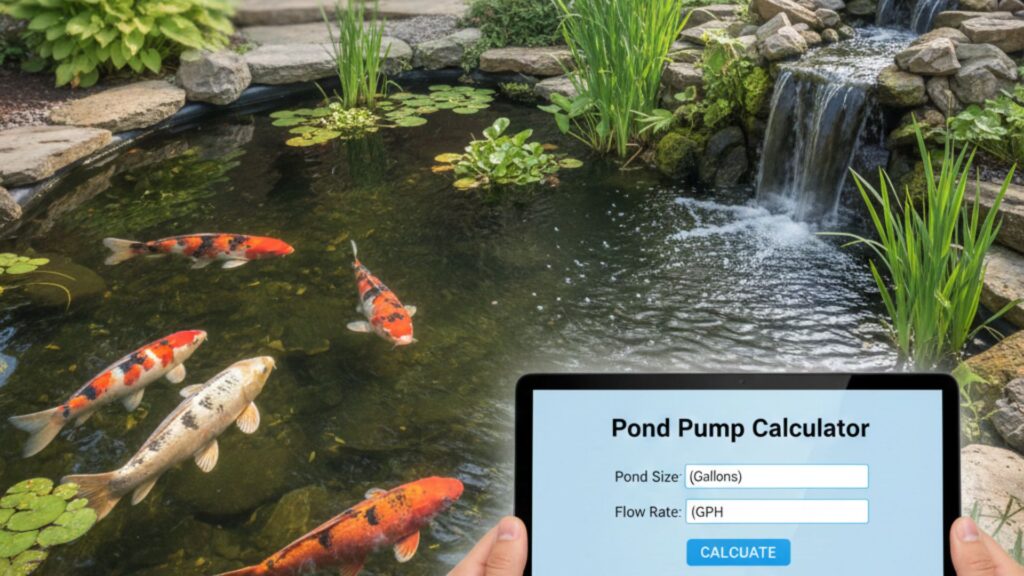
Ever wonder why your backyard pond struggles with cloudy water or algae? Many beginners in the USA make one simple mistake: choosing the wrong pump. Knowing how to calculate pond pump size is essential for healthy water circulation and a thriving pond ecosystem.
Whether you have a koi pond, a peaceful garden pond, or a waterfall feature, proper pump sizing keeps water moving efficiently, improves filtration, and saves energy. Ignoring flow rate or head pressure can lead to poor water quality, stressed fish, and wasted electricity.
This guide will show you step-by-step how to measure your pond, determine ideal flow, calculate total dynamic head (TDH), and pick the perfect pump. You’ll also learn how to use pond pump flow rate calculators and head pressure tools to get accurate results every time.
Follow this guide to calculate the perfect pump for your pond easily and ensure clean, clear water for years to come. By the end, you’ll confidently select a pump that matches your pond type, size, and water features without guesswork.
Understanding Pond Pump Basics
A pond pump moves water through your pond system. It keeps water clean, oxygen-rich, and healthy for fish and plants. When you calculate pond pump size correctly, your pond stays clear and balanced. When you don’t, problems start fast.
A pump that’s too small won’t circulate enough water. Waste builds up, algae grow, and fish suffer. A pump that’s too powerful can stress fish, waste energy, and damage filters. That’s why proper sizing matters before you buy anything.
Most pond problems come from guessing pump size instead of calculating it. A few simple terms can help you avoid that mistake.
Key Pond Pump Terms You Should Know
Before using a pond pump GPH calculator or choosing a model, understand these basics.
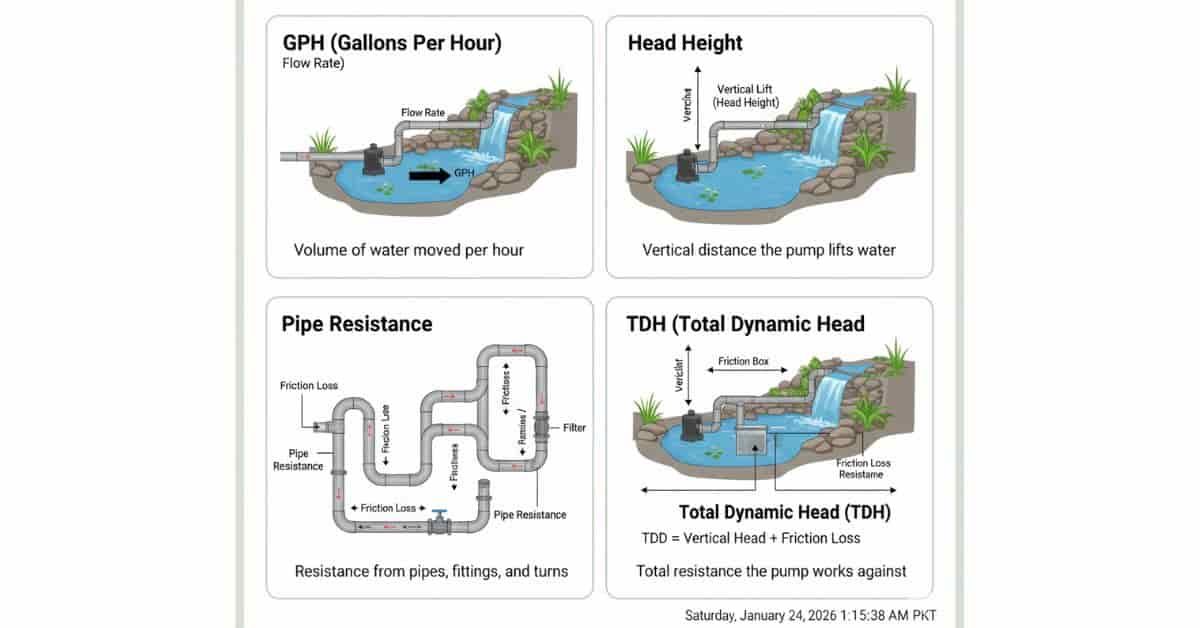
- GPH (Gallons Per Hour)
- This shows how much water the pump moves in one hour. Most ponds need the full water volume circulated at least once per hour.
- Flow Rate
- Flow rate is the actual water moving through your system. It often drops as water travels uphill or through pipes.
- Head Height
- Head height is the vertical distance water must travel from the pump to the outlet. Higher lifts reduce pump flow.
- TDH (Total Dynamic Head)
- TDH includes head height plus resistance from pipes, bends, filters, and waterfalls. This is why pumps rarely deliver their “rated” GPH in real ponds.
👉 This is where tools like a pond pump head height calculator or pond pump head pressure calculator become useful. They help you estimate real-world performance, not just box numbers.
Why These Terms Matter for Pump Sizing
Pump manufacturers rate pumps at zero head height. That condition rarely exists in backyard ponds. Even a small waterfall or filter adds resistance.
If you ignore head pressure, you’ll end up with less flow than expected. Your pond may look fine at first, then slowly decline.
Understanding these basics helps you:
- Choose the correct pump size
- Avoid overspending on oversized pumps
- Improve filtration and water clarity
- Reduce long-term energy costs
Takeaways: Pond Pump Basics (Quick Summary)
- Pond pumps move water; sizing controls pond health
- GPH tells volume, but TDH tells reality
- Head height and pressure always reduce flow
- Calculators help remove guesswork
Pro Tips for Beginners
- Always size pumps based on real flow, not advertised GPH
- Measure vertical lift carefully; inches matter
- When unsure, use a calculator and double-check results
How Pump Size Affects Pond Health
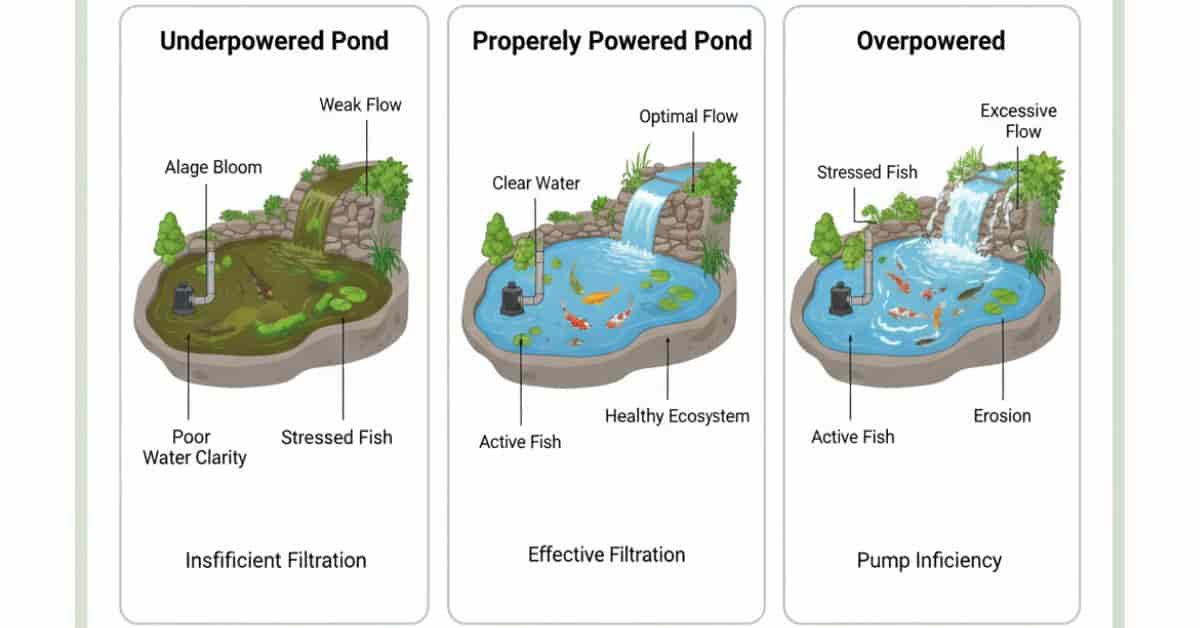
Pump size has a direct impact on your pond’s health. When you choose the wrong size, water quality drops fast. Algae grows, debris settles, and fish feel the stress. That’s why pump sizing matters as much as filters or liners.
An appropriately sized pump keeps water moving at the right speed. It supports oxygen levels, improves filtration, and keeps the ecosystem stable. Too much or too little flow can upset that balance.
Overpowered vs. Underpowered Pond Pumps
Both extremes create problems. Understanding the difference helps you avoid costly mistakes.
Underpowered pumps
- Poor water circulation
- Waste settles on the pond bottom
- Filters don’t work efficiently
- Low oxygen levels stress fish
An underpowered pump often comes from ignoring head height or TDH. The pump looks strong on paper, but fails in real conditions.
Overpowered pumps
- Excessive water movement
- Fish struggle against strong currents
- Plants uproot or bend
- Higher energy bills
Oversized pumps also wear out filters faster and waste electricity. Bigger is not always better.
How Pump Size Affects Circulation and Filtration
Water circulation spreads oxygen and nutrients evenly. When the flow stays consistent, filters catch debris before it breaks down. This keeps ammonia and sludge under control.
If the flow drops too low:
- Dead zones form
- Water turns cloudy
- Algae blooms increase
If the flow is too strong:
- Filters may bypass debris
- Water moves too fast to clean properly
Using a pond pump GPH calculator helps balance flow with real-world conditions. It considers lift and pressure losses, not just rated output.
Impact on the Pond Ecosystem
Fish, plants, and beneficial bacteria depend on stable flow. Sudden or extreme water movement stresses living systems.
Correct pump sizing helps:
- Fish swim comfortably
- Plants absorb nutrients efficiently
- Beneficial bacteria thrive in filters
Tools like a pond pump head height calculator or pond pump head pressure calculator help you estimate actual flow. That accuracy protects the entire ecosystem.
Takeaways: Pump Size & Pond Health
- The correct pump size keeps water clean and balanced
- Underpowered pumps cause stagnation and waste buildup
- Overpowered pumps stress fish and waste energy
- Calculators reduce sizing errors
Pro Tips
- Aim for steady flow, not maximum power
- Check pump curves, not just box labels
- Recalculate the flow when adding waterfalls or filters
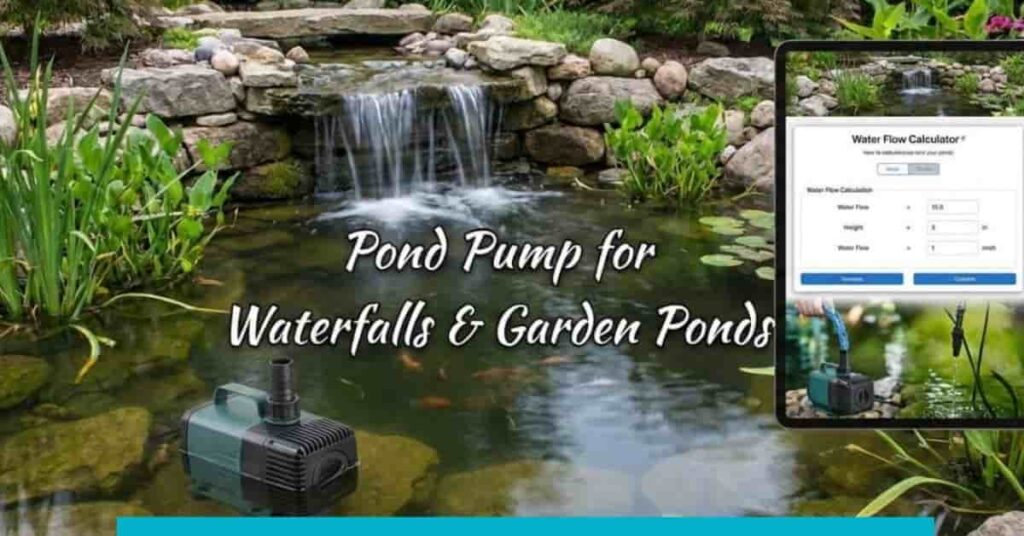
If your pond includes a stream or waterfall feature, this waterfall and garden pond pump guide explains how flow rate and lift affect real-world performance.
It’s especially useful for understanding pump sizing when visual water movement and elevation changes are involved.
Step 1 – Measure Your Pond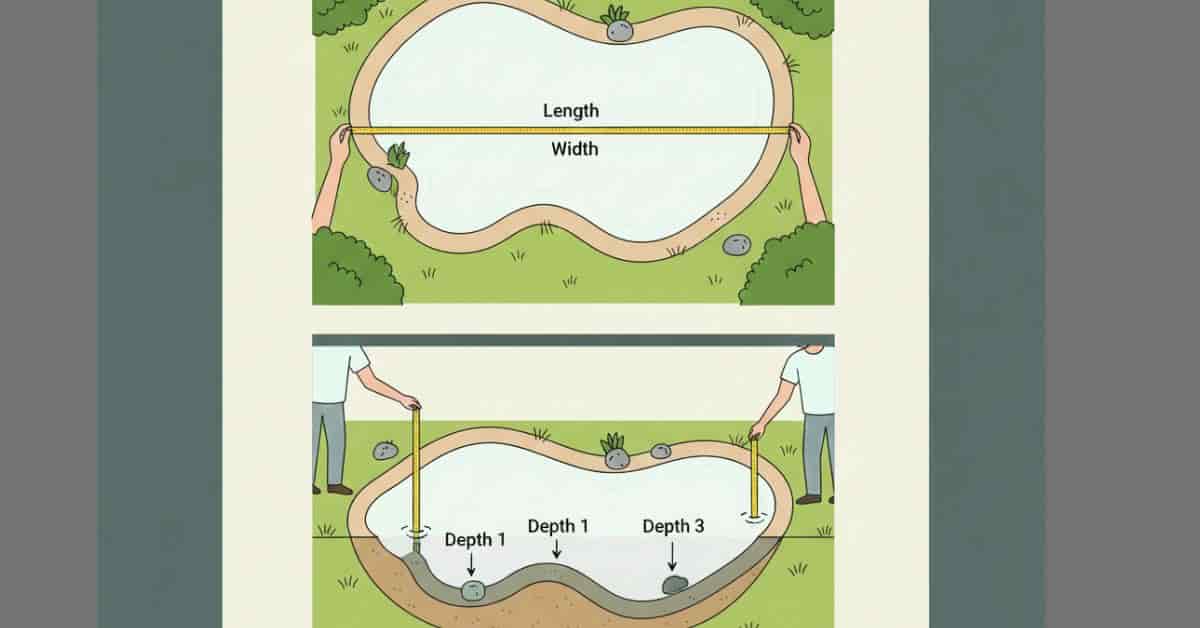
The first step to calculate fish pond pump size is knowing your pond’s volume. Pump flow depends on how much water your pond holds. If this number is wrong, every calculation after it will be off.
You don’t need special tools. A tape measure and a few minutes are enough for most backyard ponds.
Measure Length, Width, and Depth
Start by measuring your pond at its widest points.
- Length: the longest side of the pond
- Width: widest point across
- Average depth: add shallow and deep areas, then divide by two
For ponds with uneven bottoms, take several depth readings. Use an average to stay accurate.
Basic formula:
| Calculation | Formula | Result |
|---|---|---|
| Pond Volume | Length × Width × Average Depth | Volume (cubic feet) |
This method works well for square, rectangular, and oval ponds. For free-form ponds, estimate the shape as closely as possible.
Convert Pond Volume to Gallons (US)
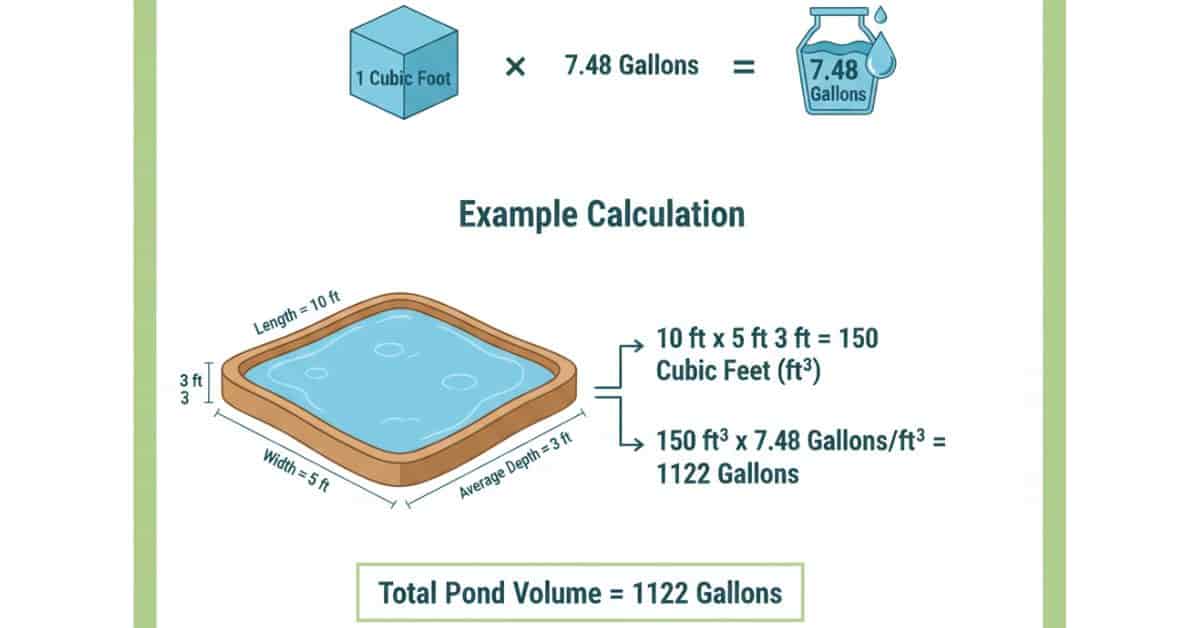
Pumps in the US use gallons per hour (GPH). You must convert cubic feet into gallons.
Conversion rule:
- 1 cubic foot = 7.48 gallons
Formula:
| Conversion | Formula | Result |
|---|---|---|
| Volume Conversion | Cubic feet × 7.48 | Total gallons |
This step is critical when you calculate the pond pump flow rate. Skipping it leads to undersized pumps.
Example: 1,000-Gallon Backyard Koi Pond
Let’s walk through a simple example.
- Length: 10 feet
- Width: 6 feet
- Average depth: 2.25 feet
Step 1:
10 × 6 × 2.25 = 135 cubic feet
Step 2:
135 × 7.48 ≈ 1,010 gallons
This pond needs a pump that can move about 1,000 gallons per hour, before accounting for head height and pressure losses.
Takeaways: Measuring Your Pond
- Accurate measurements prevent pump sizing errors
- Always use the average depth for uneven ponds
- Convert to gallons before choosing a pump
Pro Tips
- Measure twice to avoid mistakes
- Round slightly up if unsure
- Recalculate the volume if you expand the pond
Step 2 – Determine Desired Flow Rate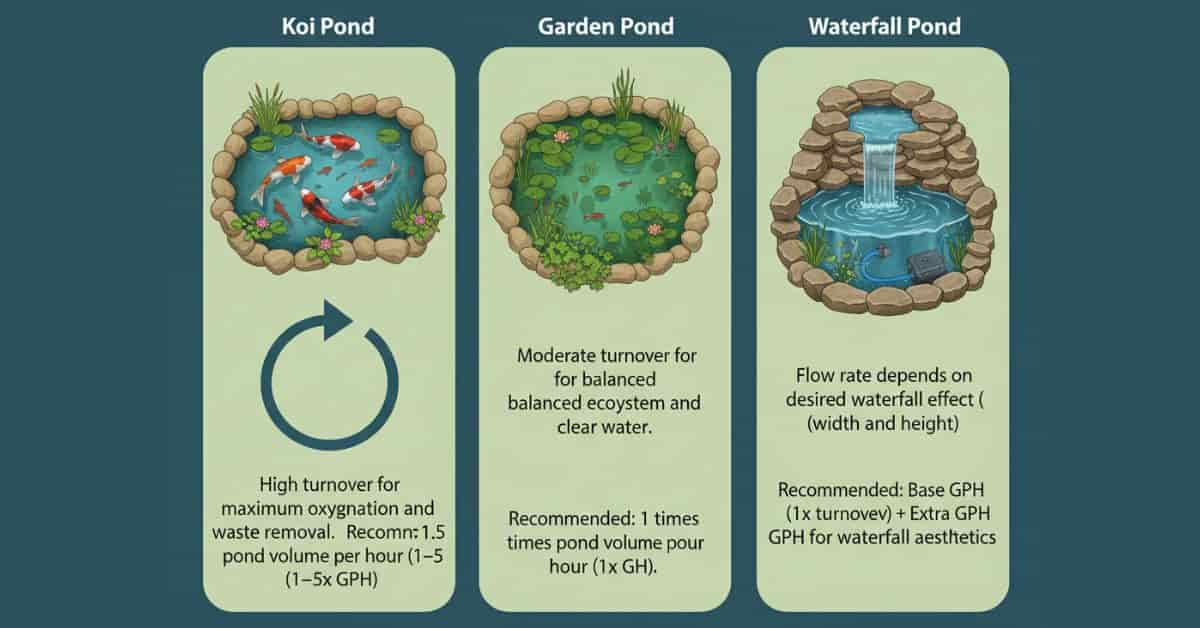
Once you know your pond’s volume, the next step is to set the correct flow rate. This tells you how fast water should move through the system. To calculate the GPH pond pump needs correctly, focus on full water turnover.
For most backyard ponds, the goal is simple:
Circulate the entire pond volume at least once per hour.
This rule keeps oxygen levels stable and helps filters remove waste before it breaks down.
Ideal Circulation Rates by Pond Type
Different ponds need different flow speeds. Fish load, plants, and features all matter.
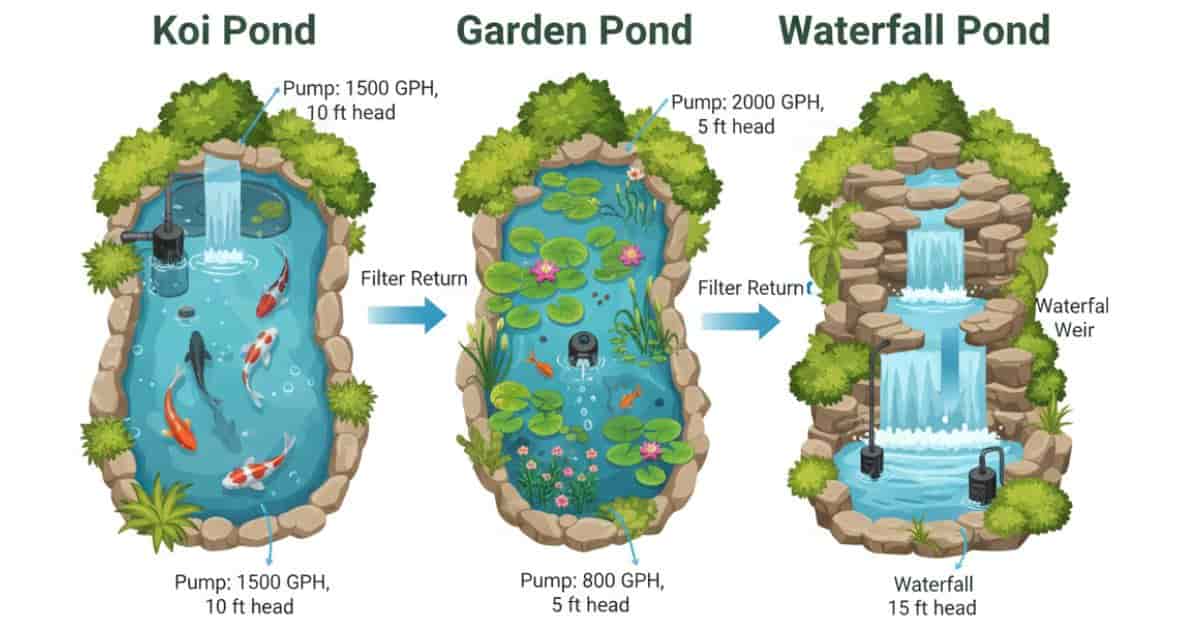
- Koi ponds
- Koi produce heavy waste. Aim for 1 to 1.5 times pond volume per hour.
- Garden ponds
- With fewer fish, 1x turnover per hour usually works well.
- Waterfall ponds
- Waterfalls need extra flow for a visual effect. Add flow on top of the base turnover rate.
These guidelines give you a safe starting point when using a pond pump sizing calculator.
How to Calculate GPH Manually
Use this simple method before moving to calculators.
Formula:
| Calculation | Formula | Result |
|---|---|---|
| Required Pump Flow | Pond volume (gallons) ÷ 1 hour | Required GPH |
Example:
- Pond volume: 1,000 gallons
- Desired turnover: 1x per hour
Required flow rate:
1,000 GPH (before head loss)
This number will drop once you factor in head height and pipe resistance.
How to Use a Pond Pump Flow Rate Calculator
An online pond pump flow rate calculator speeds things up and reduces mistakes.
Most calculators ask for:
- Pond volume in gallons
- Desired turnover rate
- Water features like waterfalls or streams
The calculator then suggests a target GPH. Some tools also account for head pressure automatically.
👉 Use calculators to confirm your math, not replace understanding.
Takeaways: Choosing the Right Flow Rate
- Complete pond turnover per hour is the baseline
- Koi ponds need higher flow than garden ponds
- Waterfalls require extra GPH
- Calculators help refine results
Pro Tips
- Don’t size pumps at minimum flow; allow a safety margin
- Plan for future fish growth
- Recalculate the flow if you add features later
Step 3 – Calculate Total Dynamic Head (TDH)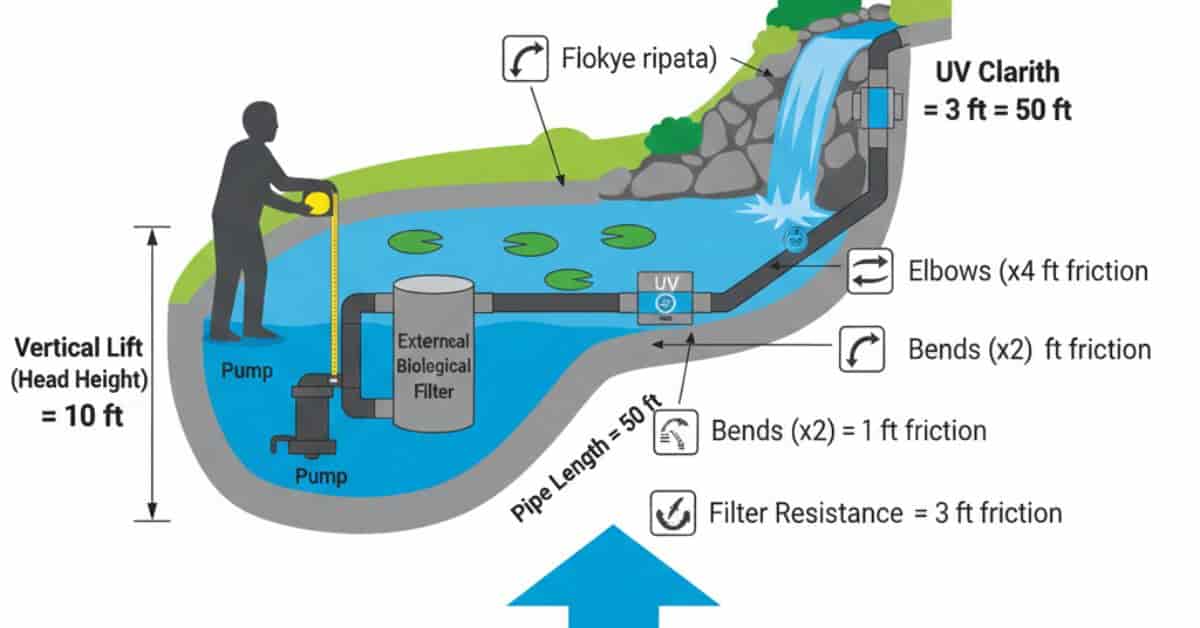
Total Dynamic Head, or TDH, shows how hard your pump must work to move water. It combines vertical lift and resistance from pipes and fittings. If you skip this step, your pump will deliver far less flow than expected.
Most pumps list their largest GPH at zero head height. That situation rarely exists in real ponds. Even a small waterfall or filter adds pressure.
To size a pump correctly, you must calculate head height and head pressure together.
What Is Head Height and Head Pressure?
Head height is the vertical distance water travels from the pump to the highest outlet. Measure from the pump’s position to the waterfall spillway or filter return.
Head pressure comes from resistance inside the system. It includes:
- Pipe length
- Pipe diameter
- Elbows and bends
- Filters and UV units
When you add head height and pressure losses, you get TDH. This number explains why real flow is always lower than advertised flow.
This is also why tools like a pond pump head height calculator or pond pump head pressure calculator are so helpful.
How to Measure Pump Lift (Vertical Head)
Start with the vertical lift. This part is simple.
Steps:
- Find the pump location in the pond or skimmer
- Measure straight up to the highest water outlet
- Record the height in feet
Example:
- Pump depth: 1 foot below water
- Waterfall height: 3 feet above water
Total vertical head: 4 feet
Even a few inches can reduce flow, so measure carefully.
How to Estimate Pipe and Fitting Resistance
Pipe resistance adds hidden pressure loss. Many pond owners overlook this step.
Basic guidelines:
- Longer pipes increase head pressure
- Smaller pipe diameters reduce flow
- Each elbow or bend adds extra resistance
As a simple estimate:
- Add [placeholder] feet of head for each 90-degree bend
- Add an extra head for filters and UV units
This rough method works well for backyard ponds when calculating head pressure for pond pumps.
Example: US Backyard Pond TDH Diagram
Imagine a typical US backyard pond with:
- 4 feet of vertical lift
- 10 feet of pipe
- 3 elbows
- One filter box
Vertical head: 4 feet
Estimated resistance: [placeholder] feet
Estimated TDH: [placeholder] feet
This is the number you’ll match against a pump’s performance curve.
Takeaways: Understanding TDH
- TDH shows real pump workload
- Head height and pressure both reduce flow
- Most pump ratings ignore resistance
- Calculators simplify TDH estimates
Step 4 – Choosing the Right Pump
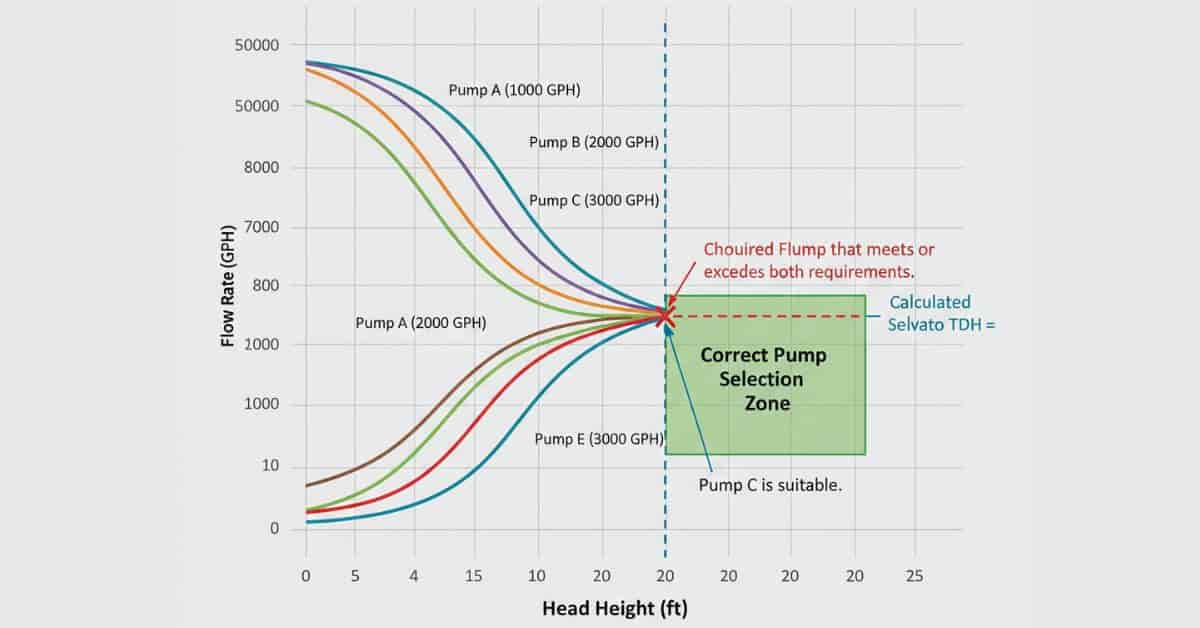
Now it’s time to choose the pump. This step connects everything you’ve measured so far. To calculate the correct pump for a pond, you must match the flow rate with the total dynamic head (TDH). Pond size alone is not enough.
A pump that looks perfect on the box may fail once installed. Always check how much flow the pump delivers at your TDH, not at zero head.
Match Flow Rate and TDH Correctly
Every pump has a performance curve. This chart shows how the flow drops as the head height increases.
Here’s how to use it:
- Find your required GPH on the chart
- Locate your TDH on the vertical axis
- Choose a pump that meets both values
If the pump cannot hit your target flow at your TDH, it’s undersized. This step answers the common question: How do I calculate what size pond pump I need?
Choose Based on Pond Type
Different ponds place different demands on pumps.
- Koi ponds
- Need a strong, steady flow for heavy waste loads. Choose reliable pumps rated for continuous use.
- Waterfall ponds
- Need extra flow for visual effect. A higher GPH is often needed, even for small ponds.
- Small garden ponds
- Lower flow needs, but accuracy still matters. Oversizing can disturb plants and fish.
Always size for function first, then appearance.
Example: 2-Foot Waterfall with a 100-Gallon Pond
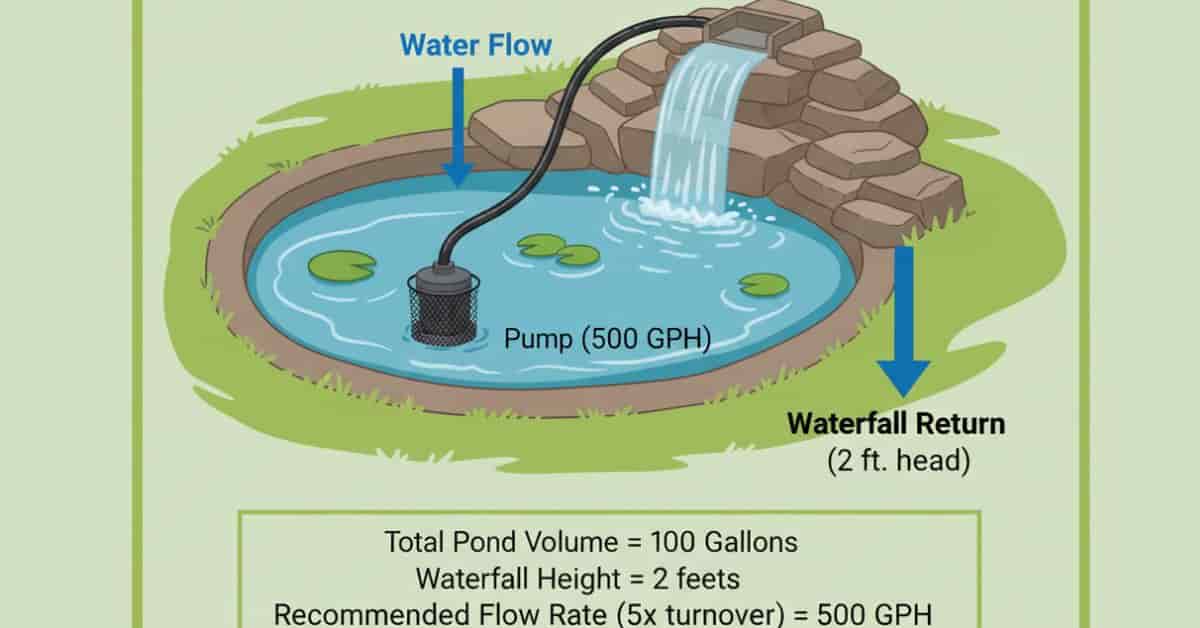
Let’s walk through a real-world example.
- Pond volume: 100 gallons
- Desired turnover: 1x per hour → 100 GPH
- Waterfall height: 2 feet
- Pipe and fittings: minimal
Add a safety margin for head loss.
Target pump rating:
- Look for a pump rated around 150–200 GPH at zero head
- This ensures close to 100 GPH at 2 feet of lift
This is a simple way to calculate the pump needed for a 2-foot waterfall 100-gallon pond without guesswork.
When to Upsize Slightly
Minor upsizing helps cover:
- Pipe friction
- Filter resistance
- Future pond upgrades
Avoid large oversizing. Excess flow wastes energy and stresses the pond ecosystem.
Takeaways: Choosing the Right Pond Pump
- Match pump flow to TDH, not pond size alone
- Check performance curves before buying
- Pond type affects flow needs
- Small safety margins are smart
Step 5 – Manual Calculation vs Online Calculator
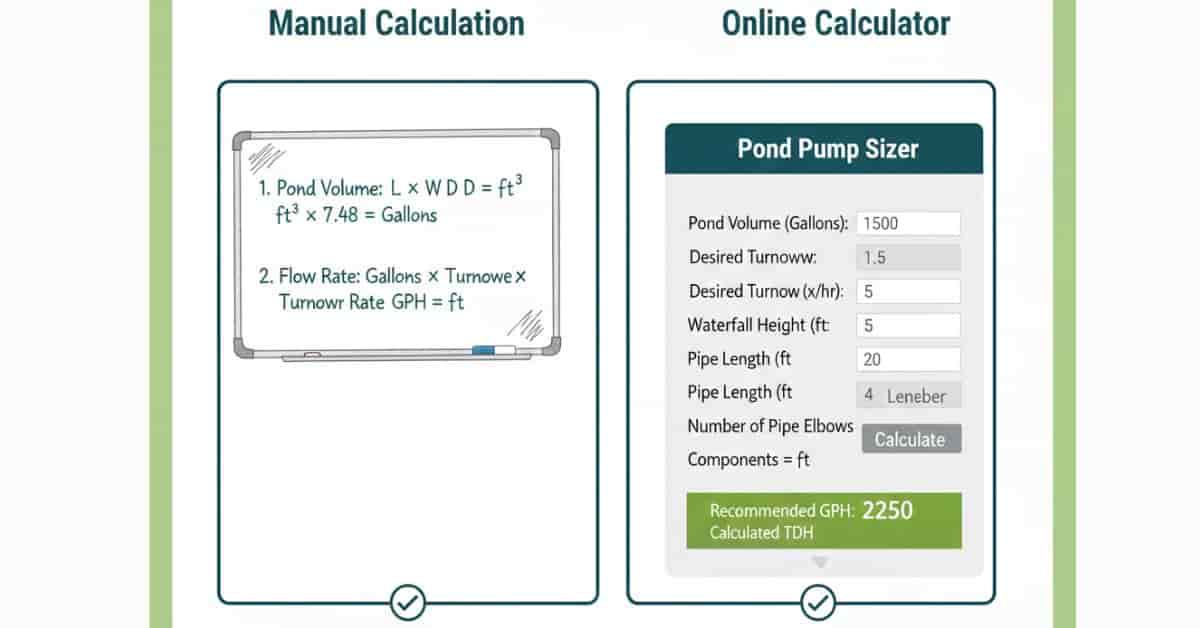
At this point, you know your pond size, flow rate, and TDH. Now you can decide how to finish the process. You can calculate everything by hand or use an online tool. Both methods work when used correctly.
Many pond owners ask how to calculate pond pump head height and pressure without making mistakes. The best answer is to understand both options and use them together.
Manual Calculation: Pros and Cons
Manual calculations help you understand how your pond system works. They give you complete control over each input.
Pros
- Clear understanding of flow and pressure
- No reliance on software
- Useful for learning and planning
Cons
- Easy to miss pipe resistance
- Time-consuming
- Errors compound quickly
Manual math works best for small, simple ponds. Complex layouts increase the risk of miscalculations, especially when learning how to calculate pond pump head pressure.
Using an Online Pond Pump Calculator
An online calculator simplifies the process. It combines volume, flow, and head loss into one result.
Most calculators ask for:
- Pond volume in gallons
- Desired turnover rate
- Vertical lift height
- Pipe length and fittings
A good tool estimates real-world flow. This helps when you calculate pump capacity for a small outdoor pond or add features like waterfalls.
👉 Calculators save time and reduce common errors.
How to Verify Calculator Results
Even good calculators need a quick check.
Use these tips:
- Compare results with manual estimates
- The round flow needs a slight upward
- Confirm the pump meets GPH at your TDH
- Review the pump’s performance curve
If numbers seem too low or too high, recheck inputs. Minor entry errors create significant flow differences.
Takeaways: Choosing the Best Method
- Manual calculations build understanding
- Online calculators improve accuracy
- Using both gives the best results
- Always verify with pump curves
Pro Tips
- Measure lift from the pump, not the water surface
- Recalculate when plumbing changes
- Save calculator results for future upgrades
Common Mistakes to Avoid
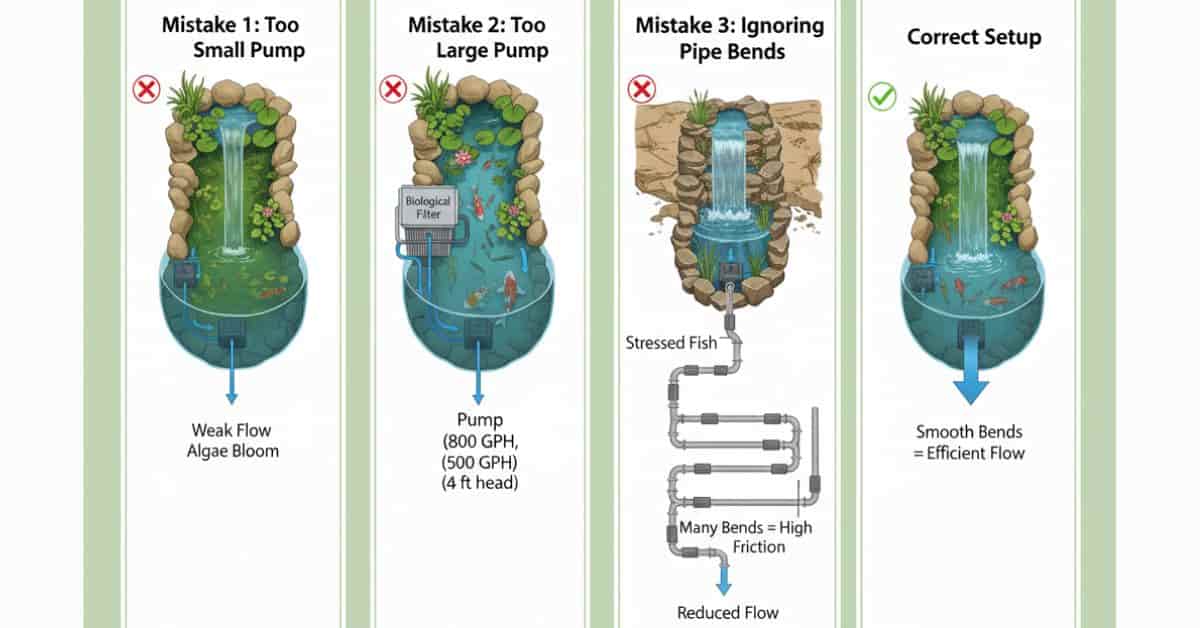
Even experienced pond owners can make errors when selecting a pump. These mistakes affect water quality, filtration, and pond health. Knowing them helps you calculate pump size for a fish pond or koi pond correctly the first time.
1. Choosing a Pump Too Small or Too Large
Too small:
- Water circulates poorly
- Debris and waste build up
- Filters underperform
Too large:
- Fish struggle against strong currents
- Plants may uproot
- Energy costs rise
Constantly match pump flow to pond volume and TDH, not just the largest pump available.
2. Ignoring Waterfall or Skimmer Requirements
Water features add resistance and demand extra flow. Many beginners forget to factor them in.
- Skimmers trap debris but reduce flow slightly
- Waterfalls need higher GPH for smooth operation
Not accounting for these features often leads to an undersized or inefficient pump.
3. Not Factoring Pipe Bends and Length
Pipe friction reduces flow. Each elbow, bend, or long run adds resistance.
Common errors:
- Using small-diameter pipes
- Adding multiple 90-degree bends without adjustment
- Underestimating friction losses
Even a short pipe with a couple of bends can reduce flow by 10–20%. Use a pond pump head height calculator to account for these losses.
Takeaways: Avoiding Pump Mistakes
- Measure pond volume and TDH accurately
- Add extra flow for waterfalls and skimmers
- Factor in pipe length and bends
- Oversizing is not a solution
Pro Tips
- Double-check all measurements before buying
- Use online calculators to validate manual math
- Consider future pond expansions or added features
Conclusion
In this guide, we covered everything beginners need to know about sizing a pond pump. You learned how to measure your pond, determine ideal flow rates, calculate total dynamic head (TDH), and match a pump to your pond type.
Knowing how to calculate pond pump size ensures your koi, garden, or waterfall pond stays clean, healthy, and energy-efficient. Using both manual calculations and online tools helps you pick the right pump with confidence, avoiding common mistakes like undersizing or oversizing.
By taking the time to size your pump correctly, you protect your pond ecosystem, improve filtration, and enjoy clear, well-circulated water year-round.
💡 Share your pond pump experiences in the comments or explore our calculator tools to find the perfect pump for your backyard pond.
Michael Brooks and Sarah Lane are the co-founders of the Pond Pump Team, a trusted U.S.-based group helping homeowners and landscapers build better ponds and water features. Michael, an experienced pond engineer from Oregon, has worked for over 12 years on pump sizing, flow systems, and water circulation. Sarah, a pond designer from Colorado with nine years of experience, focuses on eco-friendly and easy-to-maintain pond and waterfall designs. Together, they’ve completed more than 180 pond projects and created tools like the Pond Pump Calculator and Pond Liner Calculator to make pond planning simple, accurate, and sustainable.
Need help with your pond setup? Contact the Pond Pump Team for expert advice and reliable solutions.