Introduction
Most pond leaks happen because the liner doesn’t fit correctly. Even a small miscalculation can lead to tears, wrinkles, or water loss. On the flip side, oversizing your liner wastes money—sometimes $100–$400 in extra material that isn’t needed.
Whether you’re building a backyard garden pond, a koi pond, a fish pond, or a decorative water feature, accurate measurements are essential. Each pond type has unique depth, shape, and shelf requirements. Using a pond liner calculator ensures you get precise dimensions for your pond without guesswork.
By entering your pond’s length, width, and depth, a pond liner calculator instantly tells you the correct liner size. This makes calculating pond liner size simple, accurate, and stress-free. You’ll know exactly how much material to buy and how to position it for a snug fit.
In the US, measurements are usually in feet and inches, so it’s important to use units consistent with your pond plans. Doing so avoids confusion when ordering liner material or checking dimensions against a calculator.
Whether you’re a DIY enthusiast or a professional landscaper, accurate pond liner calculations save time, money, and headaches.
👉 Use our free pond liner calculator below to get your exact liner size and start your pond project with confidence.
What Is a Pond Liner Calculator?
A pond liner calculator is a simple tool that helps you calculate pond liner size fast and accurately. You enter your pond’s length, width, and depth. The tool then tells you the correct liner dimensions to buy.
Many pond owners guess the liner size. This often leads to leaks or wasted material. A pond-calculator liner removes that guesswork. It ensures your liner fits properly, with enough extra for the edges.
Both DIY beginners and professional landscapers use a pond liner measurement calculator. If you’re building a small garden pond, it saves time. If you’re installing a deep koi pond, it prevents costly mistakes.
Most tools support common pond types, including:
- Rectangular ponds
- Round or circular ponds
- Koi ponds
- Fish ponds
A free pond liner calculator is especially helpful if you’re planning your first backyard pond. It gives you confidence before buying materials.
How the Calculator Determines Liner Size
A pond liner calculator works using a simple formula. It asks for:
- Pond length
- Pond width (or diameter for round ponds)
- Maximum depth
The tool then adds extra liner for proper edge overlap. Most professionals recommend 12–24 inches of overlap. The calculator includes this automatically, so you don’t forget it.
For rectangular ponds, it calculates the liner length and width separately. For round ponds, it adjusts based on diameter. Some tools also account for shelves of varying depths.
Because the tool applies the correct pond liner calculation formula behind the scenes, you avoid math errors. You get accurate pond liner dimensions in seconds.
If you want fast, reliable results without manual calculations, a pond liner measurement calculator is the easiest solution.
Why Accurate Pond Liner Measurement Is Critical
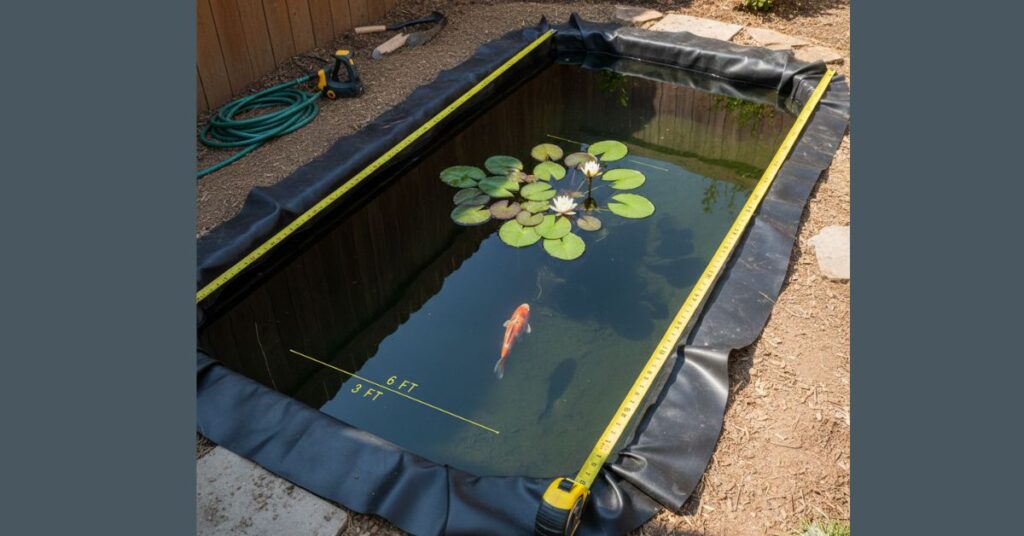
Accurately calculating pond liner size protects your pond from day one. Even small measuring mistakes can create big problems later. When you measure correctly, your liner fits smoothly and lasts longer.
Many pond issues start with poor pond liner calculations. The liner may look fine at first. But stress points often appear after filling the pond with water.
In the US, the weather makes accuracy even more important. Northern states face freeze and thaw cycles. Southern states deal with strong sun and high heat. Both conditions put pressure on the liner material. Proper pond liner dimensions reduce that stress.
If you want a pond that lasts for years, careful measuring is not optional. It’s essential.
Risks of Incorrect Pond Liner Calculations
An undersized liner creates immediate problems. It stretches too tightly across the pond. Over time, that tension can cause tearing or edge pull-out.
An oversized liner causes different issues. Extra folds trap debris and make installation harder. Large wrinkles also affect the pond’s final appearance.
Incorrect pond liner dimensions can also:
- Make anchoring difficult
- Increase material costs
- Complicated edging with rocks or pavers.
- Create weak spots along shelves.
Fixing these mistakes often means draining the pond. That adds time and expense.
Long-Term Impact on Pond Health
Accurate pond liner calculations help prevent leaks. A properly fitted liner sits evenly and handles water pressure better.
Leaks can lower water levels and stress fish. Koi and other pond fish need stable water conditions. A secure liner helps maintain that balance.
In colder US regions, freeze and thaw cycles expand trapped water under loose areas. In hot southern states, extreme heat weakens overstretched material. Correctly calculating pond liner size reduces both risks.
When the liner fits well, your pond stays stronger, safer, and more durable for years.
Step-by-Step: How to Calculate Pond Liner Size Manually
You don’t always need a special tool to figure out your liner size. You can do it yourself with a simple formula. Many pond owners still work it out by hand before double-checking with a pond liner calculator.
Just follow these two steps.
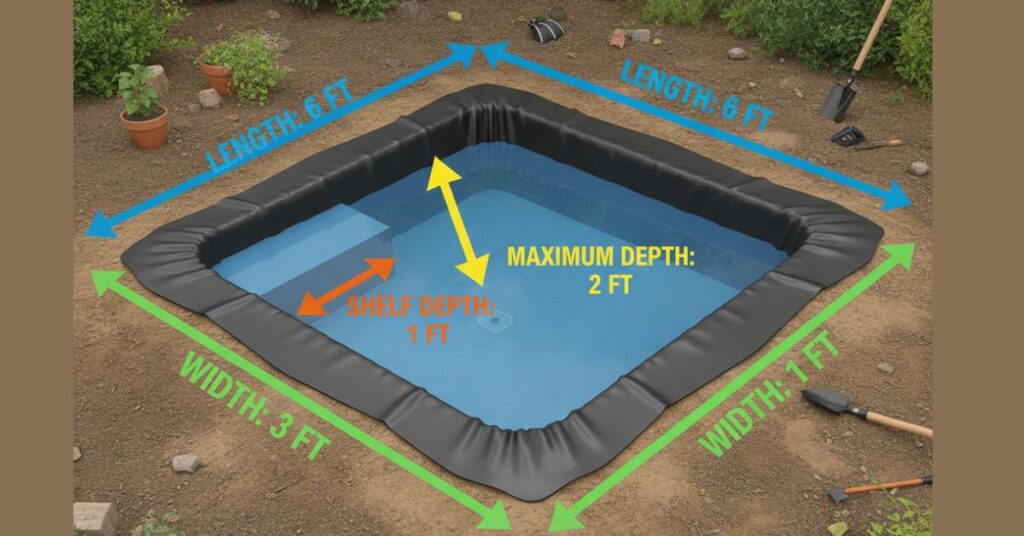
Step 1 – Measure Your Pond Dimensions
Begin by measuring carefully. Use a tape measure and jot down each number.
Measure:
- Total pond length
- Total pond width
- Maximum depth
- Shelf depth, if your pond has plant ledges
Be sure to measure the longest and widest parts of your pond. If your pond has curves, measure across the widest part.
To find the depth, measure from the top edge down to the deepest spot. If your pond has shelves, measure both the shelf depth and the full depth.
In the US, most people use feet and inches, so a pond liner calculator in feet works best for backyard ponds. If you’re outside the US, you might prefer to use metres.
Keep your measurements in the same units. Don’t mix feet and inches. It’s best to convert everything to feet before you start calculating.
Pro Tip
Double-check your measurements before you start calculating. Even small mistakes can affect your final liner size.
Step 2 – Use the Pond Liner Calculation Formula
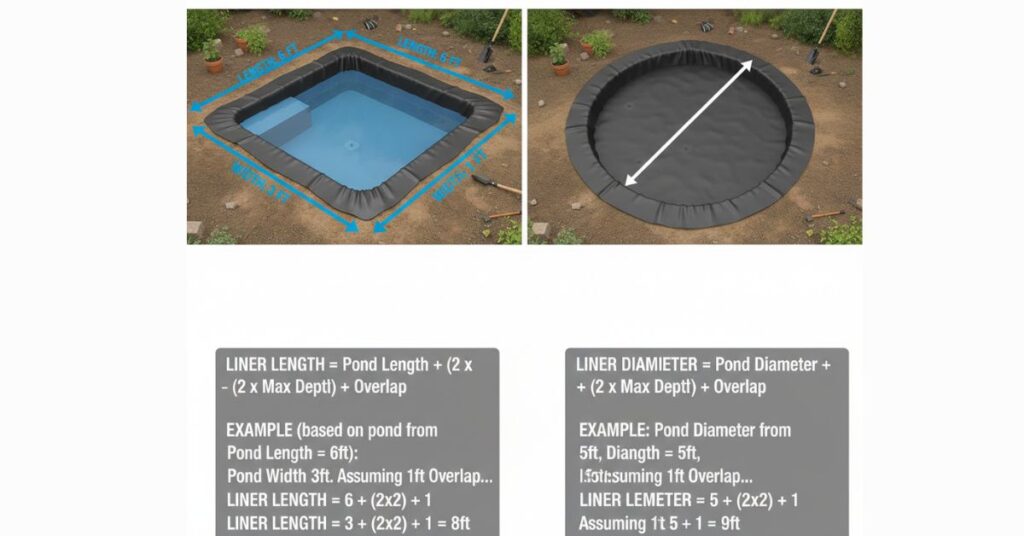
Once you have your measurements, use the right formula. Be sure to add extra liner for overlap. Most installers suggest adding 12 to 24 inches, or 1 to 2 feet.
Rectangular Pond Formula
For rectangular ponds, figure out the length and width one at a time.
Liner Length = Pond Length + (2 × Depth) + Overlap
Liner Width = Pond Width + (2 × Depth) + Overlap
This formula covers the liner going down one side, across the bottom, and up the other side.
Round / Circular Pond Formula
For round ponds, use the diameter instead of length and width.
Liner Diameter = Pond Diameter + (2 × Depth) + Overlap
A round or circular pond liner calculator will use this same formula for you. Worked Example (US Customary Units)
Let’s calculate a 10 ft × 8 ft pond that is 2 ft deep.
Assume 1 ft overlap.
Step 1: Calculate Liner Length
10 ft + (2 × 2 ft) + 1 ft 10 + 4 + 1 = 15 ft
Step 2: Calculate Liner Width
8 ft + (2 × 2 ft) + 1 ft 8 + 4 + 1 = 13 ft
Final liner size needed: 15 ft × 13 ft
This amount of liner will cover your pond and let you secure the edges safely.
Example for a Koi Pond
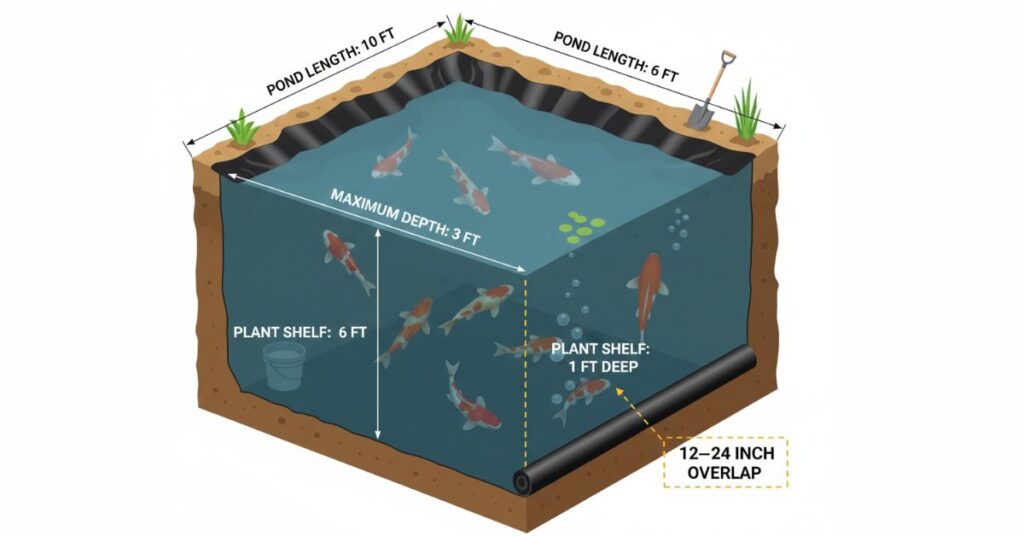
Koi ponds are usually deeper, often between 3 and 4 feet, which is better for the fish.
Imagine a 12 ft × 10 ft pond that is 3 ft deep. Use 1.5 ft overlap.
Liner Length: 12 + (2 × 3) + 1.5 = 12 + 6 + 1.5 = 19.5 ft
Liner Width: 10 + (2 × 3) + 1.5 = 10 + 6 + 1.5 = 17.5 ft
You should round up to the next available liner size.
A koi pond liner calculator or fish pond liner calculator makes this process easier and helps prevent math mistakes, especially for deeper ponds.
Takeaway
Manual calculations work well if you follow the formula closely. Still, many pond owners double-check their results with a pond liner calculator to make sure they get the right size before buying.
After measuring and installing your pond liner, check our pump selection guide to maintain optimal water circulation.
How Much Extra Liner Should You Add?
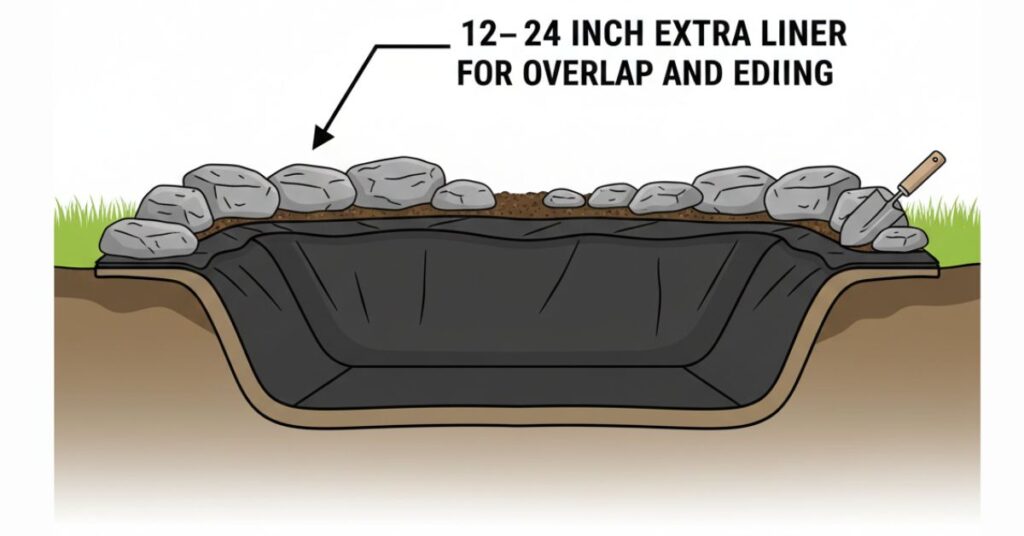
When figuring out the size of your pond liner, be sure to add extra material for overlap. Most experts suggest leaving 12 to 24 inches on every side. This extra liner helps keep the edges secure and avoids problems later.
Why add so much extra? The liner needs to go down one side, across the bottom, and up the other side of the pond. You also need enough material to anchor it securely around the edge.
Keep the liner in place under rocks or edging stones. Rocks or edging stones.
- Protect the liner if the soil shifts.
- Make up for small measuring mistakes.
- Handle water movement and settling.
When calculating pond liner dimensions, never cut it too close. A tight liner increases stress along the edges. Over time, that tension can cause pull-out or small In colder parts of the US, freezing and thawing can make the soil around your pond expand. In warmer areas, heat can soften the liner and make it shift a bit. Leaving extra liner at the edges helps it handle these changes.
Pro Tip
If your pond has shelves or uneven sides, aim for 18 to 24 inches of extra liner. It’s cheaper to use a bit more liner now than to replace a damaged one later.
Pond Shapes & Special Design Considerations
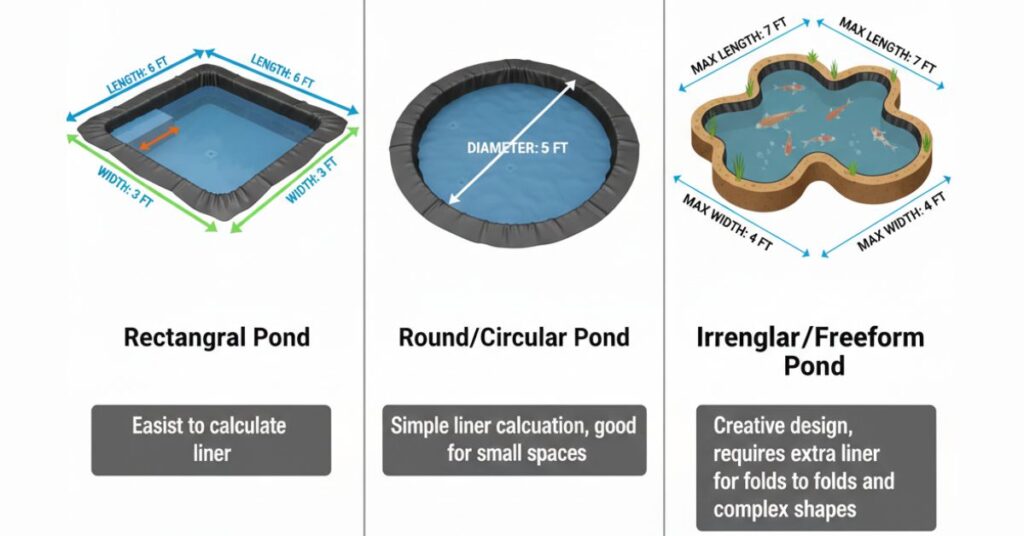
The shape of your pond is important when figuring out the right liner size. Each shape needs its own method. While a pond liner size calculator can do this for you, it’s useful to know the basics yourself.
Rectangular Ponds
Rectangular ponds are the simplest to measure and calculate. You need:
- Length
- Width
- Maximum depth
The formula for rectangular ponds is simple and predictable, which is why many DIY builders choose this shape.
If you use a pond liner size calculator, pick the rectangular option. The tool will use the right formula and add the needed overlap for you.
You usually don’t need to adjust the measurements by hand unless your pond has shelves or uneven depths. If it does, measure the deepest spot and pay close attention to any ledges.
Round & Circular Ponds
For round ponds, measure the diameter instead of length and width. The liner needs to cover the curved base and sides evenly.
A pond liner size calculator will adjust automatically when you choose the round or circular option. It uses the diameter and depth to figure out the total liner size.
Manual calculation is fine for simple circular ponds. But if the sides slope or the depth changes, double-check your measurements before you buy the liner.
Irregular or Freeform Ponds
Freeform ponds are more complicated. They usually have curves, shelves, and areas with different depths.
A pond liner size calculator will usually estimate based on the longest length, the widest width, and the deepest point. This method works for most backyard ponds.
You’ll need to adjust the measurements yourself if
- The pond has multiple deep areas.
- Shelves vary significantly
- The shape includes sharp corners.
In these situations, carefully measure the widest and longest parts of your pond. If you’re unsure, add extra overlap. It’s better to have too much liner than not enough.
Coordinating pond liner dimensions with your waterfall pump setup helps avoid leaks and overflow issues.
Types of Pond Liner Materials & Thickness Guide
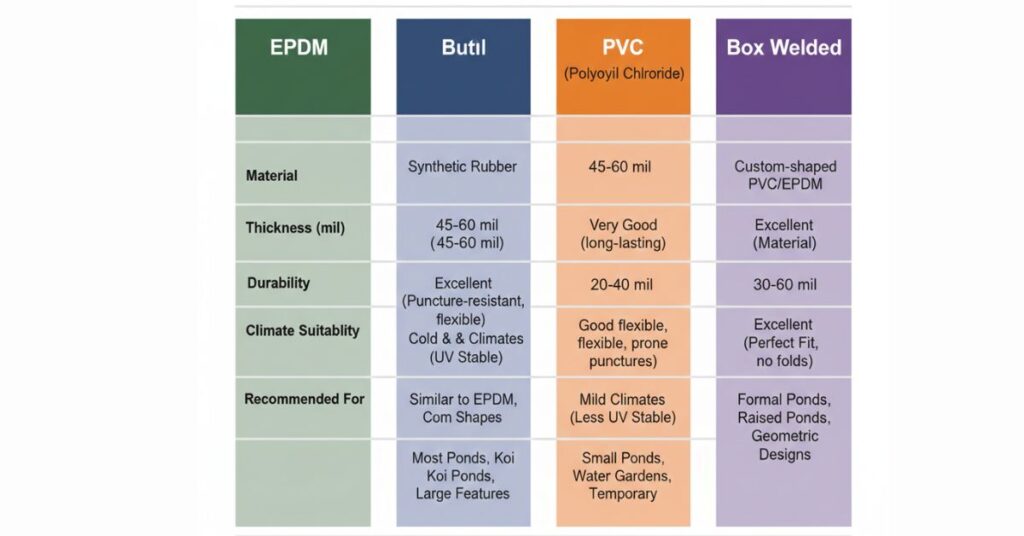
Picking the right material is just as important as getting the size right. A koi pond liner calculator or fish pond liner calculator can help you figure out the dimensions. The type of liner you choose will also impact how long it lasts and how well it holds up.
Climate is important too. If you live in a cold northern state, you’ll need a flexible liner. In hot southern states, look for liners that resist UV damage.
EPDM Rubber Liner
EPDM is the most common pond liner in the US. It’s flexible, durable, and safe for fish.
Most EPDM liners come in the following:
- 45 mil/60 mil: This option is heavier and more resistant to punctures. mil—Heavier and more puncture-resistant
45 mil works well. A 60-mil liner is better for deep koi ponds or areas with rocky soil. Better for deep koi ponds or rocky soil.
EPDM handles freeze and thaw cycles very well. It also resists UV damage in hot climates like Texas or Arizona. With proper installation, it can last decades.
Butyl Rubber Liner
Butyl rubber is a premium option. It offers strong flexibility and a long lifespan.
It performs well in cold weather and stays elastic over time. However, it often costs more than EPDM. Availability in the US may also vary.
Professionals sometimes pick butyl for high-end koi ponds.
PVC Liner
PVC is a budget-friendly choice. It works for small decorative ponds or temporary installations.
However, PVC can become brittle in freezing weather and may break down faster in strong sunlight. It usually doesn’t last as long as EPDM.
For deep koi ponds, PVC is not ideal.
Box-welded liners
Box-welded liners are custom-made to fit specific dimensions. Manufacturers weld seams to match your pond’s exact size.
This option helps avoid extra folds and material. It’s a good fit for large rectangular ponds or formal water features.
Thickness Recommendation Guide
| Pond Type | Recommended Thickness | Climate Suitability | Expected Lifespan |
|---|---|---|---|
| Small Garden Pond | 45 mil EPDM | Most US climates | Long-term |
| Koi Pond (3–4 ft deep) | 60 mil EPDM | Cold & hot states | Long-term |
| Temporary Pond | PVC | Mild climates | Shorter-term |
| Custom Formal Pond | Box Welded | Varies | Long-term |
Takeaway
If you want your pond to last, EPDM is usually the safest choice for most ponds in the US. Be sure to use a koi pond liner calculator or fish pond liner calculator to check your dimensions before picking a thickness.
How to Use Our Free Pond Liner Calculator
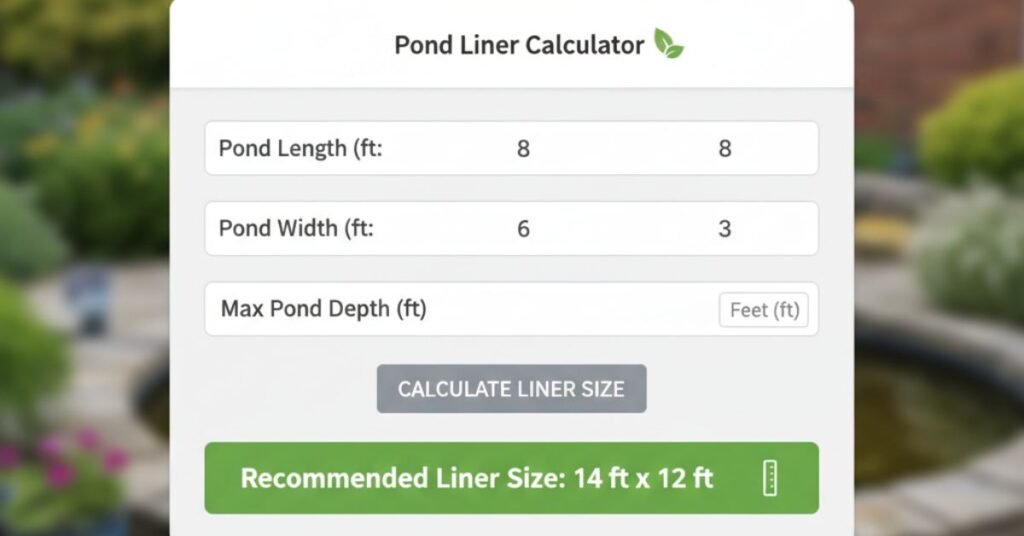
A pond liner calculator makes sizing your pond liner quick and easy. Instead of doing manual calculations, you get accurate dimensions in seconds. Here’s how to use it step by step.
- Enter the pond length – Measure from one end to the other.
- Enter the pond width – For round ponds, enter the diameter instead.
- Enter the pond depth – Use the maximum depth. Include shelf areas if your pond has ledges.
- Select your units—choose feet or meters depending on your location.
- Get instant liner size – The tool calculates the correct liner dimensions automatically, including recommended overlap.
Using a free pond liner calculator ensures you avoid math mistakes and guesswork. It supports all pond shapes—rectangular, round, and irregular. The calculator also adds extra material for edges automatically, so you don’t risk running short.
Benefits of Using the Pond Liner Calculator
- Eliminates math errors
- Saves time on manual calculations
- Provides instant, accurate results
- Supports all pond shapes
- Automatically includes edge overlap.
Whether you’re a beginner or a professional landscaper, this tool simplifies pond planning.
👉 Try the pond liner calculator now and get your exact liner size in seconds.
Common Mistakes When Calculating Pond Liner Size
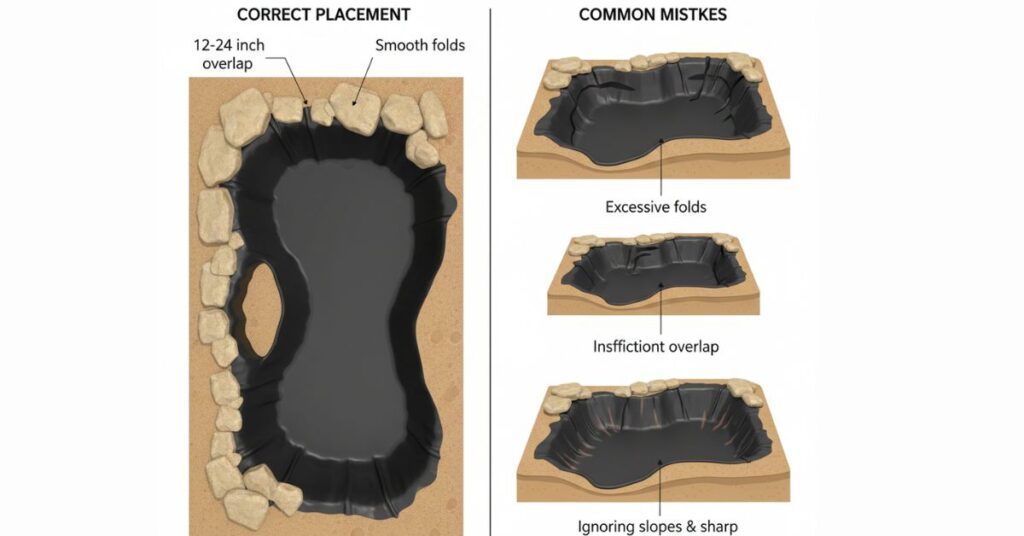
Even small errors in calculating pond liner size can lead to bigger problems later. Knowing what to avoid saves time, money, and frustration.
Measurement Errors
Accurate measurement is the first step. Many beginners make these mistakes:
- Ignoring slopes – Ponds often have sloped sides or shelves. Forgetting them underestimates the liner size.
- Forgetting shelves – Plant or fish shelves add depth that must be included.
- Measuring uneven ground – Soil may not be level; measure at multiple points to get the largest dimensions.
Using a pond liner calculator helps reduce these errors, but manual double-checking is always smart.
Material Selection Mistakes
Choosing the wrong liner material or thickness can cause long-term issues:
- Wrong thickness – Thin liners may tear, especially in koi ponds or rocky areas.
- Not accounting for sharp rocks—Rocks or roots can puncture liners if extra protection or thicker material isn’t used.
A koi pond liner calculator or fish pond liner calculator can guide you on the appropriate liner size, but material choice is equally critical.
Installation Mistakes
Even with perfect measurements, poor installation can ruin a pond:
- Not smoothing folds—wrinkles can trap debris and cause stress points.
- Insufficient overlap – Too little extra material leads to exposed edges and possible leaks.
Pro Tip
Always measure twice, choose the right thickness for your climate, and allow extra overlap. Small precautions prevent costly fixes later.
Conclusion
Accurate pond liner calculations are the foundation of a successful pond project. Getting the right liner size prevents leaks, reduces material waste, and ensures a clean, professional-looking installation. Whether you’re building a backyard garden pond, a koi pond, or a decorative water feature, precise measurements save time and money.
Using a pond liner calculator makes this process easy. It eliminates guesswork, automatically accounts for overlap, and adjusts for pond shape. Even beginners can confidently determine the correct liner dimensions before purchasing materials.
Before buying your liner, measure your pond carefully—length, width, depth, and any shelves or slopes. Double-check these numbers in the calculator to confirm the best fit.
For a complete pond setup, consider using related tools:
- [Pond pump calculator]—choose the right pump for your pond size
- [Pond volume calculator] – calculate total water capacity
- [Pond cost estimator] – plan your budget efficiently
Starting with accurate liner measurements ensures every other step goes smoothly.
👉 Use our pond liner calculator to get precise measurements and start your pond project with confidence.

Michael Brooks and Sarah Lane are the co-founders of the Pond Pump Team, a trusted U.S.-based group helping homeowners and landscapers build better ponds and water features. Michael, an experienced pond engineer from Oregon, has worked for over 12 years on pump sizing, flow systems, and water circulation. Sarah, a pond designer from Colorado with nine years of experience, focuses on eco-friendly and easy-to-maintain pond and waterfall designs. Together, they’ve completed more than 180 pond projects and created tools like the Pond Pump Calculator and Pond Liner Calculator to make pond planning simple, accurate, and sustainable.
Need help with your pond setup? Contact the Pond Pump Team for expert advice and reliable solutions.