Introduction
Worried you used the wrong amount of pond treatment?
Calculating pond volume is crucial for healthy water and thriving fish. It enables accurate treatments, proper water balance, and efficient filtration. Many beginners in the USA make guesses about their pond’s gallonage, leading to poor filtration, incorrect chemical dosing, and stressed fish. Small mistakes disrupt water balance and harm koi or goldfish.
Calculating pond gallons is simple. Take basic measurements, use the formula, and get accurate results. This guide shows how to calculate pond gallons for any shape. Follow the steps for accuracy every time.
For quicker results, you can use a pond volume & gallons calculator guide instead of manual calculations.
Why Calculating Pond Volume Matters
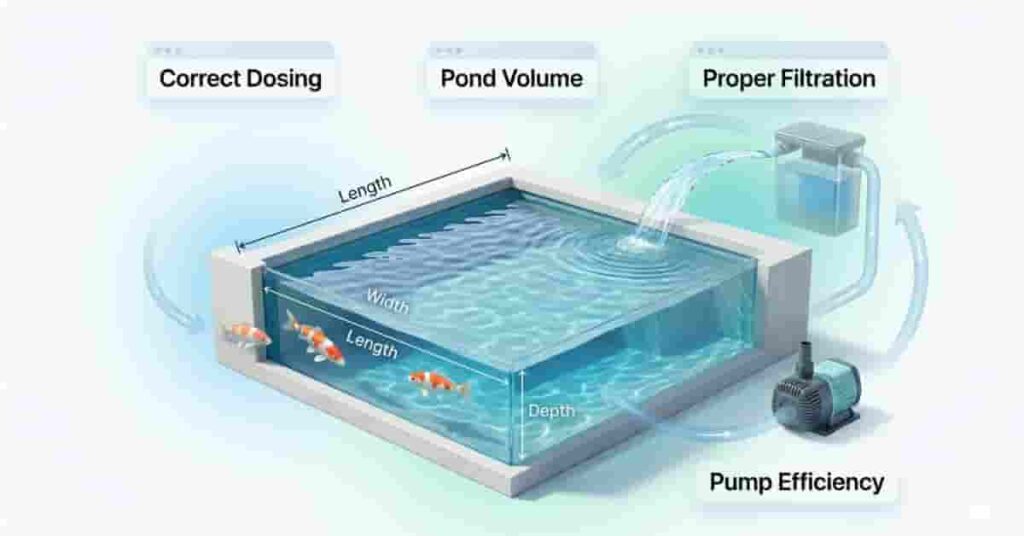
Knowing your pond volume is not just a number—it controls everything in your pond. From fish health to water clarity, accurate pond gallons help you make the right decisions. Many beginners guess their pond size, but even small errors can cause big problems.
If your calculations are off, you may add too many chemicals or choose the wrong equipment. This can lead to poor water quality, stressed fish, and extra maintenance. When you know your exact pond gallons, you can manage your pond with confidence and avoid costly mistakes.
For Fish & Koi Ponds
Fish depend on stable, clean water to stay healthy. When you know your pond volume, you can dose treatments correctly. This includes dechlorinators, medications, and beneficial bacteria. Too much can harm fish, while too little may not work at all.
Proper pond gallons also help you choose the right filtration system. Filters are rated by water volume, so accuracy matters. A correctly sized filter removes waste efficiently and keeps water clear.
For Water Features & Garden Ponds
Even without fish, pond volume plays a key role in water features. Pumps, fountains, and waterfalls all depend on the correct pond gallons. If your pump is too small, the water flow will look weak. If it’s too strong, it may cause splashing and water loss.
Knowing your pond volume also helps manage water levels. Evaporation, leaks, or refilling become easier to track when you know how much water your pond holds. This keeps your system stable and reduces maintenance issues.
Mini Case Insight:
A small backyard pond owner upgraded their pump without checking the pond’s gallons. The result was excessive splash and daily water loss. After recalculating the pond volume, they chose the correct pump size and fixed the issue.
Takeaways:
- Pond volume ensures proper pump sizing.
- Helps maintain stable water levels
- Improves the performance of fountains and waterfalls
Step 1 – Measure Your Pond Dimensions
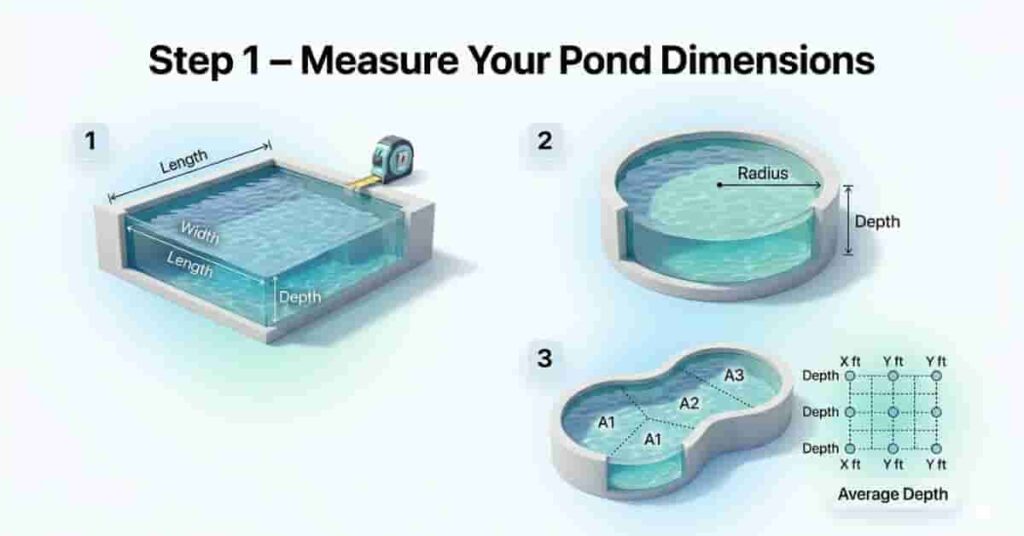
The first step in learning how to calculate pond volume is taking accurate measurements. This step sets the foundation for everything that follows. If your measurements are wrong, your final pond gallons will be off as well.
Start by identifying your pond shape. Most ponds fall into three simple categories: rectangular, circular, or irregular. Each shape uses a slightly different method, but the goal is the same—to measure surface area and depth correctly.
Rectangular Ponds
Rectangular ponds are the easiest to measure. You only need three values: length, width, and average depth.
- Measure the longest length of the pond.
- Measure the widest point.
- Find the average depth (not just the deepest point)
Use this format:
Length × Width × Average Depth
This gives you the total volume in cubic feet, which you’ll convert to pond gallons later.
Circular Ponds
For round ponds, you’ll measure the radius instead of length and width. The radius is the distance from the center to the edge.
- Measure from the center to one side (radius)
- Measure the average depth.
Use this format:
Radius × Radius × Depth × π
This method helps you accurately estimate water volume for circular garden ponds and small water features.
Irregular Ponds
Irregular ponds need a simple estimation method. These ponds don’t have perfect shapes, so you’ll rely on averages.
- Divide the pond into smaller sections (if possible)
- Estimate surface area
- Calculate average depth
Average depth method:
(Shallow depth + Deep depth) ÷ 2
Multiply this by the surface area to get an approximate volume.
Pro Tips
- Measure depth at several points for better accuracy.
- Always include slopes and shelves in your depth calculation.
- Use a measuring tape or marked stick for consistency.
Step 2 – Calculate Water Volume
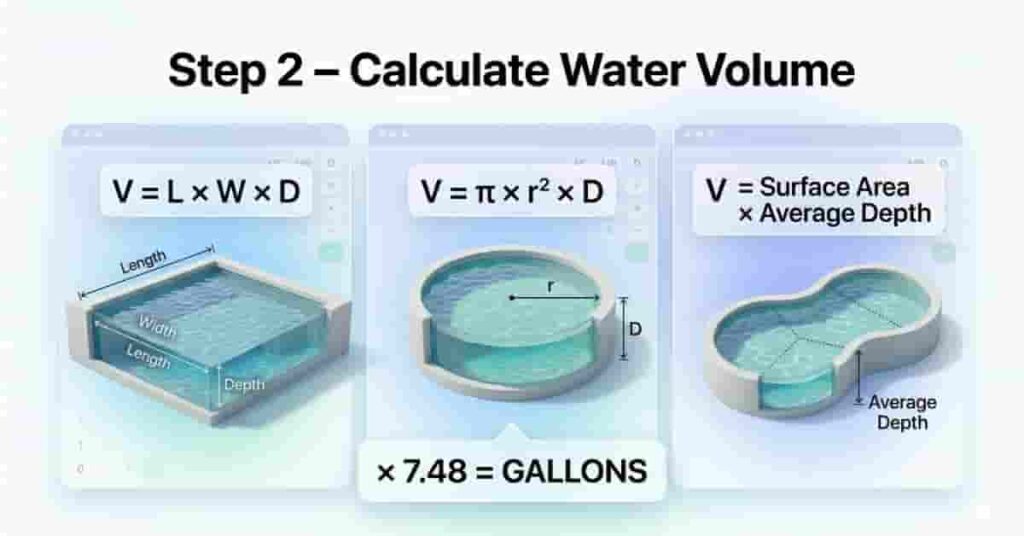
Now that you have your measurements, the next step is to calculate the actual water volume. This is where you turn dimensions into usable numbers. If you’re wondering how to calculate gallons in a pond, this step makes it clear.
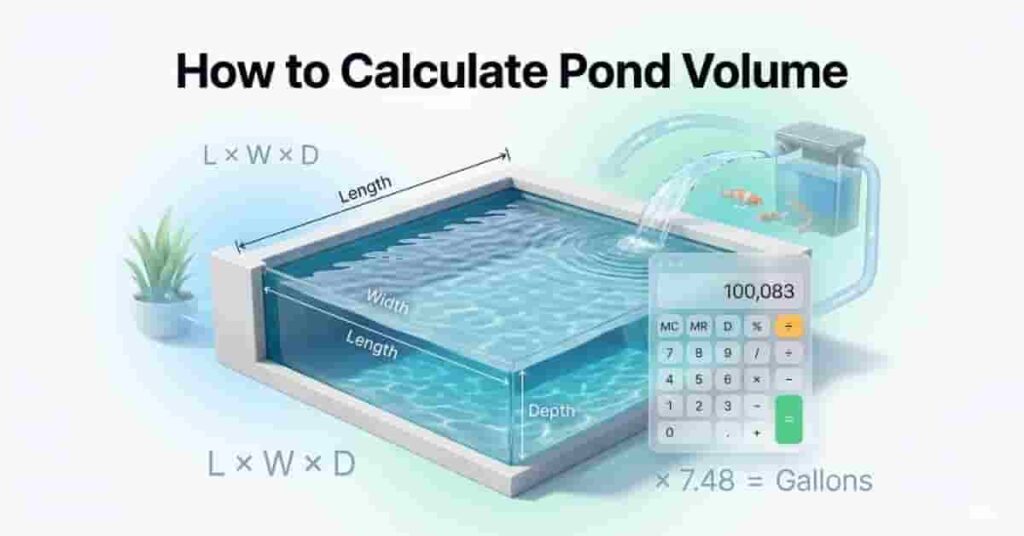
You’ll first calculate volume in cubic feet, then convert it into pond gallons. The conversion is simple:
1 cubic foot = 7.48 gallons
Rectangular Pond Formula
Rectangular ponds use the simplest formula. Multiply the three main measurements to get volume.
- Volume (cubic feet) = Length × Width × Depth
- Convert to gallons = Volume × 7.48
For example, if your pond is 10 ft long, 6 ft wide, and 2 ft deep:
10 × 6 × 2 = 120 cubic feet
120 × 7.48 = 897.6 gallons
This method works best for formal ponds with straight edges and even depth.
Pro Tips:
- Always use average depth, not maximum depth.
- Double-check measurements before multiplying.
Takeaways:
- Multiply L × W × D for cubic feet.
- Convert using 7.48 to get pond gallons.
- Best for simple, box-shaped ponds
Circular Pond Formula
Circular ponds require a slightly different formula because of their shape. You’ll use the radius instead of length and width.
- Volume (cubic feet) = π × r² × Depth
- Convert to gallons = Volume × 7.48
Example:
Radius = 4 ft, Depth = 2 ft
π × 4² × 2 = 100.53 cubic feet
100.53 × 7.48 ≈ 751.9 gallons
This method helps you accurately calculate the volume of water in round or oval ponds.
Pro Tips:
- Measure the radius carefully from the center to the edge.
- Use π ≈ 3.14 for quick calculations.
Takeaways:
- Use π × r² × D for circular ponds
- Always convert cubic feet to gallons.
- Ideal for round garden ponds
Irregular Pond Formula
Irregular ponds don’t follow perfect shapes, so you’ll estimate using averages. This method is common for natural-style ponds.
- Volume (gallons) = Surface Area × Average Depth × 7.48
Start by estimating the surface area. Then calculate the average depth using:
(Shallow depth + Deep depth) ÷ 2
Multiply everything together to get the total pond gallons.
Mini Case Insight:
A homeowner guessed their pond size and overdosed on algae treatment. After using the average depth method, they corrected the dosage and cleared the water safely.
Step 3 – Convert to Gallons
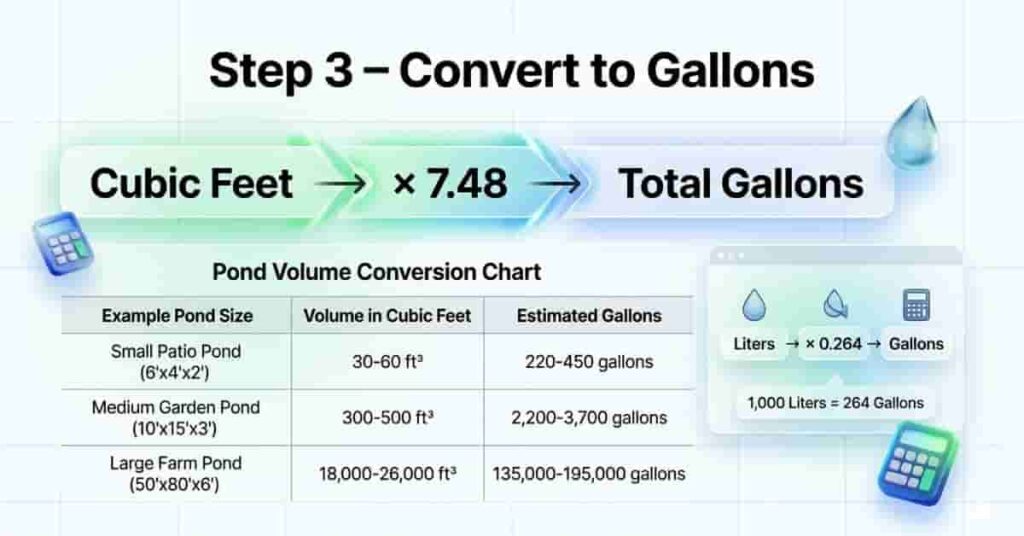
Once you have your pond volume in cubic feet or liters, the final step is to convert it to gallons. This is the most practical unit for pond care in the USA. It helps you dose treatments, size equipment, and maintain water balance.
If you’ve already used cubic feet, you’ve done most of the work. Just multiply by 7.48 to get pond gallons. If your measurements are in liters, use the quick conversion below.
Quick Conversion Formula (Liters to Gallons)
- 1 liter = 0.264 gallons
- Gallons = Liters × 0.264
This is useful if your pond measurements or pump ratings are in metric units. Many beginners mix units, so always double-check before converting.
If you want faster results, you can also use a pond gallons calculator. These tools reduce errors and save time, especially for irregular ponds.
Pond Size Reference Table
Here’s a simple guide to help you understand common pond sizes:
- Small Pond:
300–800 gallons
Ideal for small gardens or decorative features - Medium Pond:
800–2,500 gallons
Suitable for goldfish or small koi setups - Large Pond:
2,500+ gallons
Best for koi ponds and advanced filtration systems
Pro Tips
- Always round slightly down when dosing chemicals
- Recalculate gallons after adding rocks or features.
- Use the same unit system throughout your calculation.
Common Mistakes to Avoid
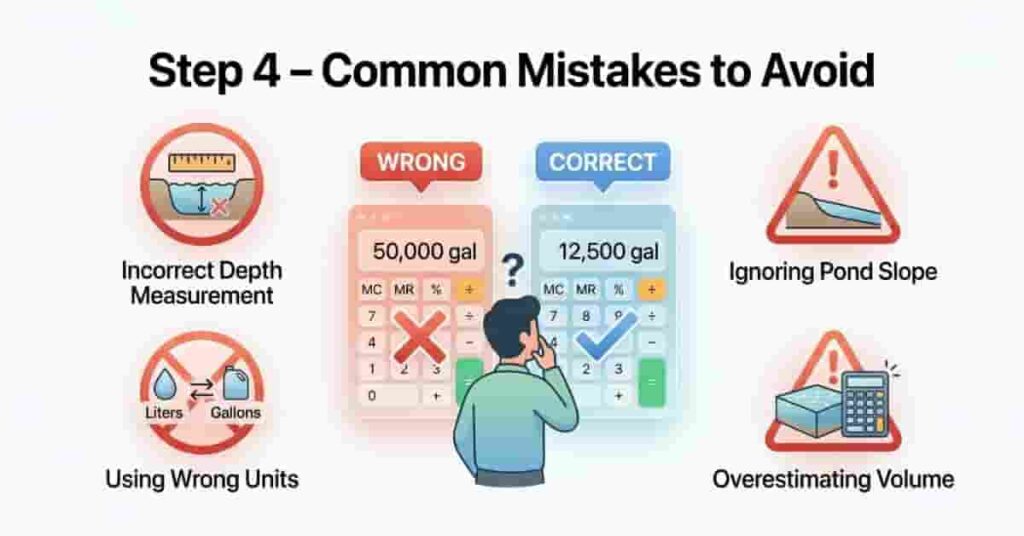
Even small mistakes can lead to wrong pond volume results. If you’re learning how to calculate pond volume, avoiding these errors will save time and prevent problems later.
Many beginners miscalculate pond gallons, leading to incorrect chemical dosing or poor equipment choices. Let’s fix the most common issues.
Common Mistakes
- Forgetting the pond slope
Most ponds are not flat. Ignoring slopes or shelves can reduce accuracy and give incorrect pond gallons. - Using the wrong units
Mixing feet, inches, and meters leads to significant calculation errors. Always stick to one unit system. - Overestimating depth
Using the deepest point instead of the average depth gives inflated results. This leads to overdosing on treatments.
Tools & Calculators to Simplify Calculation
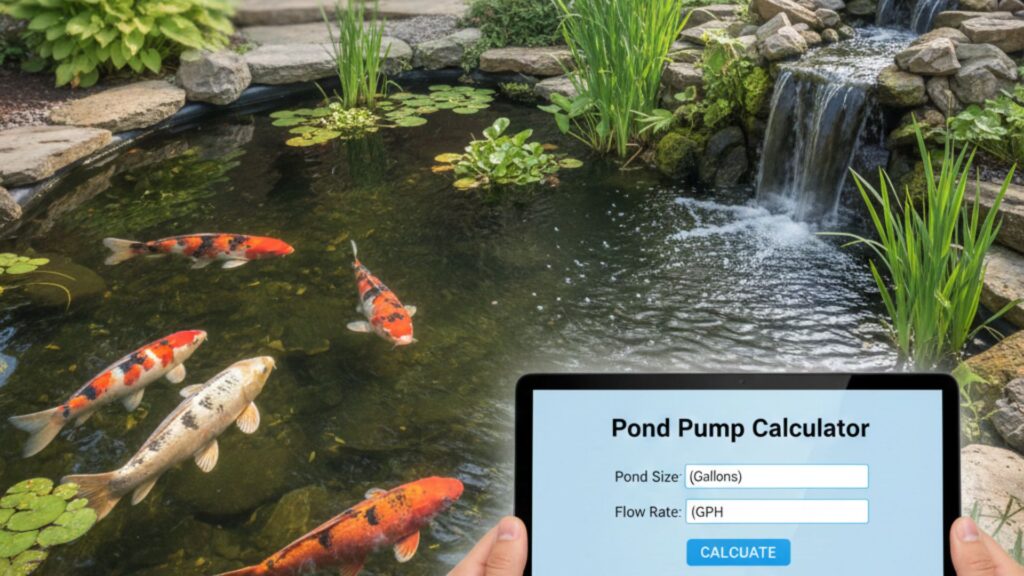
Manually calculating pond volume can take time, especially for irregularly shaped ponds. That’s where digital tools make things much easier. If you’re unsure how to calculate pond gallons, using a calculator helps you avoid mistakes and get fast results.
These tools are especially useful for beginners who want accurate pond measurements without doing manual math. They also reduce errors when converting units or estimating average depth.
Recommended Tools
- Pond Volume Calculator
Quickly estimates total water volume based on pond shape and dimensions. Ideal for both simple and irregular ponds. - Pond Gallon Calculator
Converts your pond measurements directly into gallons. This is perfect for USA users who work mainly in gallons. - Pond Water Calculator
A complete tool that combines volume, depth, and conversion in one place. Great for quick planning and pond setup.
Conclusion
In this guide, we explained how to measure, calculate, and convert pond size into accurate water volume. You also learned simple formulas and tools to estimate pond gallons with confidence.
Understanding how to calculate pond volume helps you maintain clean water, protect fish health, and choose the right equipment. When you know your exact pond gallons, pond care becomes easier and more reliable.
Before finishing, always double-check your measurements and use a calculator for better accuracy. Small errors can affect filtration and water balance over time.
If you found this guide helpful, share it with other pond owners or drop your questions in the comments. You can also explore more pond care resources on our website to keep your setup healthy and efficient.
Michael Brooks and Sarah Lane are the co-founders of the Pond Pump Team, a trusted U.S.-based group helping homeowners and landscapers build better ponds and water features. Michael, an experienced pond engineer from Oregon, has worked for over 12 years on pump sizing, flow systems, and water circulation. Sarah, a pond designer from Colorado with nine years of experience, focuses on eco-friendly and easy-to-maintain pond and waterfall designs. Together, they’ve completed more than 180 pond projects and created tools like the Pond Pump Calculator and Pond Liner Calculator to make pond planning simple, accurate, and sustainable.
Need help with your pond setup? Contact the Pond Pump Team for expert advice and reliable solutions.