Introduction
Ever fill a pond and realize the water or fish load is off?
Understanding the exact pond volume ensures fish health, clear water, and easier long-term maintenance. Accurate measurements prevent overstocking, support effective filtration, and reduce chemical use, making pond care more efficient and cost-effective.
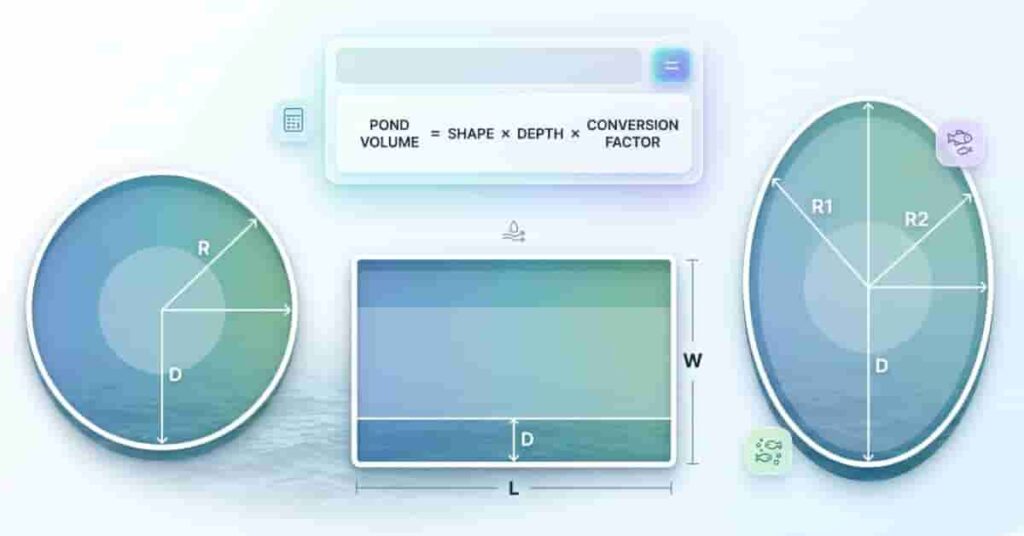
Ponds come in circular, rectangular, oval, and kidney shapes. Each shape needs its own calculation. Using the wrong formula can disrupt your pond, especially for pumps, filtration, and water treatments.
This guide will show you how to calculate pond volume and gallons for any shape with simple, step-by-step methods. You will discover how accurate measurements lead to healthier fish populations, reliable pump performance, and accurate chemical dosing, saving you money and trouble.
Learn how to calculate pond volume correctly for any shape and gain clear advantages: healthier fish, efficient filtration, and reduced setup costs.
For complex designs, learn about irregular pond volume calculation methods to avoid mistakes.
Circular Pond Volume Calculation
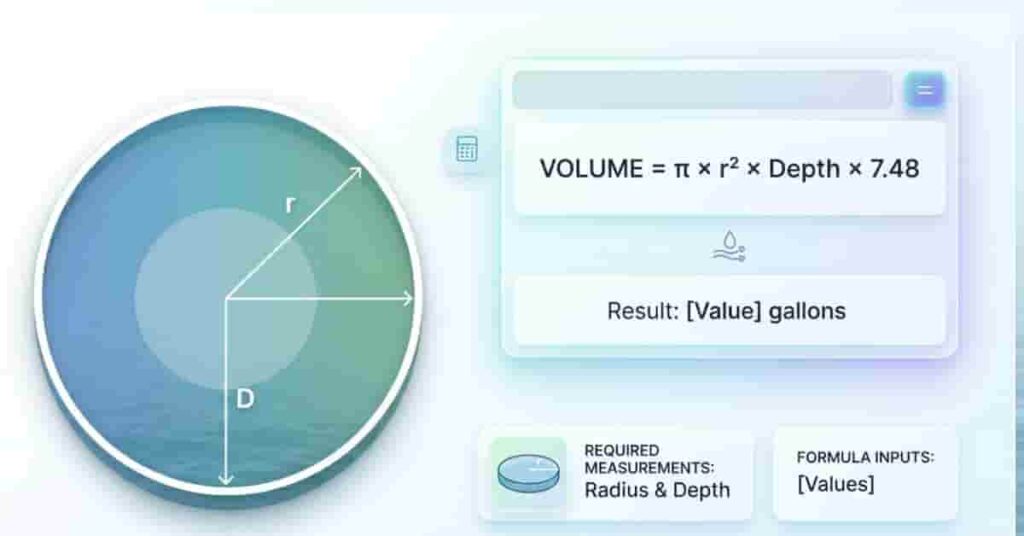
Calculating the volume of a circular pond is simple with the right formula. If you’re new to ponds, this step is especially helpful when using a circular pond volume calculator or choosing equipment.
The standard formula is:
Volume = π × radius² × depth × 7.48
This formula gives you the pond volume in gallons, which helps with fish stocking, filtration planning, and water treatment. Many people starting out sometimes guess the depth or radius, which can lead to mistakes. That’s why sticking to clear steps really helps.
📊 Example Calculation (Circular Pond)
Let’s say your pond has:
- Radius = 5 feet
- Depth = 3 feet
Step-by-step:
- Square the radius: 5 × 5 = 25
- Multiply by π (3.14): 25 × 3.14 = 78.5
- Multiply by depth: 78.5 × 3 = 235.5
- Convert to gallons: 235.5 × 7.48 = 1,761.54 gallons.
So, the pond holds approximately 1,761 gallons of water.
📏 Tips for Accurate Measurement
- Measure radius from center to edge, not diameter
- Always use average depth for uneven ponds.
- Take measurements at multiple points for better accuracy.
- Avoid guessing, especially when using a round pond gallon calculator.
Correct measurements prevent pump and filter overload. Your system runs efficiently.
You can also simplify things using a pond volume & gallons calculator guide.
Rectangular Pond Volume Calculation
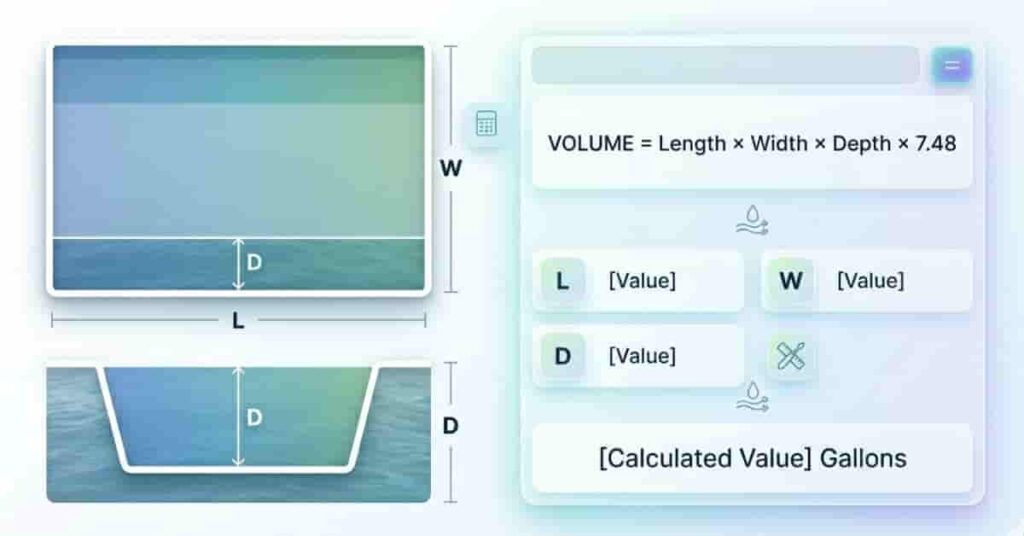
Calculating the volume of a rectangular pond is one of the easiest methods with a rectangular pond volume calculator. This shape is common in backyard and koi ponds, as well as in commercial setups, because it is easy to measure and design. The key is using accurate length, width, and average depth to avoid overestimating water volume.
The standard formula is:
Volume = Length × Width × Average Depth × 7.48
This gives the total pond volume in gallons. The factor 7.48 converts cubic feet into gallons, which is essential for proper pond planning. Many beginners in the USA make the mistake of using maximum depth instead of average depth, especially in ponds with uneven bottoms.
📊 Example Calculation (Rectangular Pond)
Let’s assume your pond measurements are:
- Length = 10 feet
- Width = 6 feet
- Average Depth = 3 feet
Step-by-step:
- Multiply length × width: 10 × 6 = 60
- Multiply by depth: 60 × 3 = 180 cubic feet
- Convert to gallons: 180 × 7.48 = 1,346.4 gallons.
So, the pond holds approximately 1,346 gallons of water.
⚠️ Notes on Sloped Sides and Irregular Bottoms
Not all rectangular ponds are perfectly flat. Many have sloped sides or uneven floors. In these cases, always use the average depth instead of the deepest point. Take multiple depth measurements and calculate the mean for better accuracy.
If the bottom is highly irregular, divide the pond into smaller sections and calculate each part separately. Then add the results together for a more precise total volume. This helps avoid mistakes when sizing pumps, filters, and chemical treatments.
Using correct measurements ensures your pond stays balanced and your equipment runs efficiently without overload.
Oval Pond Volume Calculation
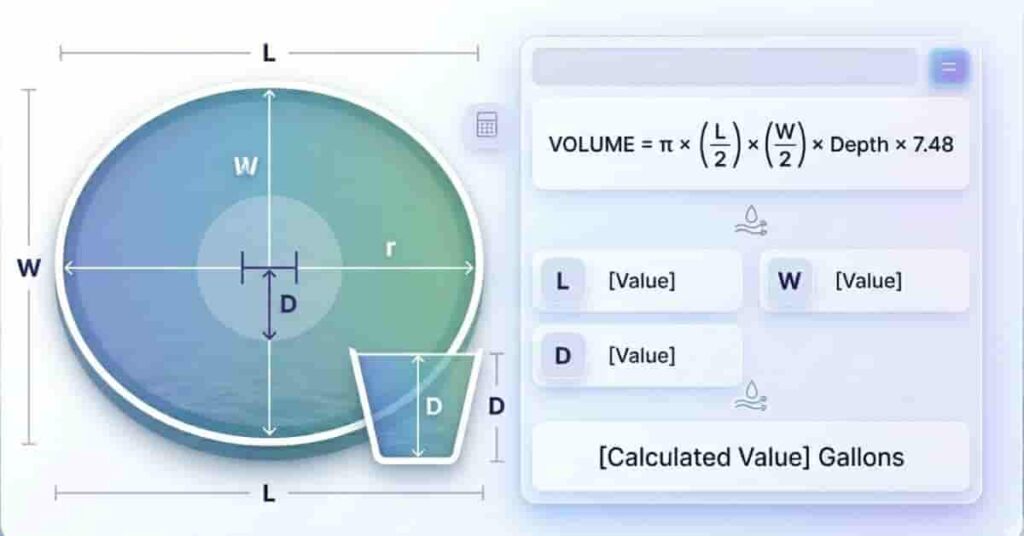
Oval ponds look simple, but their shape can make volume estimation tricky. Using the right formula helps you get accurate results, especially when using an oval pond volume calculator for setup planning. This is important for fish health, filtration sizing, and water balance.
The standard formula is:
Volume = π × (Length ÷ 2) × (Width ÷ 2) × Depth × 7.48
This method treats the oval like a stretched circle and gives the volume in gallons. Many beginners in the USA make the mistake of measuring only the longest side, resulting in incorrect results. Always measure both length and width for accuracy.
📊 Step-by-Step Example (Oval Pond)
Let’s assume:
- Length = 12 feet
- Width = 6 feet
- Depth = 3 feet
Step 1: Divide length and width by 2
- 12 ÷ 2 = 6
- 6 ÷ 2 = 3
Step 2: Apply the formula
- π × 6 × 3 × 3 = 169.65 cubic feet (approx.)
- 169.65 × 7.48 = 1,268.8 gallons
So, the pond holds approximately 1,269 gallons of water.
📏 Tips for Accurate Measurement
- Always measure the longest and widest points, not estimates.
- Take depth readings from multiple spots and use the average.
- Avoid using sloped edge depth as the final depth.
- Double-check values before using an oval pond volume calculator.
Accurate measurements help prevent overstocking fish and ensure your pump and filtration system match the real pond size.
Other Shapes (Optional)
Not all ponds follow simple shapes like circles or rectangles. Many modern garden ponds are kidney-shaped, trapezoidal, or fully irregular. These shapes can look beautiful, but they make volume calculation more complex. That’s where an irregular pond volume calculator or a kidney-shaped pond volume calculator becomes very useful for accurate planning.
Instead of using a single fixed formula, the best approach is to break the pond into smaller, simpler shapes. You can combine rectangles, circles, or triangles and add their volumes. This approach provides a close, practical estimate, even for complex designs.
For example, a kidney-shaped pond can be split into two overlapping ovals, or into one oval and one rectangle. Trapezoidal ponds can be treated as two rectangles with different widths. Triangular sections can be calculated separately and added to the total volume. This method helps beginners avoid large errors when estimating water capacity.
📊 Example (Irregular Pond Method)
Imagine a kidney-shaped pond:
- One oval section = 800 gallons
- One small rectangular section = 300 gallons
Total estimated volume = 1,100 gallons
📏 Tips for Irregular Pond Measurement
- Divide the pond into 2–4 simple shapes.
- Measure each section separately for better accuracy.
- Use average depth for all sections.
- Sketch the pond before calculating to avoid confusion.
Common Mistakes in Shape-Based Calculations
Many beginners make simple errors when calculating pond volume by shape. These mistakes can lead to wrong water estimates, which directly affect fish health, filtration performance, and chemical balance. Even when using a pond volume calculator, small measurement errors can lead to significant differences in results.
One of the most common mistakes is using the wrong formula for the pond shape. For example, applying a rectangular formula to a circular or oval pond gives inaccurate results. Each shape needs its own method, whether you are using a circular pond volume calculator or an irregular pond volume calculator.
Another major issue is ignoring sloped sides or uneven bottoms. Many ponds are not perfectly flat. If you measure only the deepest point, you will overestimate the actual water volume. Always use average depth by taking multiple readings across the pond.
Rounding errors also cause problems. Rounding too early in the calculation can slightly change the final result, especially in larger ponds. It is better to keep decimal values until the final step.
📊 Example of Error Impact
A small 10–15% miscalculation in pond volume can lead to:
- Overcrowded fish stocking
- Underpowered pump systems
- Incorrect chemical dosing
🧠 SEO Tip
Including terms like ‘irregular pond volume calculator,’ ’round pond gallon calculator, ‘and’ shape-based mistakes’ improves long-tail keyword coverage. It also increases your chance of ranking for featured snippets and “how to calculate pond volume” searches.
Avoiding these common errors ensures your pond system stays balanced, efficient, and easy to maintain over time.
Conclusion
Calculating pond volume correctly depends on using the right shape formula and accurate measurements. We covered how circular, rectangular, oval, and irregular ponds each need a different approach. Small mistakes can lead to major issues in fish stocking, pump sizing, and water treatment balance.
Using a circular pond volume calculator or any shape-based method helps you avoid guesswork and get precise results. Always measure carefully, check average depths, and confirm your calculations before setting up equipment. Even small errors can affect long-term pond performance.
If you are still unsure, revisit the formulas and compare your results with a trusted tool. Consistency is key to a healthy, stable pond system.
Michael Brooks and Sarah Lane are the co-founders of the Pond Pump Team, a trusted U.S.-based group helping homeowners and landscapers build better ponds and water features. Michael, an experienced pond engineer from Oregon, has worked for over 12 years on pump sizing, flow systems, and water circulation. Sarah, a pond designer from Colorado with nine years of experience, focuses on eco-friendly and easy-to-maintain pond and waterfall designs. Together, they’ve completed more than 180 pond projects and created tools like the Pond Pump Calculator and Pond Liner Calculator to make pond planning simple, accurate, and sustainable.
Need help with your pond setup? Contact the Pond Pump Team for expert advice and reliable solutions.