Introduction
Ever filled a pond and wondered if you used too much or too little water? Many beginners in the USA struggle to calculate pond volume correctly. This leads to wrong fish stocking, pump issues, and chemical imbalance.
Getting the numbers right matters for healthy and clear water. In this guide, you will learn how to calculate pond volume and how to calculate gallons in a pond using simple methods. We will also cover the formulas for circular, rectangular, and irregular ponds, step by step.
These methods make pond planning easier, even if you have never measured water volume before. You will also understand how to calculate pond volume without confusion or technical stress. Follow these formulas to calculate pond volume and gallons accurately for any pond size.
By the end, you can confidently size your pond pump and maintain safe fish levels. This helps you avoid costly mistakes and keeps your pond ecosystem stable year-round.
For quicker results, you can use a pond volume & gallons calculator guide instead of manual calculations.
Understanding Pond Volume
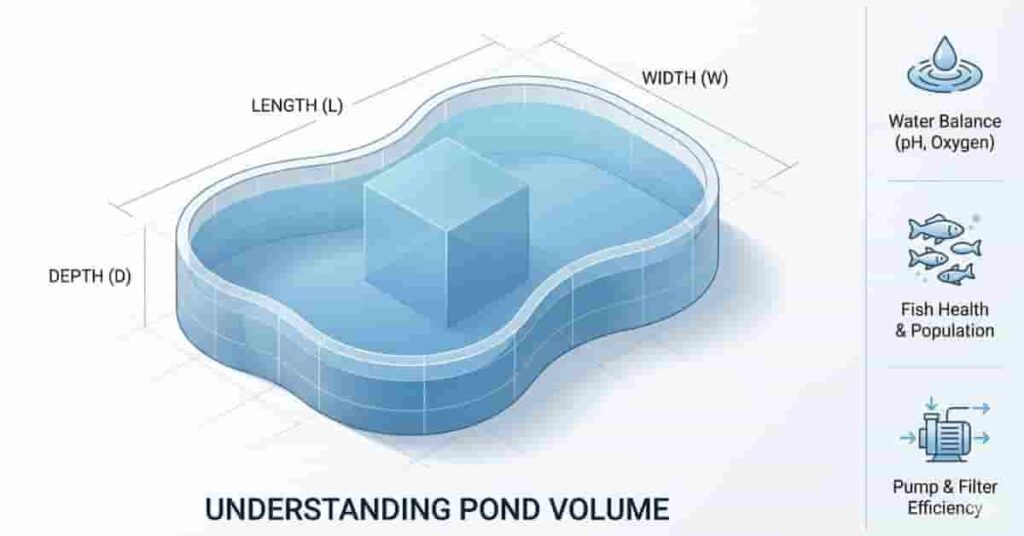
Pond volume means the total amount of water your pond can hold. It depends on the pond’s length, width, and depth. When you calculate pond volume, you get a clear idea of how much water is inside your pond. This helps you plan everything more accurately, from fish stocking to maintenance.
Knowing your pond volume matters more than most beginners realize. It directly affects fish health, water quality, and equipment performance. If you guess wrong, you may overstock fish or use the wrong pump size. This can lead to poor oxygen levels and unstable water conditions. That is why calculating pond volume is a key step for any pond owner.
Pond volume is measured in different units depending on the system you use. The most common units include cubic feet, gallons, and liters. In the USA, gallons are widely used for pond planning and maintenance. Many people also convert cubic feet into gallons for easier understanding.
When you understand these units, calculating pond volume becomes much simpler. It also helps you compare pond sizes and estimate pond gallons more accurately for better management.
Rectangular Pond Volume Formula
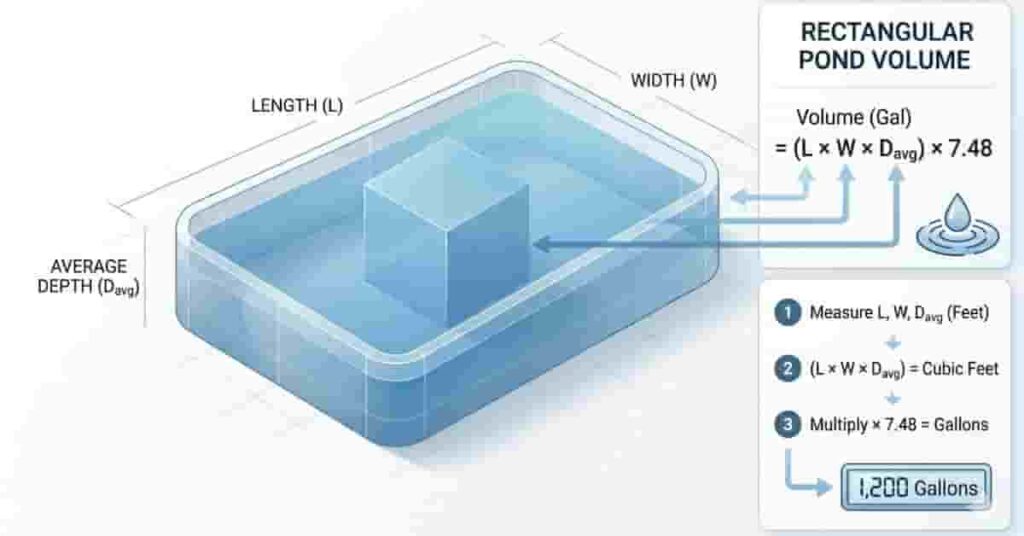
The rectangular pond formula is the easiest way to calculate pond volume. Most backyard ponds in the USA use this shape. It helps you quickly estimate water capacity for maintenance and fish care. When you calculate pond volume correctly, you avoid mistakes in stocking and filtration.
Here is the standard formula used to calculate gallons in a pond:
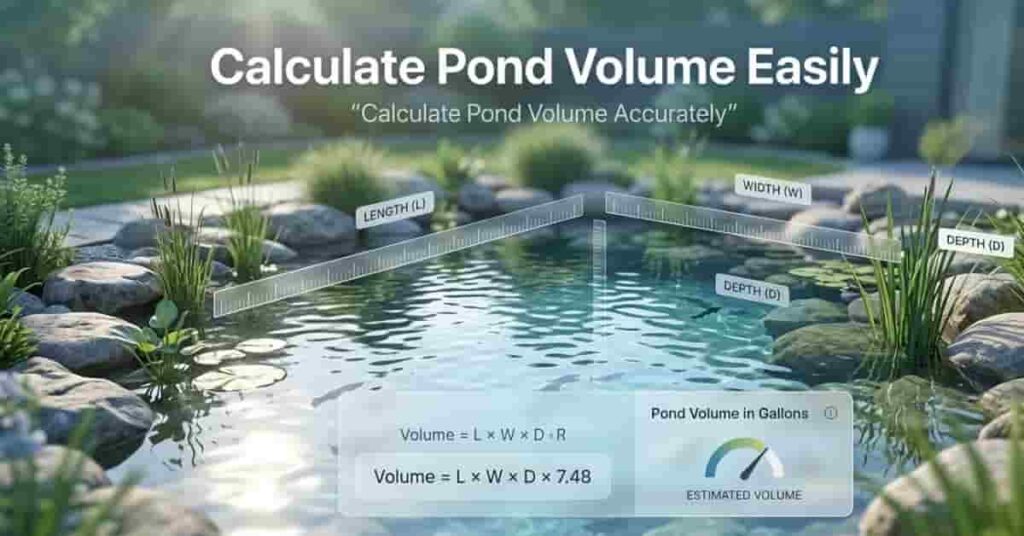
Volume = Length × Width × Average Depth × 7.48 (for gallons)
To better understand this, let’s take a real example. Imagine your pond is 10 feet long, 6 feet wide, and 3 feet deep on average. First, multiply the dimensions: 10 × 6 × 3 = 180 cubic feet. Now convert it into gallons by multiplying by 7.48. The total is about 1,346 gallons. This gives you a clear idea of your pond’s water capacity.
Accuracy matters when you calculate pond volume. Always measure depth at multiple points rather than relying on a single reading. Many ponds are uneven, even if they look flat. Taking an average depth gives you a more realistic result and helps calculate gallons in a pond more correctly.
Pro Tips
- Measure depth in at least 3–5 different spots.
- Avoid guessing dimensions; use a tape measure for accuracy.
- Recheck calculations if you plan to add fish or upgrade your pump.
Takeaways
The rectangular formula is simple but powerful. It helps beginners quickly calculate pond volume without confusion. Once you understand it, you can easily estimate water needs and improve pond balance.
It also helps to understand different pond volume formula methods for better accuracy.
Circular Pond Volume Formula
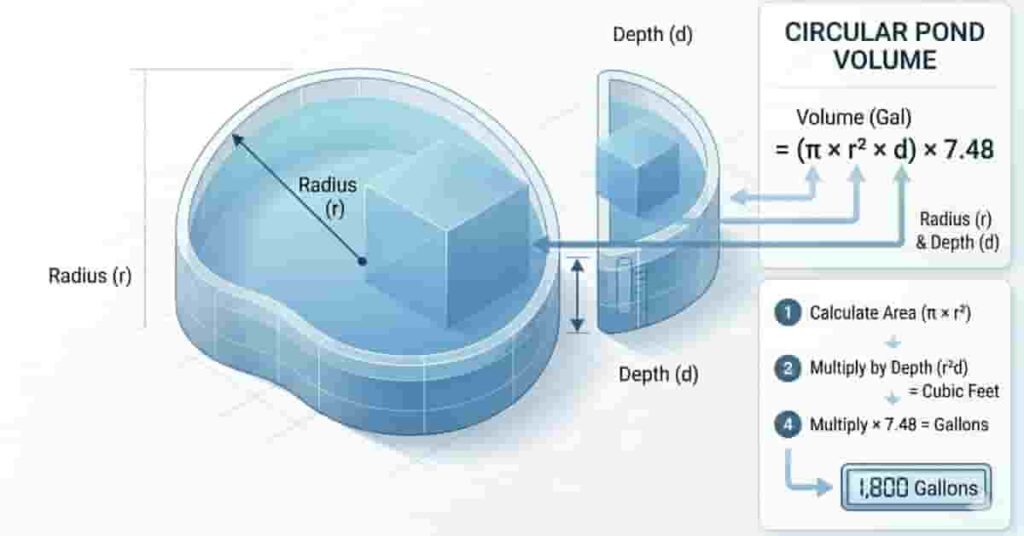
Circular ponds require a different approach because of their circular shape. Instead of length and width, you use the radius. This method helps you calculate volume more accurately for round backyard ponds. Calculating the volume of a circular pond helps plan for fish and filtration.
Here is the standard formula used for circular ponds:
Volume = π × radius² × depth × 7.48 (for gallons)
Let’s take a simple example. Imagine your circular pond has a radius of 5 feet and an average depth of 3 feet. First, square the radius: 5 × 5 = 25. Then multiply by π (3.1416), which gives about 78.54 cubic feet. Now multiply by depth: 78.54 × 3 = 235.62 cubic feet. Finally, convert to gallons by multiplying by 7.48, giving around 1,762 gallons.
This method is widely used when calculating ponding volume for round ponds. It works well even if the pond edges are slightly uneven, as long as the radius is measured correctly.
Pro Tips
- Always measure the radius from the exact center of the pond.
- Double-check depth at multiple points for better accuracy.
- Use a string or tape measure for a precise circular layout.
Irregular Pond Volume Formula
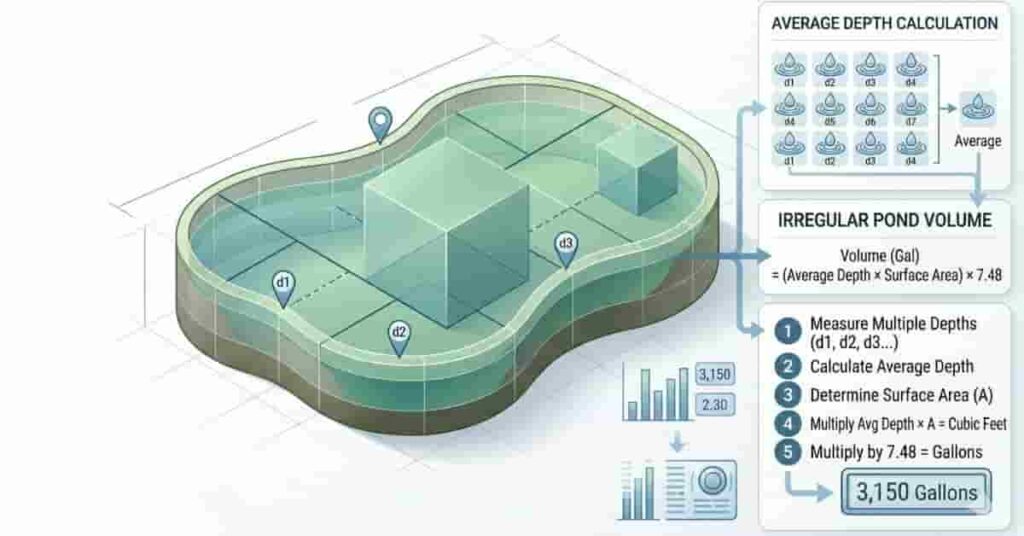
Irregular ponds are the most common type of backyard pond. They do not have a perfect shape, so standard formulas do not work well. Instead, you use a simple estimation method based on average depth and surface area. This helps you calculate pond volume more realistically and avoid major errors.
The standard method is:
Average Depth × Surface Area × 7.48 (for gallons)
To use this method, first measure the pond’s surface area. You can break the shape into smaller sections, like rectangles or circles, and then add them together. Next, measure depth at several points across the pond. Avoid using a single depth reading, as irregular ponds often have slopes and dips.
Now, calculate the average depth by adding all depth measurements and dividing by the number of points. Multiply this average depth by the total surface area. Finally, multiply the result by 7.48 to convert cubic feet into gallons. This gives you a practical estimate when you calculate pond volume for uneven ponds.
This method works best when you want to calculate gallons in a pond that has curved edges or natural shapes.
Conversion Between Units
When calculating pond volume, you often need to convert between different units. This is important because some formulas use cubic feet, while most pond owners prefer gallons. Understanding these conversions helps you calculate pond gallons more accurately and avoid confusion.
To convert cubic feet to gallons, use a simple conversion factor. Multiply the cubic feet value by 7.48 to get gallons. This is the standard conversion used in pond calculations across the USA. It helps you quickly estimate pond capacity for rectangular, circular, or irregular ponds.
For metric users, liters are also commonly used. To convert liters into gallons, divide the number of liters by 3.785. This gives you a quick estimate in US gallons. Many pond tools and pond gallons calculators use this conversion automatically, but knowing the formula helps you double-check results.
Here is a simple reference table for pond sizes:
- Small pond: 500–1,500 gallons
- Medium pond: 1,500–5,000 gallons
- Large pond: 5,000+ gallons
Common Calculation Mistakes to Avoid
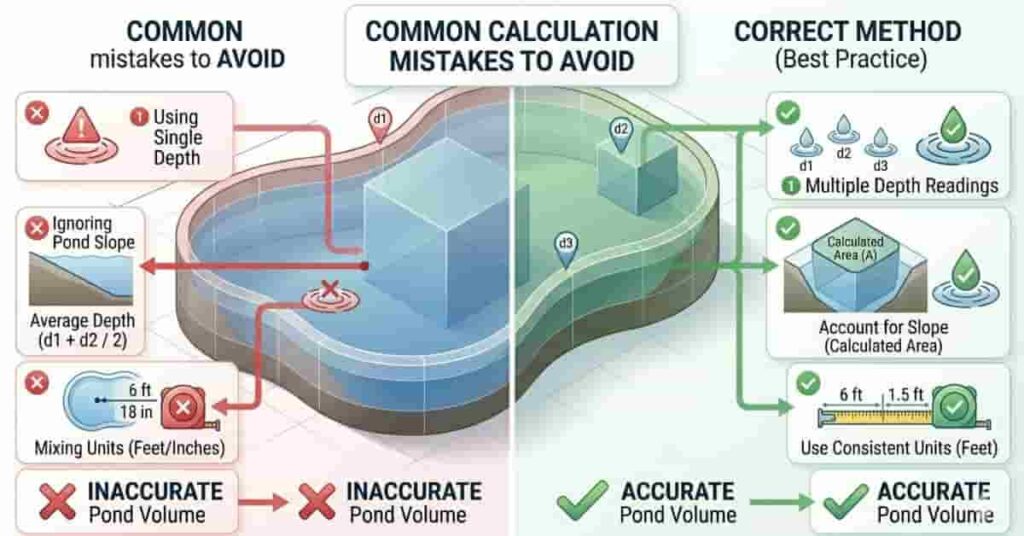
Many beginners make simple mistakes when calculating pond volume. These mistakes can lead to wrong pond size estimates, poor fish health, and incorrect equipment choices. If you avoid them, you can calculate pond gallons much more accurately and keep your water system stable.
One of the biggest mistakes is using the wrong units. People often mix feet and meters without converting them properly. This creates large errors in the final result. Always use a single unit system when calculating pond volume, then convert at the end if needed.
Another common issue is ignoring sloped or uneven sides. Many ponds are not perfectly flat or rectangular. If you assume a uniform depth, your calculation will be wrong. This affects fish stocking levels and pump performance.
A third mistake is failing to measure multiple points. Some users only measure one depth or one side of the pond. This gives an incomplete picture. Always take several measurements across different areas and use an average for better accuracy.
These small errors can cause big problems when you rely on a pond gallons calculator or manual formulas. Paying attention to detail helps you get more accurate results and better pond management.
SEO Tip: This section improves long-tail relevance for users searching common pond calculation mistakes, helping your content rank for problem-based queries.
Conclusion
This guide showed how to measure and calculate pond volume using simple methods. You learned formulas for rectangular, circular, and irregular ponds. These steps help you understand water capacity and avoid costly pond mistakes.
When you calculate pond volume correctly, you improve fish health, water balance, and equipment performance. Always double-check your measurements to ensure accurate results. Small errors can affect your pond gallons and overall system stability.
Use a pond volume chart or a pond gallons calculator for quick reference when needed. This makes planning easier and saves time during maintenance.
If this guide helped you, share it with other pond owners in the USA. You can also explore more pond care resources on our website or leave your questions in the comments.
Michael Brooks and Sarah Lane are the co-founders of the Pond Pump Team, a trusted U.S.-based group helping homeowners and landscapers build better ponds and water features. Michael, an experienced pond engineer from Oregon, has worked for over 12 years on pump sizing, flow systems, and water circulation. Sarah, a pond designer from Colorado with nine years of experience, focuses on eco-friendly and easy-to-maintain pond and waterfall designs. Together, they’ve completed more than 180 pond projects and created tools like the Pond Pump Calculator and Pond Liner Calculator to make pond planning simple, accurate, and sustainable.
Need help with your pond setup? Contact the Pond Pump Team for expert advice and reliable solutions.