Table of Contents
introduction
How much water does your pond actually hold? Many pond owners guess wrong and create expensive water problems.
A fish pond volume calculator helps you calculate accurate pond gallons before adding fish, pumps, filters, or treatments. Many beginners in the USA miscalculate pond size by using only the maximum depth. This often leads to poor water quality, incorrect medication dosing, and stressed fish.
Accurate pond volume is important for koi, goldfish, and small backyard ponds. It also helps you choose the right filtration system and maintain stable water conditions. Some pond owners measure in gallons, while others prefer liters. Understanding both makes pond maintenance much easier.
This guide will show you how to calculate the volume of a fish pond step by step, using simple formulas and practical examples. You will also learn common mistakes to avoid when using a pond gallon calculator or estimating irregular pond shapes.
💧 Use our Fish Pond Volume Calculator to instantly calculate accurate pond gallons and water capacity.
Why Calculating Pond Volume Matters
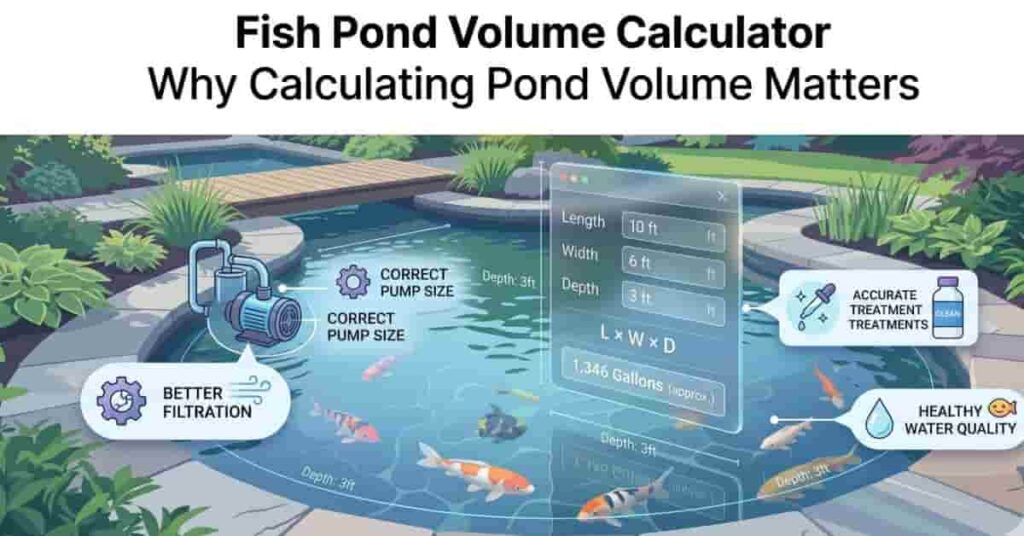
Many pond owners focus on pond shape and fish selection first. However, accurate water volume is the foundation of a healthy pond. If you miscalculate pond gallons, you may face water quality problems, poor filtration, and stressed fish.
A fish pond capacity calculator helps you estimate the true amount of water in your pond. This number affects nearly every part of pond care. Beginners often guess pond size by appearance alone. Unfortunately, even a small mistake can lead to expensive problems later.
Correct pond volume is especially important when adding water treatments or medications. Most pond products use dosage instructions based on gallons or liters. Too little treatment may not work properly. Too much can harm koi, goldfish, and beneficial bacteria.
Pond volume also helps you choose the correct pump size. A weak pump may struggle to circulate water properly. An oversized pump can waste electricity and create unnecessary water movement. Using a pond water volume calculator makes pump selection much easier.
Filtration planning also depends on accurate gallon calculations. Filters work best within specific water capacity ranges. If the filter is too small, waste and algae may build up quickly.
What You Need Before Measuring Pond Volume
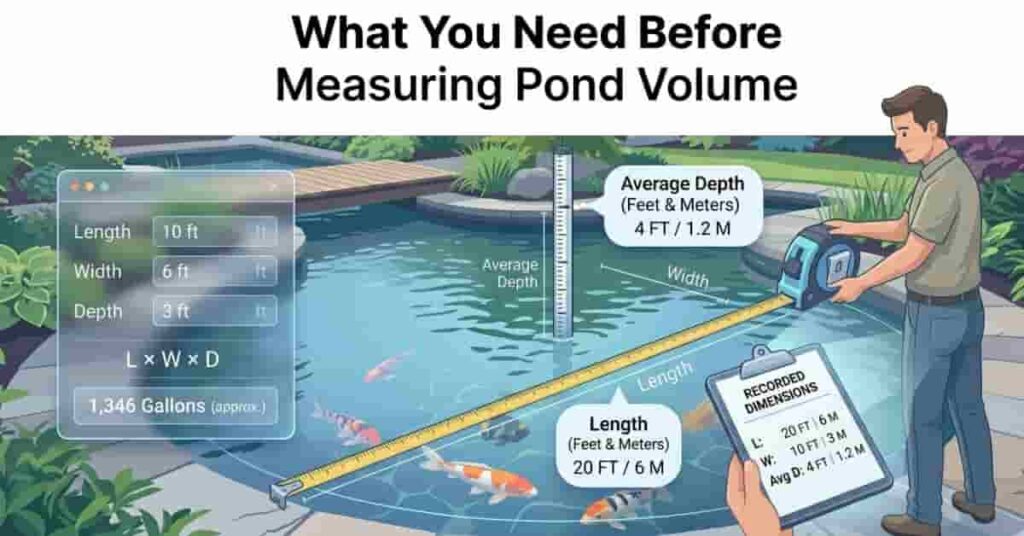
Before you calculate fish pond volume, you need accurate pond measurements. Small measurement errors can create large gallon differences. This affects pump sizing, filtration, and water treatment dosing.
Most pond owners only need a tape measure, a measuring stick, and a notepad. Try to measure the pond when the water surface is calm. This makes dimensions easier to record accurately.
You should also decide whether to measure in feet or meters. Many USA pond calculators use feet and gallons. Metric measurements work too, but you must stay consistent throughout the pond volume formula.
For irregular ponds, estimate average dimensions instead of measuring every curve. Perfect accuracy is difficult with natural pond shapes. However, close estimates usually work well for backyard ponds and koi ponds.
Takeaways
- Accurate measurements improve pond gallon calculations.
- Use the same unit system throughout the process.
- Calm water conditions make measuring easier.
- Average dimensions work well for irregular ponds.
Pro Tip
Write down every measurement immediately. Many beginners forget dimensions while switching between pond sections.
Measure Pond Length
Pond length is usually the easiest measurement to collect. Measure from one end of the pond to the other in a straight line. For rectangular ponds, measure the longest side.
Flexible tape measures work best for backyard ponds. A laser distance tool can also help with large ponds. If your pond has curved edges, measure the longest centerline rather than following every curve.
Many USA pond owners use feet because most pond gallon calculators use gallons. Metric users can measure in meters if they prefer. Just avoid mixing feet and meters in the same calculation.
Natural ponds may not have perfectly straight edges. In that case, estimate the average length. Exact precision is less important than consistency.
Measure Pond Width
After measuring the length, measure the pond’s width at its widest point. For square or rectangular ponds, this step is simple. Natural ponds often need an average width estimate instead.
Irregular ponds may narrow in some areas and widen in others. Measure several sections across the pond and calculate the average width. This creates a more realistic gallon estimate.
For example, one section may measure 6 feet wide while another measures 10 feet. In that case, the average width would be 8 feet.
Many beginners only measure the widest section. This often overestimates pond volume. Average measurements usually provide better results for a pond water volume calculator.
Measure Average Pond Depth
Average depth is one of the most important parts of the pond volume formula. Many pond owners mistakenly use only the deepest point. This often creates incorrect gallon estimates.
To calculate average depth, measure both the shallowest and deepest areas. Then divide the total by two.
For example, if the shallow area is 2 feet deep and the deepest area is 4 feet, the average depth is 3 feet.
Ponds with shelves or multiple levels may need several depth measurements. Use the overall average rather than focusing on a single spot.
Accurate depth measurements help prevent water treatment mistakes and improve filtration planning.
Pro Tip
Use a marked stick or pole instead of guessing depth from the pond edge.
Fish Pond Volume Formulas Explained
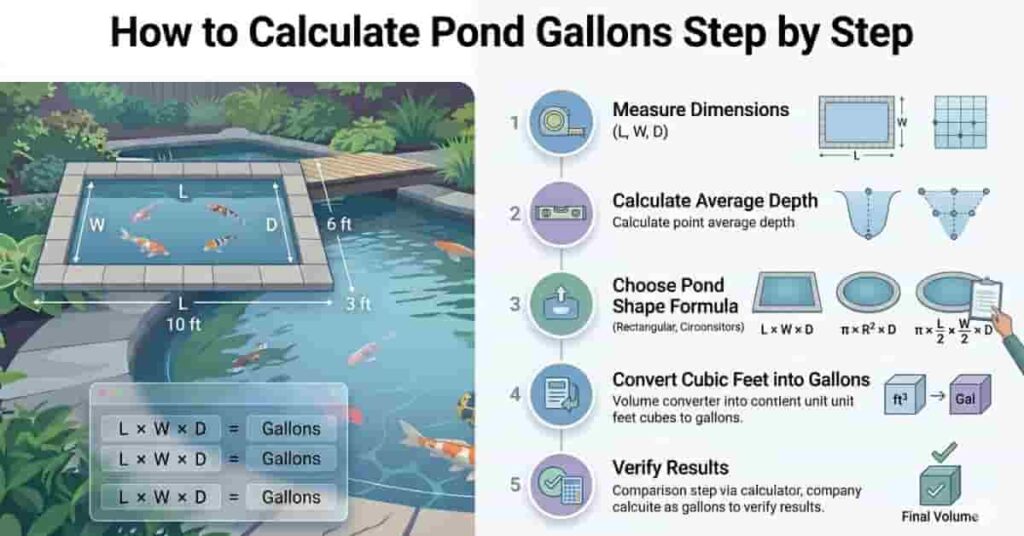
Different pond shapes require different formulas because water spreads differently in each design. A rectangular pond stores water differently from a circular or oval pond. Using the wrong formula can create inaccurate gallon estimates.
Most pond owners only need three basic formulas for backyard, koi, and natural ponds. These formulas help you estimate water capacity for filtration, pumps, and water treatments.
Before using any pond gallon calculator, make sure your measurements are accurate. Small errors in width or depth can greatly affect the final result.
Rectangular Pond Volume Formula
Rectangular ponds use one of the simplest calculation methods. This rectangular pond gallon formula works well for formal ponds with straight edges and even dimensions.
Use this formula:
In this formula:
- L = pond length
- W = pond width
- D = average depth
The number 7.48 converts cubic feet into gallons. One cubic foot of water holds about 7.48 gallons.
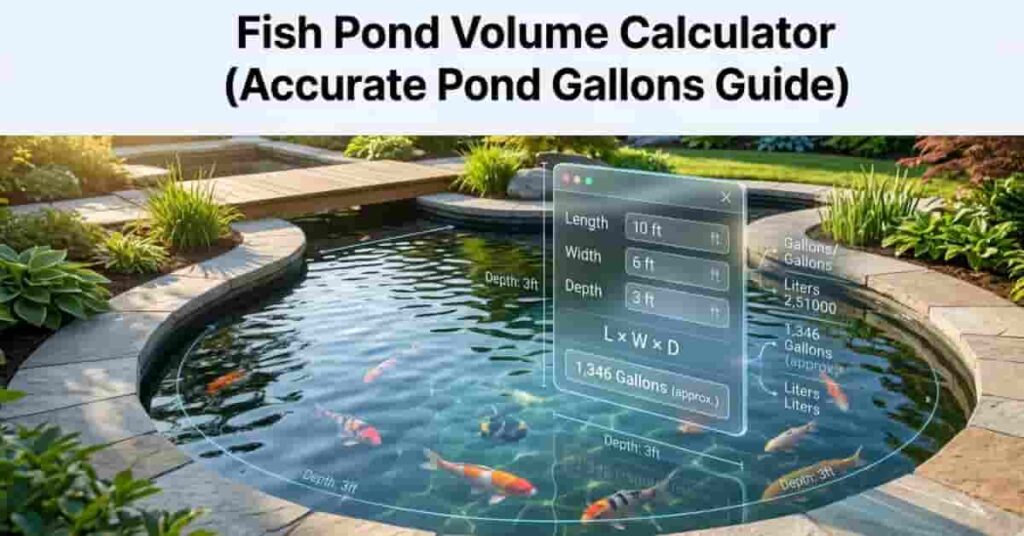
For example, a pond measuring 10 feet long, 6 feet wide, and 3 feet deep would calculate like this:
10 × 6 × 3 × 7.48 = 1,346 gallons
Many pond owners use this formula before checking results with a pond gallon calculator. It provides a quick and reliable estimate for most rectangular backyard ponds.
Circular Pond Volume Formula
Circular ponds require a different formula because water spreads evenly from the center. This formula uses the pond radius instead of width.
Use this formula:
In this formula:
- r = radius
- D = average depth
- π = pi, approximately 3.14
Many beginners confuse radius with diameter. The radius is only half the pond’s total width. If your pond measures 8 feet across, the radius is 4 feet.
For example:
- Radius = 4 feet
- Average depth = 3 feet
The pond volume estimate becomes about 1,128 gallons.
Circular formulas work well for raised ponds, decorative garden ponds, and small goldfish ponds.
Oval Pond Volume Formula
Oval pond formulas work best for natural ponds with curved edges. Many backyard koi ponds feature an oval or irregular shape rather than a perfect rectangle.
Use this formula:
In this formula:
- L = average length
- W = average width
- D = average depth
The number 5.9 helps estimate the water spread inside an oval shape. Unlike rectangular ponds, oval ponds do not use the full corner space.
For example, a pond measuring 12 feet long, 8 feet wide, and 3 feet deep would hold about 1,699 gallons.
This formula provides an estimate rather than an exact measurement. Natural ponds often contain shelves, rocks, and uneven curves that affect actual water volume.
Pro Tip
Measure several widths and depths across the pond for better oval pond estimates.
How to Calculate Pond Gallons Step by Step
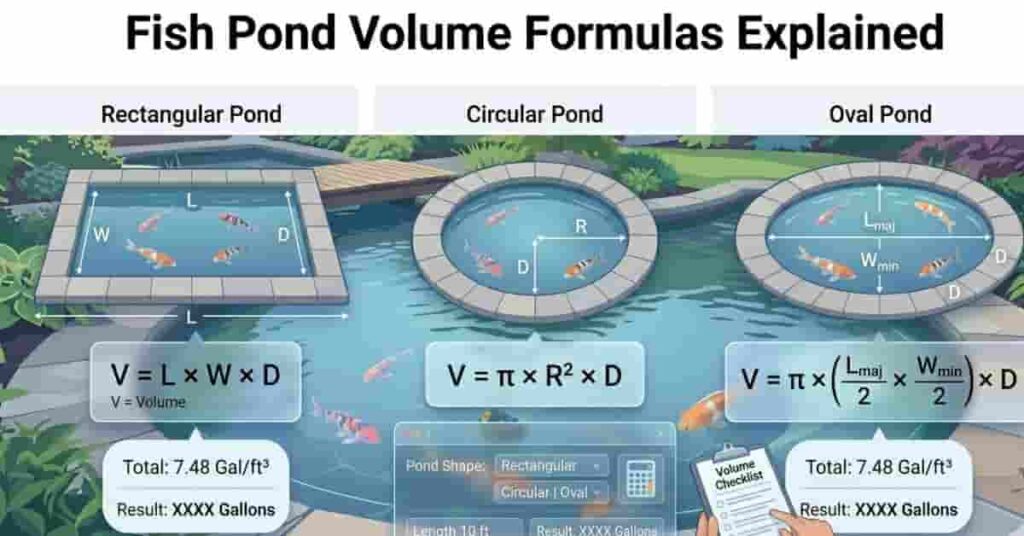
Calculating pond gallons becomes much easier when you follow a simple process. Many beginners try to guess pond size and end up with inaccurate results. A few careful measurements can help you estimate water capacity more accurately.
Most backyard ponds only require basic math and a simple pond volume formula. Once you know your pond gallons, you can plan filtration, pump sizing, and water treatments with confidence.
Step 1 — Measure Pond Dimensions
Start by measuring the length and width of the pond. Use a tape measure for the most accurate measurement. Rectangular ponds usually need one length and one width measurement.
Natural ponds may require several measurements across different areas. Use average dimensions for curved or uneven shapes.
Measure everything using the same unit system. Most USA pond owners use feet and gallons.
Step 2 — Calculate Average Depth
Next, measure the pond’s shallowest and deepest points. Add those numbers together and divide by two.
Average depth creates a more realistic pond gallon estimate than maximum depth alone.
Step 3 — Choose the Correct Pond Shape Formula
Different pond shapes use different formulas. Rectangular, circular, and oval ponds all calculate water volume differently.
Use the formula that best matches your pond shape. For natural ponds, the oval formula usually provides the closest estimate.
Step 4 — Convert Cubic Feet Into Gallons
Most pond formulas first calculate cubic feet. Multiply the result by 7.48 to convert cubic feet into gallons.
This conversion works for most freshwater backyard ponds in the USA.
Step 5 — Verify Results Using a Calculator
Finally, double-check your measurements using a fish pond volume calculator. Online calculators help confirm your math and reduce mistakes.
If your result looks unusually high or low, recheck pond depth and width measurements first. These areas often cause calculation errors.
💧 Try our Fish Pond Volume Calculator for instant and accurate results.
Gallons vs Liters Conversion
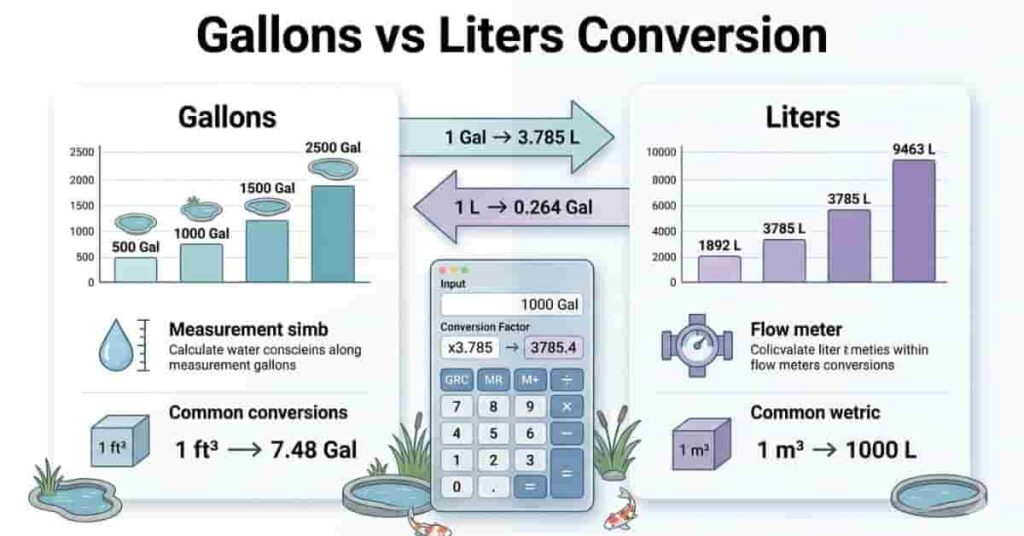
Pond volume measurements are often expressed in gallons or liters. In the USA, most pond pumps, filters, and water treatments use gallons. However, many international pond owners prefer liters and metric measurements.
Understanding both units helps you avoid dosing errors and equipment-sizing problems. A small conversion error can affect water treatments, filtration performance, and fish health.
Most pond calculators automatically convert gallons and liters. Still, learning the basic formulas makes pond planning much easier. This is especially helpful when comparing products from different countries.
Convert Pond Gallons to Liters
Many pond owners in the USA first calculate water capacity in gallons. However, some pond equipment and water treatments display measurements in liters instead.
To convert pond gallons into liters, use this formula:
For example, a 500-gallon pond contains about 1,892 liters of water.
This conversion is useful when using imported pond products or metric testing kits. It also helps compare equipment specifications from international brands.
Most online pond water volume calculators can switch between gallons and liters automatically. Still, understanding the formula gives you more confidence when checking results manually.
Convert Liters to Gallons
Some pond owners measure ponds in meters and liters from the beginning. However, many USA pond products still use gallons for pump flow rates and treatment instructions.
To convert liters into gallons, use this formula:
For example, a pond holding 2,000 liters contains about 528 gallons.
This conversion is helpful when reading USA-based pond care guides or selecting pumps with gallon-per-minute flow ratings.
Metric users should stay consistent during measurements. Mixing feet, meters, gallons, and liters can create confusing results and inaccurate pond calculations.
Common Pond Volume Calculation Mistakes
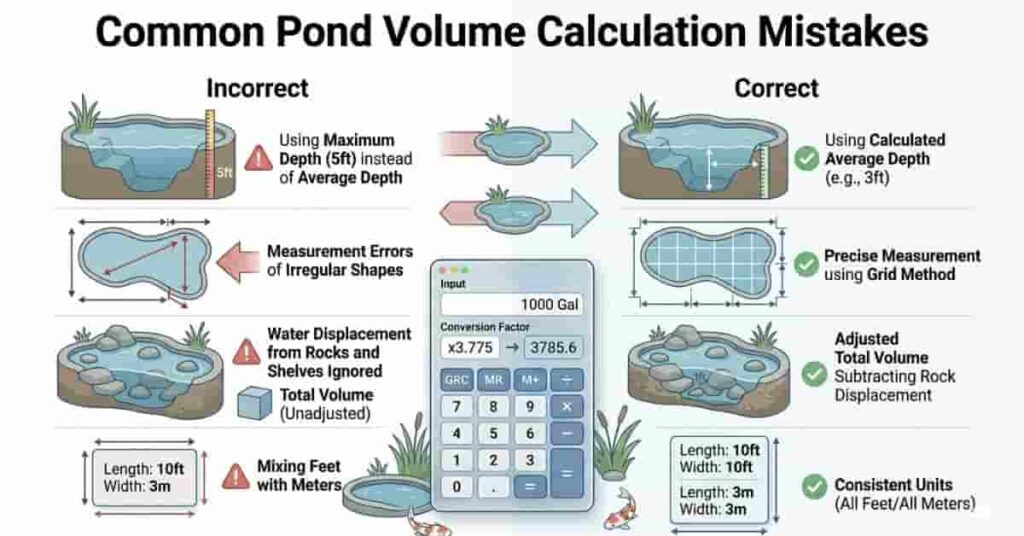
Many pond owners calculate water volume incorrectly without realizing it. Even small mistakes can affect filtration, pump sizing, and water treatment dosing. Incorrect pond gallon estimates may also create unhealthy water conditions for koi and goldfish.
Most calculation problems happen because beginners rush measurements or use the wrong pond volume formula. Fortunately, these mistakes are easy to avoid once you understand the basics.
Learning common errors can help you create more accurate pond gallon calculations and improve overall pond maintenance.
Using Maximum Depth Only
One of the most common beginner mistakes is using the deepest part of the pond as the overall depth. This usually overestimates total pond gallons.
Most ponds contain shallow shelves, sloped edges, or uneven bottoms. Because of this, average depth provides a much more realistic estimate of water volume.
To calculate average depth, measure both the shallowest and deepest areas. Then divide the total by two.
For example, if the shallowest area is 2 feet deep and the deepest is 4 feet, the average depth is 3 feet.
Using average depth improves pump sizing, filtration planning, and medication dosing accuracy.
Ignoring Irregular Pond Shape
Many backyard ponds have curved edges and natural shapes. Beginners often measure them as perfect rectangles, which leads to inaccurate gallon estimates.
Natural ponds usually require average measurements and approximation formulas. Oval pond formulas often work best for irregularly shaped ponds.
Instead of measuring one width and one length only, measure several sections across the pond. Then calculate the average dimensions.
Exact precision is difficult with natural ponds. However, close estimates usually provide enough accuracy for filtration and water treatment planning.
Forgetting Water Displacement
Rocks, gravel, waterfalls, and planting shelves reduce actual water capacity. Many pond owners forget to account for these features during calculations.
For example, a pond may technically hold 1,500 gallons based solely on its dimensions. After adding rocks and shelves, the true water volume may be much lower.
This mistake can affect medication dosing and water treatment safety. Overdosing pond treatments may stress fish and beneficial bacteria.
Most pond owners use estimated reductions for heavy rock features. Exact displacement measurements are difficult, but rough adjustments improve accuracy.
Mixing Feet and Meters
Using mixed measurement units creates confusing and inaccurate pond calculations. Many beginners measure pond length in feet but depth in meters by mistake.
This problem often happens when using online pond gallon calculators or imported pond equipment. Small unit errors can lead to large gallon discrepancies.
Choose one system before starting measurements. USA pond owners usually use feet and gallons. Metric users often use meters and liters.
Stay consistent throughout the entire pond volume formula. Consistent measurements improve accuracy and make calculations easier to verify later.
Example Pond Volume Calculations
Real examples make pond volume formulas much easier to understand. Many beginners feel confused when looking at formulas alone. Simple calculations help show how pond dimensions turn into actual gallon estimates.
These examples use common backyard pond shapes and average depth measurements. The results may vary slightly depending on the rocks, shelves, and pond design. However, they provide a reliable starting point for planning filtration, pumps, and water treatment.
500 Gallon Small Backyard Pond
Small backyard ponds are common for beginner pond owners. These ponds usually hold goldfish, small water plants, or decorative fountains.
Imagine a rectangular pond measuring:
- Length = 6 feet
- Width = 4 feet
- Average depth = 2.8 feet
Use the rectangular pond formula:
The result equals about 503 gallons.
This pond size works well for small patio ponds and basic water garden setups. A small filtration system and moderate water flow usually provide enough circulation.
1000 Gallon Koi Pond
Medium-sized koi ponds need more accurate volume calculations because koi produce large amounts of waste. Proper filtration and circulation become more important as pond size increases.
Imagine a rectangular koi pond measuring:
- Length = 10 feet
- Width = 6 feet
- Average depth = 2.3 feet
Use the formula:
Rectangular Pond Volume Formula
Use this formula to estimate pond gallons for rectangular ponds:
10 × 6 × 2.3 × 7.48
Rectangular Pond Volume Formula
Use this formula to estimate pond gallons for rectangular ponds:
Where: Length × Width × Average Depth × 7.48 (conversion factor to gallons)
The result equals about 1,032 gallons.
This pond size can support a small koi setup with proper filtration and maintenance. Many USA pond owners use ponds in this size range for beginner koi keeping.
Large Natural Pond Example
Natural ponds often contain curved edges, shelves, and uneven depths. Because of this, exact gallon calculations are difficult. Most pond owners use average measurements and oval pond formulas for estimation.
Imagine a natural pond measuring:
- Average length = 18 feet
- Average width = 12 feet
- Average depth = 3.5 feet
Use the oval pond formula:
Oval Pond Volume Formula
Use this formula to calculate pond gallons for oval or natural ponds:
Where: Length × Width × Average Depth × 5.9 (conversion factor for oval ponds)
The result equals about 4,460 gallons.
Large ponds usually contain rocks, waterfalls, and planting shelves. These features slightly reduce the actual water capacity. Most pond owners use the formula result as a close estimate rather than an exact number.
How Accurate Pond Volume Helps Your Pond
Accurate pond volume does much more than provide a gallon number. It helps nearly every part of pond care work properly. When pond owners guess water capacity, they often choose the wrong equipment or use incorrect treatment amounts.
One of the biggest benefits is better pump sizing. Pond pumps work best when matched to the actual water volume. A pump that is too small may not circulate water effectively. An oversized pump can waste energy and create excessive water movement.
Filtration systems also depend on accurate pond gallon calculations. Filters are designed for specific water capacities. If the filter is undersized, waste and algae may build up quickly. Correct filtration improves water clarity and helps maintain healthier conditions for koi and goldfish.
Water treatment dosing becomes much safer with accurate pond volume measurements. Most medications, dechlorinators, and algae treatments use gallon-based instructions. Too much treatment may stress fish and beneficial bacteria.
Accurate pond volume also makes routine maintenance easier. Water changes, pump upgrades, and seasonal cleaning become more predictable when you know your pond capacity.
Stable water quality is another major benefit. Proper circulation and filtration help maintain balanced oxygen levels and cleaner water conditions throughout the pond.
Accurate gallon estimates are also important before estimating safe fish capacity. You can later use this information when planning koi or goldfish stocking levels.
Conclusion
Accurate pond volume calculations help you build a healthier and easier-to-maintain pond. In this guide, you learned how to measure pond dimensions, use the correct formulas, and avoid common calculation mistakes. You also discovered how pond gallons affect pumps, filtration, and water treatment safety.
A fish pond volume calculator speeds up and improves the reliability of the process for beginners. Whether you own a koi pond, goldfish pond, or natural backyard pond, accurate gallon estimates improve long-term pond care.
Remember to recheck pond volume after adding rocks, shelves, waterfalls, or other pond features. Small changes can affect actual water capacity over time.
💧 Try our pond gallon calculator anytime you need quick and accurate pond measurements.
If this guide helped you, share it with other pond owners or explore more pond care resources on our website.
Michael Brooks and Sarah Lane are the co-founders of the Pond Pump Team, a trusted U.S.-based group helping homeowners and landscapers build better ponds and water features. Michael, an experienced pond engineer from Oregon, has worked for over 12 years on pump sizing, flow systems, and water circulation. Sarah, a pond designer from Colorado with nine years of experience, focuses on eco-friendly and easy-to-maintain pond and waterfall designs. Together, they’ve completed more than 180 pond projects and created tools like the Pond Pump Calculator and Pond Liner Calculator to make pond planning simple, accurate, and sustainable.
Need help with your pond setup? Contact the Pond Pump Team for expert advice and reliable solutions.