Introduction
Ever filled a pond and realized you had no idea how much water it actually holds? That mistake is more common than you think.
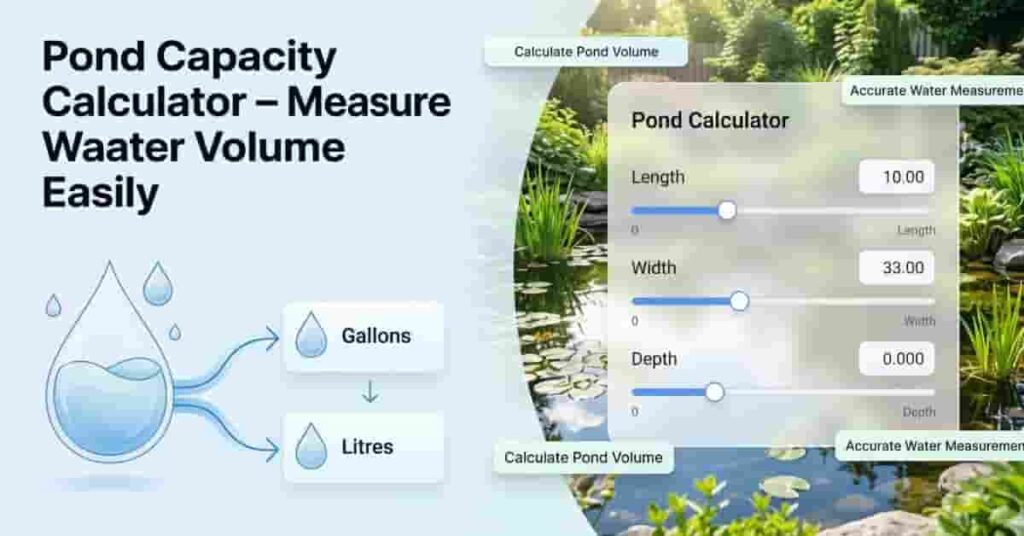
A pond capacity calculator helps you measure your pond’s water volume with accuracy. Many beginners in the USA struggle with sizing ponds for fish, irrigation, and maintenance planning. Without proper capacity, filtration, and aeration systems, performance often fails.
Understanding pond capacity is essential for healthy water balance and proper fish stocking. In this guide, you will learn simple methods to calculate pond size, avoid common mistakes, and choose the right setup for your needs. By the end, you will confidently estimate water storage and plan your pond system better. Use our guide to easily calculate your pond’s full water capacity. This is especially useful for koi ponds and backyard water features.
For better planning, check the pond water volume guide to understand actual usage.
How to Measure Your Pond for Capacity
To use a pond capacity calculator correctly, you must start with accurate measurements. Small errors can lead to wrong water volume results. This affects filtration, aeration, and fish health. Beginners often guess sizes, but that leads to poor pond planning. A simple measuring method gives much better results.
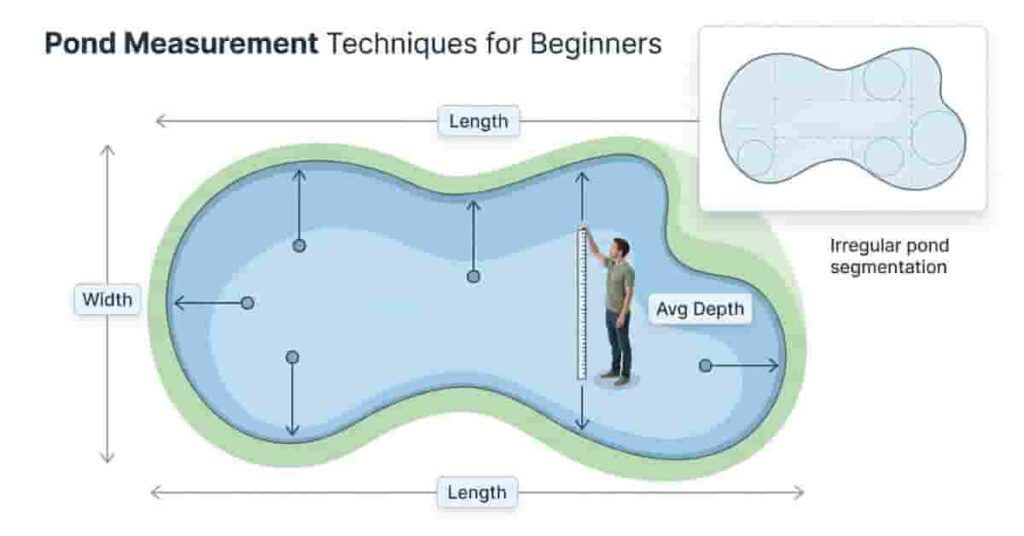
Start by measuring the length, width, and depth of your pond. Use a measuring tape for straight edges and a stick or pole for depth. For depth, measure at multiple points, then calculate an average. This gives a more realistic result for your pond water capacity calculator.
For irregular ponds, break the shape into smaller sections. Treat each section like a rectangle or circle. Measure each part separately, then add the results together. This method improves accuracy for curved or natural pond designs.
📊 Diagram Idea
Place a labeled top-view diagram showing:
- Length and width arrows
- Multiple depth points marked.
- Section breakdown for irregular shapes
Alt text: “Pond measurement diagram showing length, width, depth points, and section-based calculation for irregular ponds.”
🧠 Pro Tips for Accurate Measurement
- Measure depth at 3–5 different points for better accuracy.
- Always measure water depth, not just pond wall height.
- Round measurements to the nearest inch or centimeter
- Recheck measurements after adding rocks or decorations.
- Use a consistent unit system (feet or meters only)
Using these steps ensures your pond capacity calculator gives reliable results. Accurate measurements help you design better filtration and avoid overstocking fish. Even small backyard ponds benefit from correct water volume planning.
Calculating Pond Capacity
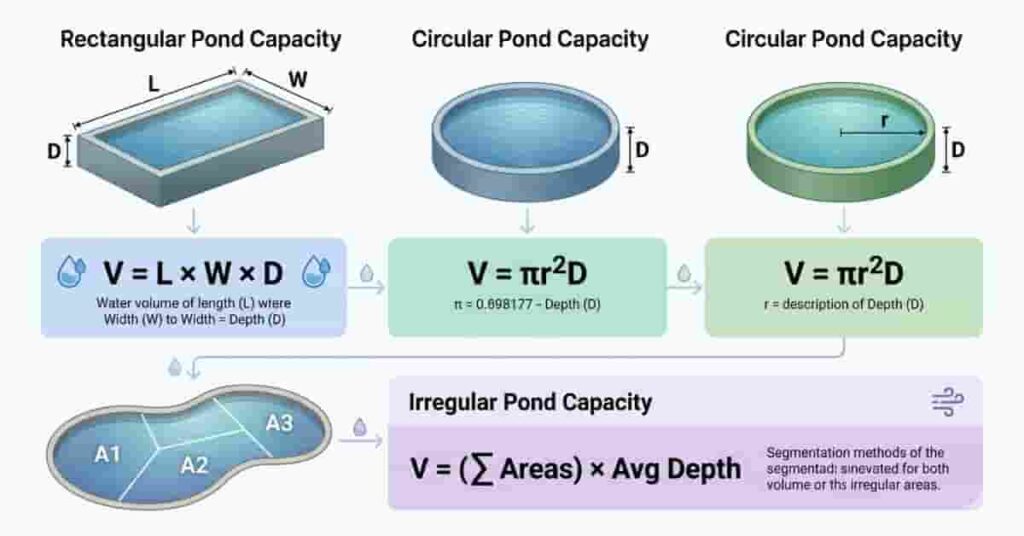
To calculate pond capacity accurately, you must use the correct formula for your pond shape. A pond capacity calculator helps convert basic measurements into water volume. This is important for filtration, aeration, and fish stocking. Even small errors can significantly reduce your pond’s total water storage capacity.
For a rectangular or square pond, use this formula:
Length × Width × Average Depth × 7.48 = US gallons.
This works best for simple garden ponds with straight edges. Make sure you use the average depth, not the maximum depth. This yields a more realistic result when calculating pond capacity.
For a circular or round pond, use:
π × (radius²) × Depth × 7.48 = US gallons.
Measure the radius from the center to the edge. Keep depth consistent by averaging multiple points.
For irregular or sloped ponds, divide the pond into smaller shapes. Treat each section like a rectangle or circle. Then calculate each part separately. Finally, add all results together. This method improves accuracy for natural or custom-designed ponds.
📊 Diagram Idea
Include a visual showing:
- Rectangular pond with L × W × D labels
- Circular pond with radius marking
- Irregular pond divided into sections.
Alt text: “Diagram showing pond capacity calculation methods for rectangular, circular, and irregular ponds with measurement labels.”
🧠 Example Calculations
- Rectangular pond: 10 ft × 5 ft × 3 ft = 1,122.5 gallons
- Circular pond: radius 4 ft, depth 3 ft = 1,130+ gallons (approx.)
- Irregular pond: split into 2 sections, then the total is added
🟢 Pro Tips
Measure depth at multiple points for accuracy. Always use the same unit system. Recheck measurements after adding rocks or plants.
Using these formulas ensures your pond water capacity calculator gives reliable results. This helps you design better systems and avoid overstocking fish or underpowering filtration.
Converting Pond Volume to Gallons or Litres
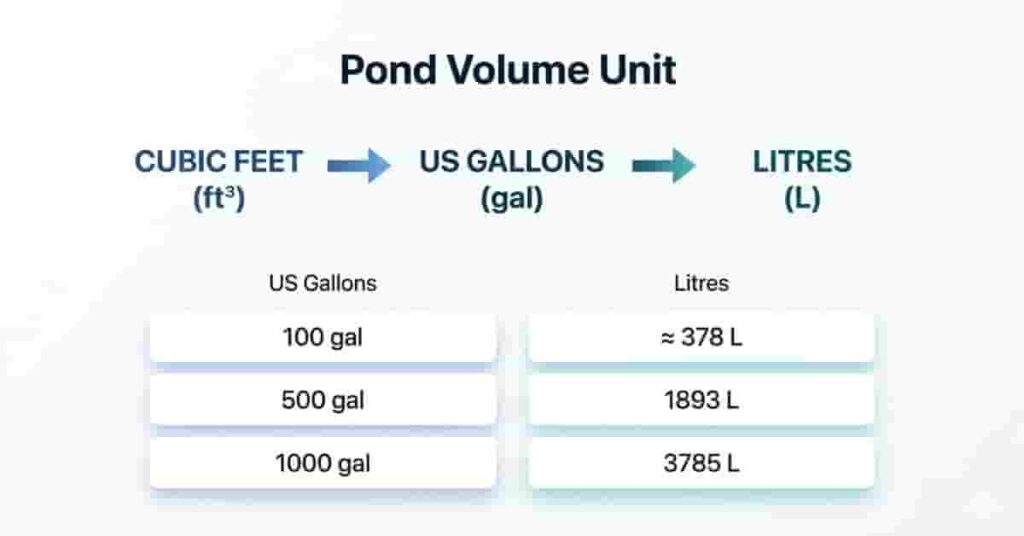
When you use a pond water capacity calculator, the final result usually comes in cubic feet or cubic meters. But most pond owners need practical units, such as US gallons or litres. Understanding this conversion helps you plan filtration systems, fish stocking, and water treatments more accurately.
The key difference is simple. US gallons are commonly used in American pond systems, while litres are widely used in metric countries. One US gallon equals about 3.785 litres. This means even small calculation errors can quickly scale into large differences in real water volume.
To convert pond volume, you first calculate the total cubic volume. Then you apply the correct conversion factor. This step ensures your pond water capacity calculator results match real-world water storage needs. Always double-check the unit before final planning.
You can also calculate quickly with a pond volume & gallons calculator guide.
Here are a few quick examples to make it easier:
- 100 US gallons ≈ 378 litres
- 500 US gallons ≈ 1,893 litres
- 1,000 US gallons ≈ 3,785 litres
- 5,000 litres ≈ 1,321 US gallons
📊 Common Pond Size Conversion Table
| 100 gallons | 378 litres |
| 500 gallons | 1,893 litres |
| 1,000 gallons | 3,785 litres |
| 2,500 gallons | 9,463 litres |
| 5,000 gallons | 18,927 litres |
This table helps beginners quickly understand real pond capacity without manual conversion. It is especially useful when comparing pump flow rates or filtration systems.
🧠 Pro Tips for Better Accuracy
Always confirm whether your system uses US or Imperial gallons. They are not the same. Use litres for more precise scientific planning. Recheck conversions when scaling pond size or upgrading equipment.
Understanding these conversions ensures your pond design stays balanced. It also helps you avoid underpowered filtration and long-term oxygen issues.
Common Mistakes in Estimating Pond Capacity
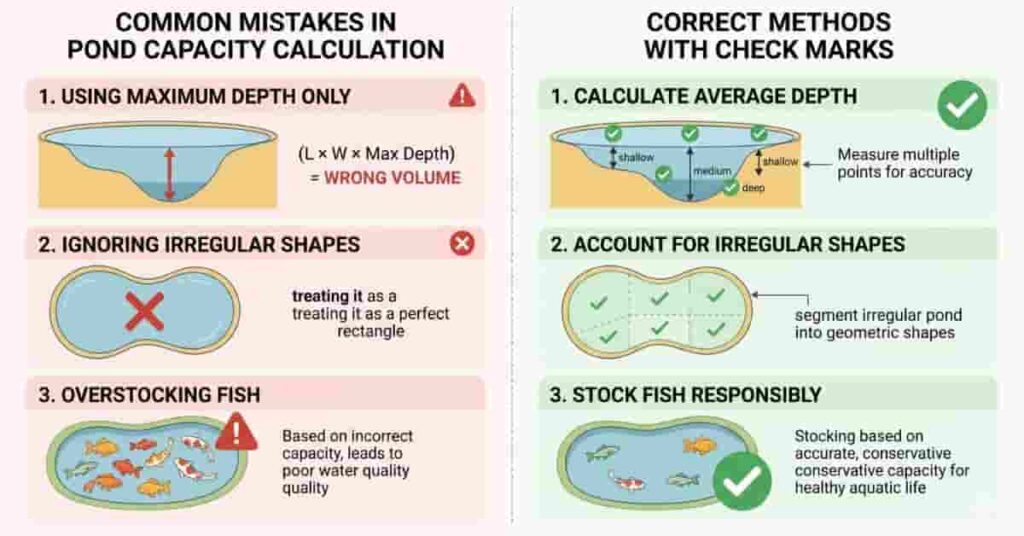
Many pond owners struggle to achieve accurate results when calculating pond capacity. Small measurement errors can lead to big problems later. These mistakes often affect filtration performance, fish health, and overall water balance. A proper pond water capacity calculator only works well when the inputs are correct and realistic.
One common mistake is using only the maximum depth instead of the average depth. This usually gives a higher water volume than the pond actually holds. It leads to weak filtration planning and oxygen imbalance in the water.
Another mistake is ignoring irregularities in the pond’s shape. Many ponds are not perfect rectangles or circles. Curves, slopes, and uneven edges alter the pond’s total water storage capacity. Always break irregular ponds into smaller sections for better accuracy.
Some users also forget to recalculate after making pond changes. Adding rocks, plants, or waterfalls reduces actual water volume. If you do not update your calculations, your pond capacity estimate becomes outdated.
Overestimating pond capacity for fish stocking is another serious issue. Too many fish in a small pond increases waste and reduces oxygen levels. This can harm fish health quickly.
🧠 Pro Tips to Avoid Errors
- Always use average depth, not maximum depth.
- Recheck measurements after any pond modification.
- Divide irregular ponds into simple sections.
- Use a reliable pond capacity calculator for validation.
- Keep fish stocking levels slightly below maximum capacity.
conclusion
In this guide, we covered how to measure pond size and accurately calculate the pond’s water volume. You also learned how formulas and unit conversions affect real results. These steps help you plan filtration, aeration, and fish stocking with confidence.
A pond capacity calculator speeds up and improves the accuracy of this process. It removes guesswork and helps you understand your true water storage needs. Beginners in the USA can avoid costly mistakes by using correct measurements and simple tools.
Always remember to recheck the pond size after any changes. Small updates can affect your pond’s overall water capacity more than you might expect.
Use the tips and methods shared here to improve your pond planning. Share your experience in the comments and explore more guides on pond design and maintenance. You can also try our pond capacity tools to get instant and reliable results.
Michael Brooks and Sarah Lane are the co-founders of the Pond Pump Team, a trusted U.S.-based group helping homeowners and landscapers build better ponds and water features. Michael, an experienced pond engineer from Oregon, has worked for over 12 years on pump sizing, flow systems, and water circulation. Sarah, a pond designer from Colorado with nine years of experience, focuses on eco-friendly and easy-to-maintain pond and waterfall designs. Together, they’ve completed more than 180 pond projects and created tools like the Pond Pump Calculator and Pond Liner Calculator to make pond planning simple, accurate, and sustainable.
Need help with your pond setup? Contact the Pond Pump Team for expert advice and reliable solutions.