Introduction
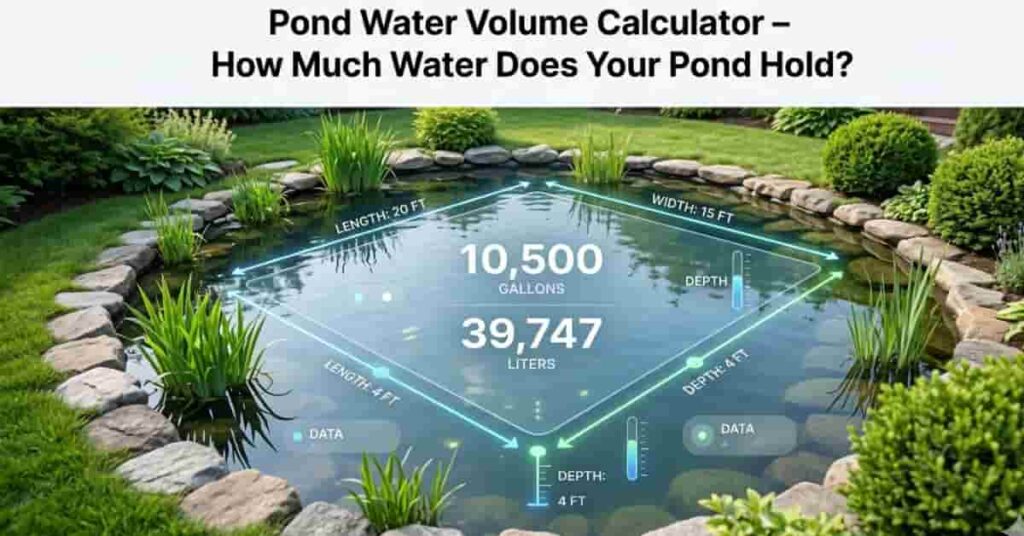
Ever wondered if your pond holds more water than you think? Most pond owners guess—and get it wrong.
Knowing your pond’s water capacity is more important than it looks. It directly affects filtration, fish health, and overall water balance. Many beginners in the USA struggle because they don’t realize how small miscalculations can lead to big problems later.
This is where a pond water volume calculator becomes essential. It helps you understand exactly how much water your pond holds, so you can make smarter maintenance decisions. Without it, you may overuse treatments or choose the wrong pump size.
In this guide, you’ll learn simple ways to measure and calculate your pond’s volume step by step. We’ll also explain how to avoid common mistakes and get accurate results every time.
By the end, you’ll confidently know how to use a how much water in my pond calculator method to keep your pond healthy, balanced, and easy to maintain.
Why Knowing Your Pond Water Volume is Important
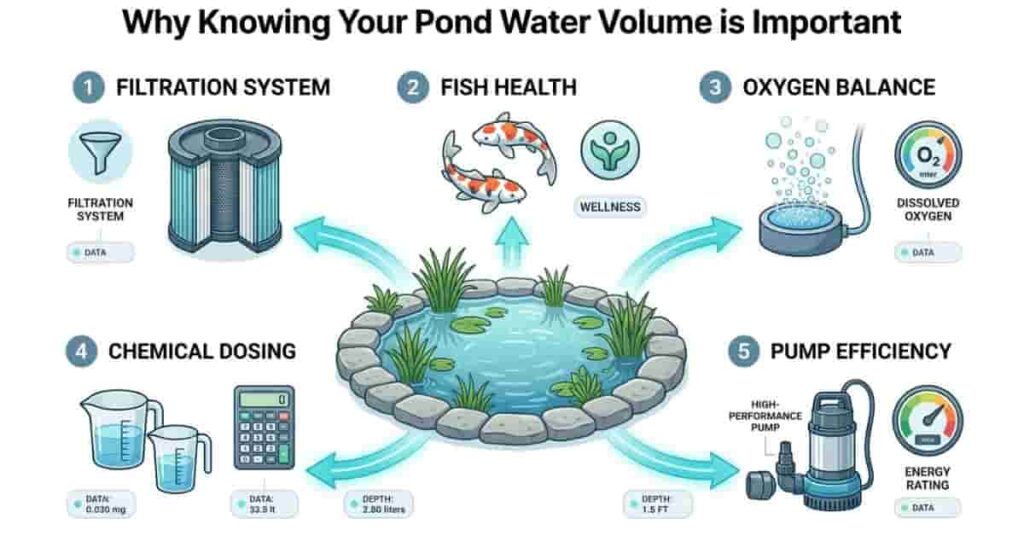
Knowing your pond’s exact water volume is not just helpful. It directly affects how healthy and stable your pond stays over time. Many beginners skip this step and end up with poor water quality, stressed fish, or weak filtration results. When you understand the true volume, every maintenance decision becomes more accurate and effective.
Correct filtration performance depends on matching your filter to the real pond size. If you guess the volume, your filter may underperform or overwork, leading to dirty water and algae growth. Proper calculation also helps prevent overstocking fish, which is one of the most common mistakes pond owners make. Too many fish in a limited amount of water quickly depletes oxygen levels and increases waste buildup.
Accurate pond volume also helps you avoid chemical overdosing. Treatments such as algaecides or water conditioners must be measured accurately. Even small mistakes can harm fish and plants. When the volume is known, dosing becomes safe and precise.
It also supports a healthy ecosystem balance by keeping oxygen, waste, and nutrients in control. Your pump and aeration system work more efficiently when they are sized correctly for the real water volume. Over time, this improves energy use, reduces maintenance issues, and extends equipment life.
In short, knowing your pond’s water volume improves every aspect of pond care and keeps your system stable in the long term.
For fish ponds, using a koi pond volume calculator guide can make calculations easier.
How to Measure Your Pond Correctly (Step-by-Step Guide)
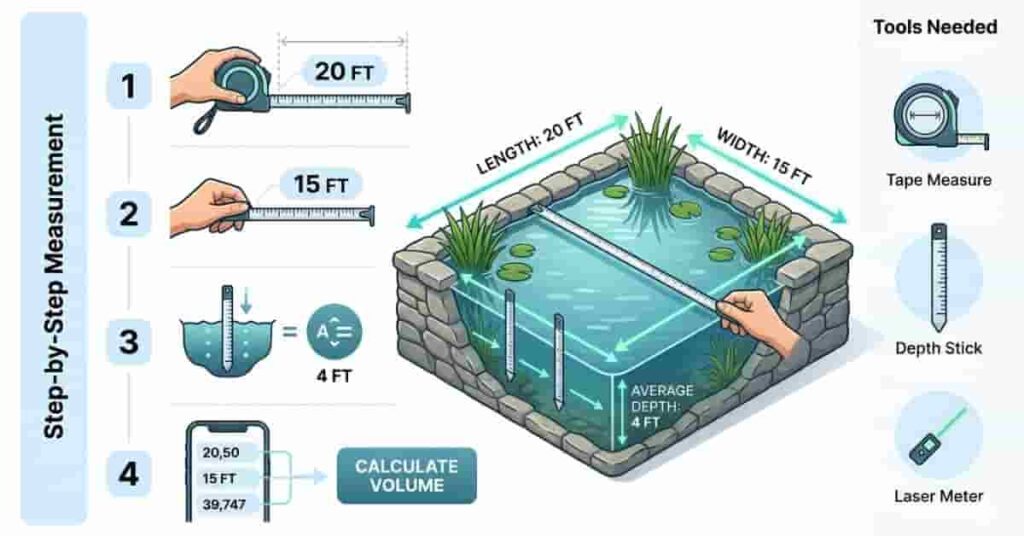
Accurate pond measurement is the first step toward using a pond water volume calculator correctly. If your measurements are wrong, every result will be off as well. That’s why you should take your time and follow a simple step-by-step process for better accuracy.
Start by measuring the length, width, and depth of your pond. Use a tape measure for straight edges and note the deepest point carefully. For depth, don’t rely on just one reading. Measure at multiple spots to calculate a realistic average depth. This is especially important for ponds with uneven bottoms or slopes.
Next, calculate the average depth, which beginners often miss. Simply add multiple depth readings and divide them by the number of points measured. This gives a more accurate result for your final volume calculation.
For tools, you can use a basic tape measure, a measuring stick, or a laser meter for higher precision. A simple stick is often enough for small backyard ponds.
If your pond has special shapes, adjust your approach. Sloped ponds need multiple depth points. Irregular ponds should be divided into smaller sections. Deep and shallow zones should always be measured separately to avoid errors.
You can also convert measurements with the pond volume in gallons and litres guide.
Pond Water Volume Formulas (Simple + Accurate Methods)
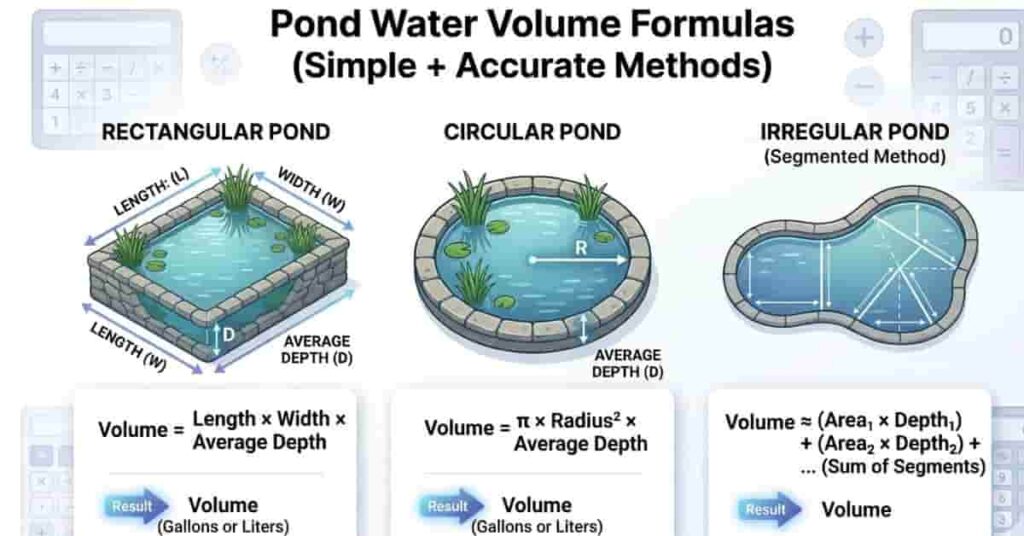
Understanding the correct formulas is the key to using any calculation method for calculating water volume in a pond method accurately. Once you apply the right equation for your pond shape, you can estimate water volume with confidence and avoid costly mistakes in filtration or treatment dosing.
🟡 Rectangular / Square Ponds
For rectangular or square ponds, the calculation is straightforward. You multiply length, width, and average depth to get the volume in cubic feet. Then convert it into gallons for practical use.
V=L×W×DV = L \times W \times DV=L×W×D
To convert cubic feet into gallons:
Vgallons=L×W×D×7.48V_{gallons} = L \times W \times D \times 7.48Vgallons=L×W×D×7.48
For example, a pond measuring 10ft × 8ft × 3ft equals 240 cubic feet. When converted, it gives around 1,795 gallons. This simple method is widely used in backyard ponds because it is fast and reliable when measurements are accurate.
🟡 Circular Ponds
Circular ponds require a different approach due to their circular shape. You use the radius and average depth to find total volume.
V=πr2DV = \pi r^2 DV=πr2D
Then convert it into gallons:
Vgallons=πr2D×7.48V_{gallons} = \pi r^2 D \times 7.48Vgallons=πr2D×7.48
This method ensures accuracy for round ponds where simple length and width measurements do not apply. Even small errors in radius can change the final result, so measure carefully.
🟡 Irregular Ponds
Irregular ponds are the most common and also the trickiest. Instead of one formula, you break the pond into smaller shapes like rectangles or circles.
- Divide the pond into sections.
- Calculate each section separately.
- Add all results together.
This method gives a realistic estimate when calculating water volume in a pond with irregular shapes, curves, or natural edges.
👉 Pro Tip
Add a diagram showing a pond split into sections for irregular shapes.
Pond Volume Conversion (Gallons & Litres Guide)
Once you calculate your pond’s size in cubic feet, the next step is converting it into gallons or litres. This is important because most pond filters, pumps, and treatments use these units. That’s why every water in my pond calculator result should include proper conversion for real-world use.
Start with simple conversions. One cubic foot of water equals about 7.48 US gallons. If you also want litres, one gallon equals 3.785 litres. These basic formulas help you quickly switch between measurement systems without confusion.
👉 Quick conversion formulas:
- Cubic feet → gallons: multiply by 7.48
- Gallons → litres: multiply by 3.785
- Cubic feet → litres: multiply by 28.32
These conversions make pond management much easier, especially when matching equipment or adding treatments.
🟡 Quick Reference Table
Here is a simple guide to estimate pond sizes:
- Small Pond: 200–800 gallons (757–3,028 litres)
- Medium Pond: 800–3,000 gallons (3,028–11,356 litres)
- Large Pond: 3,000+ gallons (11,356+ litres)
👉 Pro Tip
Add a comparison chart showing the water capacities of small, medium, and large ponds in gallons and litres.
Common Mistakes When Calculating Pond Water Volume
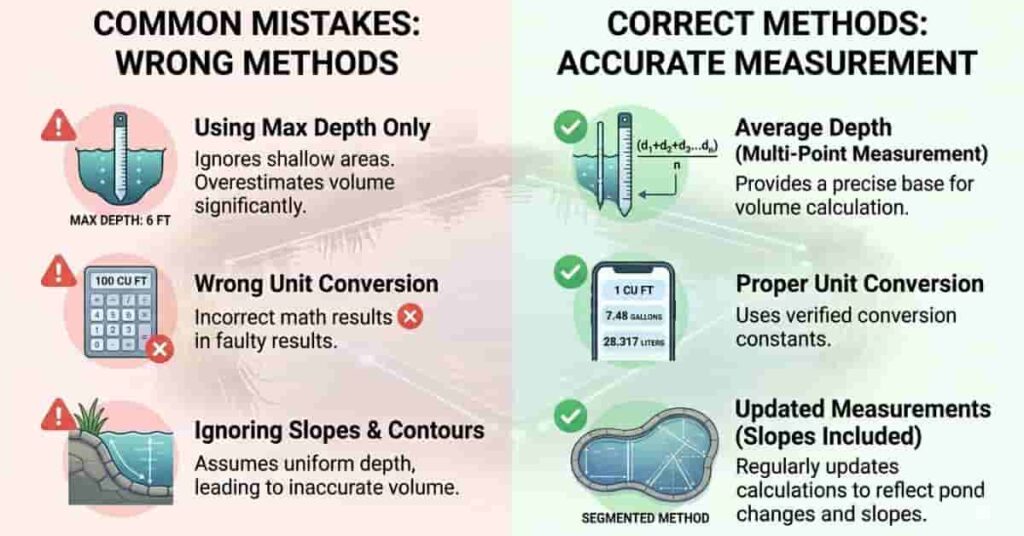
Many pond owners get incorrect results because they skip small but important details. These mistakes can lead to wrong pond sizing, poor filtration, and imbalanced water treatment. If you want accurate results from any pond water volume calculator, avoid these common errors.
One of the biggest mistakes is using only the maximum depth instead of the average depth. Ponds are rarely flat, which leads to an overestimated water volume. Always measure multiple points to get a realistic average.
Another common issue is ignoring slopes and irregular shapes. Many backyard ponds have curved edges or uneven bottoms. If you treat them like simple rectangles, your final calculation will be inaccurate.
Incorrect unit conversion is also a frequent problem. Mixing feet, meters, gallons, and litres without proper conversion results in significant errors in pump sizing and chemical dosing.
Rounding too early can also affect accuracy. Small rounding differences may not seem important, but they add up in larger ponds.
Lastly, many people forget to update their calculations after pond modifications. Adding rocks, changing depth, or expanding the pond changes the total water volume.
👉 Pro Tip (Image Idea):
Add an “common mistakes checklist” infographic showing the correct vs. incorrect pond measurement methods.
Expert Tips for Accurate Pond Measurement
Getting an accurate pond measurement makes everything easier, from filtration to fish care. Small errors can change your entire water balance, so it’s worth doing it right from the start. These expert tips will help you get reliable results every time you use a pond water volume calculator.
Start by measuring multiple depth points rather than relying on a single spot. Ponds are rarely even, and depth can change across different areas. Taking several readings gives you a realistic average and prevents overestimation or underestimation.
Always use the average depth formula when calculating volume. This simple step improves accuracy, especially for ponds with slopes or uneven bottoms. It ensures your final result reflects real water conditions, not just the deepest point.
Recalculate your pond volume after seasonal changes. Heavy rain, evaporation, or maintenance work can change water levels. Updating your numbers helps you maintain accurate filtration and dosing throughout the year.
Keep a record of pond measurements for future reference. This makes it easier to track changes and adjust your system when needed. It also saves time during maintenance or upgrades.
Finally, always match your pump and filter with the real water volume. Undersized or oversized equipment can cause poor circulation and unhealthy water conditions.
conclusion
In this guide, we explained how to measure and calculate your pond’s water volume step by step. You also learned the right formulas, conversion methods, and common mistakes to avoid. This helps you manage your pond with more confidence and accuracy.
Using a pond water volume calculator makes pond care much easier and more reliable. It ensures correct filtration, proper chemical dosing, and a healthy balance for fish and plants. When you know the exact volume of water in a pond, every maintenance decision becomes more effective.
Now it’s your turn to apply what you learned. Try measuring your pond and see the real difference it makes.
👉 Share your experience in the comments or explore more guides on our site to improve your pond setup even further.
Michael Brooks and Sarah Lane are the co-founders of the Pond Pump Team, a trusted U.S.-based group helping homeowners and landscapers build better ponds and water features. Michael, an experienced pond engineer from Oregon, has worked for over 12 years on pump sizing, flow systems, and water circulation. Sarah, a pond designer from Colorado with nine years of experience, focuses on eco-friendly and easy-to-maintain pond and waterfall designs. Together, they’ve completed more than 180 pond projects and created tools like the Pond Pump Calculator and Pond Liner Calculator to make pond planning simple, accurate, and sustainable.
Need help with your pond setup? Contact the Pond Pump Team for expert advice and reliable solutions.