Introduction
Most pond owners estimate their pond volume rather than measure it. This mistake often causes long-term problems. Without the exact water volume, every pond decision becomes inaccurate.
Incorrect pond volume affects several areas. Fish can suffer stress and weak growth if stocking levels are wrong. Filtration fails when sized incorrectly. Chemical treatments become unsafe when dosed incorrectly. Oxygen levels drop when aeration is not matched to the load. These issues slowly harm water quality and fish health.
Accurate pond volume is more than technical. It is the foundation for a healthy koi or fish pond. Whether you build a backyard pond or manage a larger one, knowing the exact gallons or litres keeps your water balanced, safe, and stable.
This guide is for beginners and pond owners seeking practical results. It covers koi and fish ponds, so you can apply it to your setup.
Use this guide and calculator to measure your pond volume in minutes, in gallons, and litres.
Koi & Fish Pond Volume Calculator (Instant Overview Section)
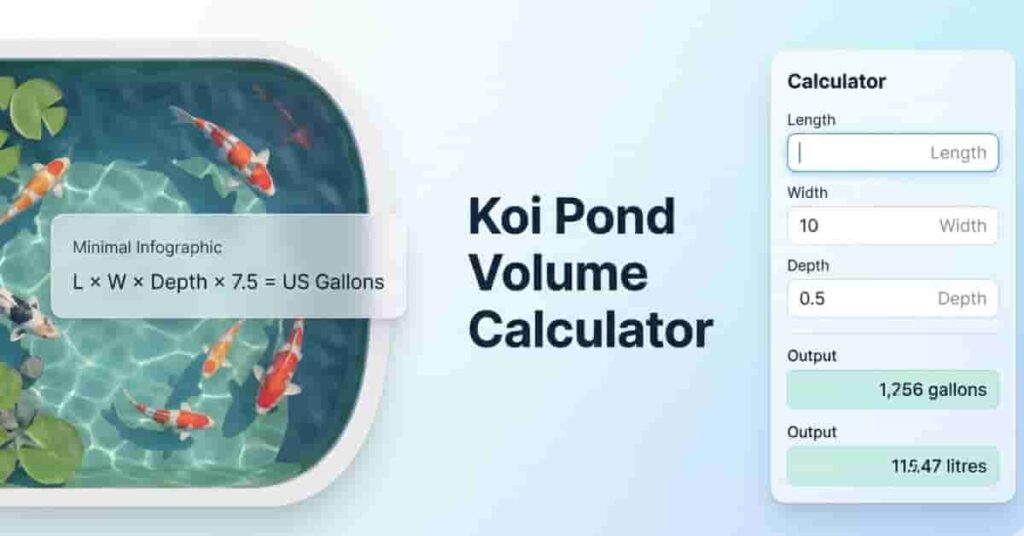
A koi & fish pond volume calculator quickly estimates your pond’s water capacity with basic measurements, helping avoid errors.
The calculator works using simple logic. You enter your pond’s length, width, and average depth, and the system calculates the total water volume. If your pond is not a perfect rectangle, you can also select an optional shape type to improve accuracy. This makes it useful for both simple garden ponds and irregular natural ponds.
Inputs required:
- Length of the pond
- Width of the pond
- Average depth (important for accuracy)
- Shape type (optional for irregular ponds)
Outputs you get:
- Total water volume in litres
- Total water volume in US gallons
This instant conversion makes it simple to understand your pond size in both litres and gallons. Having both helps with global guidelines and picking the right equipment every time.
You can also estimate limits using a pond capacity calculator guide.
This section matters because it gives users an instant solution without complex math. Most people leave websites when they don’t find quick answers. A clear calculator overview keeps them engaged and reduces bounce rate. It also improves SEO performance by encouraging users to stay longer and interact more with the content.
How to Calculate Koi Pond Volume (Step-by-Step Guide)
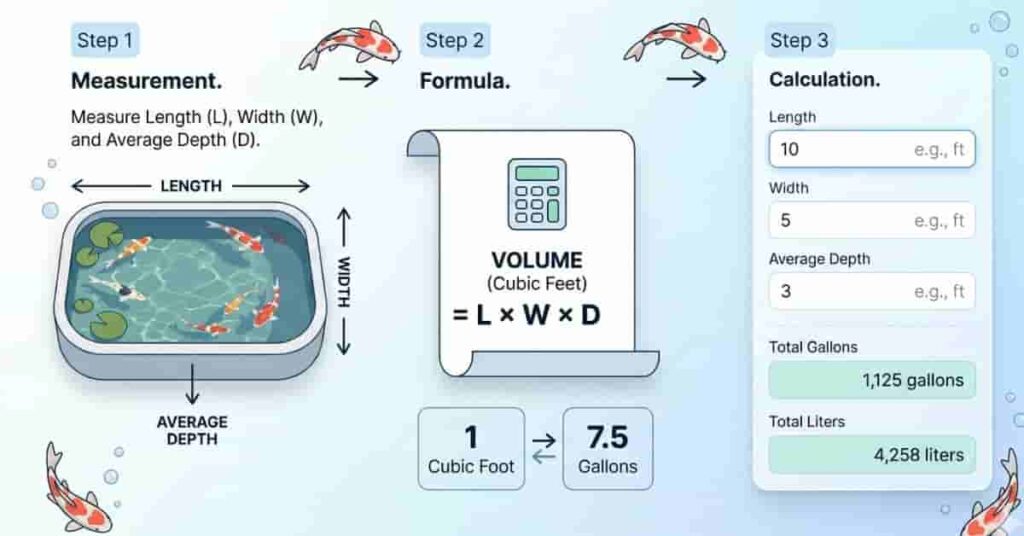
Calculating the volume of a koi pond is simple when you follow the right steps. Most pond owners struggle because they skip proper measurements or ignore depth changes. This guide helps you use a clear method to accurately estimate water volume, improving fish health and system balance. It also naturally supports terms like koi pond volume calculator and koi pond gallon calculator.
The most common method is the rectangular pond formula. You multiply length, width, and average depth, then convert the result into litres or gallons. This gives a reliable estimate for standard koi pond shapes and works well for beginners.
To manage fish health, read the pond water volume guide for better planning.
Step 1: Measure Pond Dimensions
Start by measuring your pond carefully:
- Length: Measure the longest side of the pond
- Width: Measure the widest point across
- Average Depth: Measure at 2–3 points and take the average
Depth is very important because most koi ponds are not perfectly even. Small errors in depth can significantly change the final volume.
Step 2: Use the Basic Formula
First, multiply the length by the width to find the surface area. Next, multiply this surface area by the average depth to determine the total pond volume in cubic feet. Then, multiply the cubic feet by 7.5 to convert this value to US gallons.)
This formula helps users of a koi pond volume calculator quickly understand how manual calculations work behind the tool.
Step 3: Convert to Litres (if needed)
To convert from gallons to litres, multiply by 3.785. This gives a more accurate idea of water treatment and filtration planning.
Step 4: Real-Life Example
If your pond is 10 ft long, 5 ft wide, and 3 ft deep, you can estimate its total water volume in steps. This helps you plan fish stocking and filter size correctly.
Important Depth Note
Koi ponds often have uneven bottoms for the safety of the fish and for design purposes. Always use average depth, not maximum depth. This prevents overestimating pond capacity and keeps your koi healthy.
How to Calculate Fish Pond Volume (Large & Irregular Ponds)
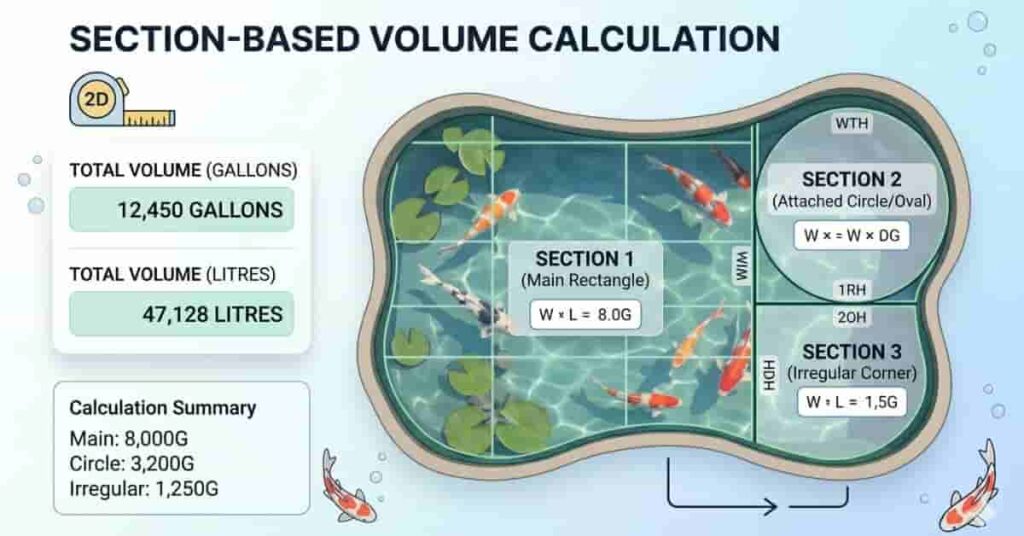
Fish ponds are larger and more irregular than koi ponds, requiring different volume calculation methods. Using simple rectangular formulas can result in inaccurate estimates, affecting fish health and filtration.
The main difference between koi ponds and fish ponds is structure. Koi ponds are often designed with controlled shapes and depths, while fish ponds can be natural, uneven, or free-form. Because of this, fish ponds need a more flexible measurement method to get accurate results.
Section-Based Measurement Method
For irregular fish ponds, visually divide the pond into manageable sections based on changes in width or depth. Measure each section’s length, width, and average depth separately. Calculate the volume of each part using basic formulas, then add them to obtain a complete estimate. This provides a realistic measurement for ponds with curves or uneven edges.
Example: Garden Fish Pond
Imagine a garden fish pond with one wide area and one narrow extension. Instead of treating it as a single shape, split it into two simple rectangles. You calculate both parts separately and then combine the results. This approach improves accuracy and supports better pond planning.
Stocking Density Importance
Accurate pond volume is essential for controlling fish stocking density. If you overestimate the water volume, you may add too many fish, increasing the risk. Precise pond volume is critical for managing fish stocking density. Overestimating water volume may lead to excessive fish, elevated waste, and decreased oxygen. This stresses fish and hinders growth over time.nd algae growth. When you know the exact pond size, you can choose a filter that handles the full load efficiently and keeps the water stable.
Pond Shape Matters – Accurate Volume Calculation Methods
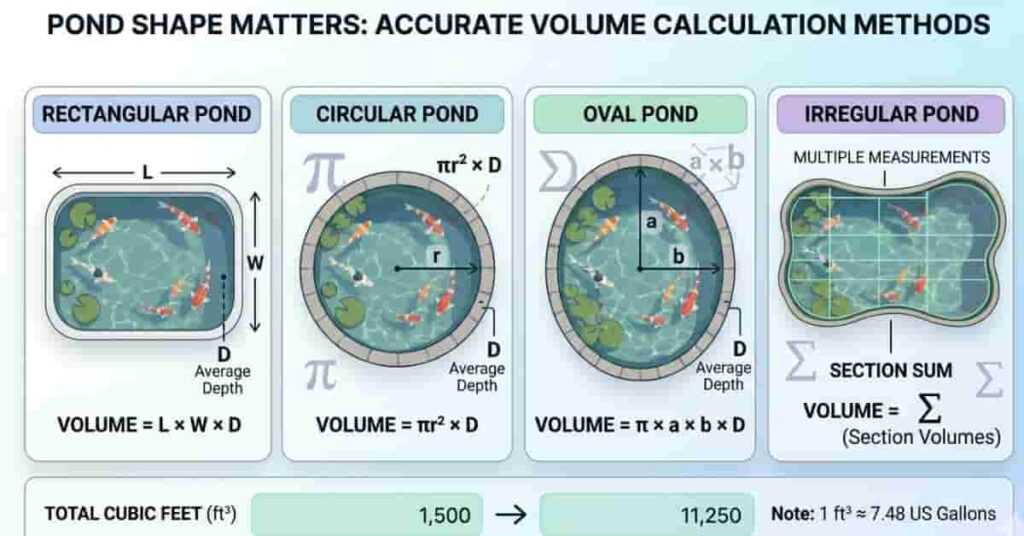
Pond shape plays a major role in getting the correct water volume. Many pond owners use a single formula for every pond, but that often leads to incorrect results. Each shape stores water differently, so you need the right method for accurate koi pond volume calculator results and proper fish pond planning.
Rectangular ponds are the easiest to measure because all sides are straight. Circular and oval ponds need radius-based calculations. Irregular or natural ponds are the hardest because they don’t follow fixed geometry. In these cases, breaking the pond into smaller sections improves accuracy and prevents overestimating water capacity.
Rectangular Ponds
Rectangular ponds are the most common for backyard setups. You simply multiply length, width, and average depth. This method works well for controlled koi pond designs with straight edges and a fairly even depth.
Formula:
Length × Width × Depth × 7.5 = US Gallons
Circular Ponds
Circular ponds require measuring the radius from the center to the edge. Apply the formula directly. This method suits decorative garden ponds and some fish pond designs.la:
π × r² × Depth × 7.5 = US Gallons
Oval Ponds
Oval ponds are slightly more complex but still manageable. You measure the longest and shortest diameters and use an average-based approach. This helps improve accuracy when using a koi pond gallon calculator for non-standard shapes.
Irregular or Natural Ponds
Natural ponds do not follow fixed shapes. The best method is to divide them into smaller sections, like rectangles or circles. Then calculate each part separately and add the results together. This reduces errors and gives a more realistic estimate for fish stocking and filtration needs.
💡 Pro Tip
Always measure average depth, not maximum depth. Irregular bottoms can easily overestimate volume and affect water balance.
Convert Pond Volume into Gallons & Litres
Knowing how to convert pond volume between gallons and litres helps ensure accurate pond planning.
Understanding both litre and US gallon conversions lets you easily select suitable pond equipment.
🔁 Key Conversion Formulas
- Use these standards for converting pond volume: 1 cubic foot = 7.48 US gallons.
- 1 litre = 0.264 US gallons
These formulas help you quickly convert pond volume to the units you need for equipment sizing and maintenance planning.
📊 Example Conversion (Koi Pond)
Convert 1,000 litres to US gallons: 1,000 × 0.264 = 264 US gallons.
This conversion helps you quickly compare calculators, check filter specs, and make informed decisions for your pond.Why Conversion Matters
Using accurate conversion helps you choose the right equipment, prevents health risks for fish, and supports reliable pond management.
Common Mistakes in Pond Volume Calculation
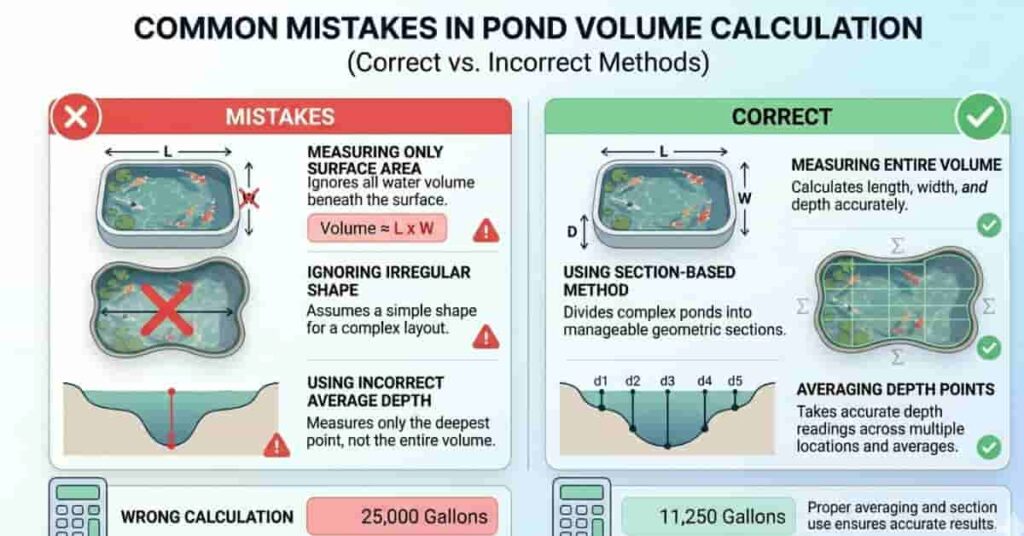
Many pond owners think pond volume is simple, but small mistakes can seriously affect results. Wrong calculations often lead to poor fish health, weak filtration, and unstable water conditions. If you use a koi pond volume calculator or fish pond volume calculator, avoiding these errors is just as important as using the formula correctly.
One of the most common mistakes is measuring only the surface area and ignoring depth. A pond may look large on top, but hold much less water if it is shallow. Depth always changes the real volume, so skipping it leads to major errors.
Another issue is failing to properly average the depth. Most ponds are not evenly flat. If you measure only the deepest point, you will overestimate water capacity. Always take multiple depth readings and use an average for accurate results.
Many people also ignore irregularities in pond shape. Natural or custom ponds rarely follow perfect shapes. Treating them like rectangles or circles gives false results and affects stocking decisions.
Overestimating pond volume is another serious mistake. It often leads to adding too many fish or using an undersized filter. This creates poor oxygen levels and increases waste buildup in the water.
Lastly, many pond owners forget to recalculate pond volume after making changes. Adding rocks, liners, waterfalls, or extensions can significantly change pond volume. Updating your calculations keeps your system balanced and safe.
Why Accurate Pond Volume is Important
Knowing the exact pond volume is not just a technical detail. It directly affects fish health, water quality, and the long-term stability of your pond. The easiest way to measure pond volume is to use the basic formula: length × width × average depth (in feet or meters), then multiply by a conversion factor to find the total gallons or litres. If your pond has an irregular shape, you can also use online calculators designed for ponds. Whether you use a koi pond volume calculator or a fish pond gallon calculator, accuracy helps you make safe decisions instead of guessing.
One of the biggest benefits is proper control of fish stocking density. Every pond has a limit on how many fish it can safely support. If you overestimate water volume, you may add too many fish, which increases waste and stress.
Accurate volume also helps maintain the right oxygen and aeration balance. Fish need enough dissolved oxygen to stay healthy. If aeration is based on the wrong pond size, oxygen levels can drop quickly, leading to unhealthy water conditions.
Filtration system sizing also depends on the correct pond volume. A filter that is too small will struggle to clean the water, while an oversized system wastes energy and money. Knowing the exact gallons or litres ensures balanced filtration performance.
Water treatment and chemical dosing are another critical area. Products like dechlorinators, algae treatments, and beneficial bacteria must be matched to the actual water volume. Incorrect dosing can harm fish or fail to fix water problems.
Most importantly, accurate pond volume helps prevent fish mortality. When stocking, oxygen, and water treatment are based on accurate data, your fish live in a stable, safe environment with fewer risks.
💡 Pro Tip
Always measure your pond before adding new fish or changing your filtration system. Even small estimation errors can create long-term water quality issues.
Quick Formula Cheat Sheet (SEO Featured Snippet Target)
This quick formula guide helps you calculate pond volume without confusion. It is useful when you don’t have a koi pond volume calculator or want to double-check results from a fish pond gallon calculator. Keep these formulas handy for fast, accurate pond planning.
📏 Rectangular Pond Formula
Rectangular ponds are the easiest to measure because all sides are straight. You just multiply length, width, and depth, then convert the result to gallons.
Formula:
L × W × Depth × 7.5 = US Gallons
This works best for standard backyard koi ponds and simple fish pond designs. Make sure you use average depth for better accuracy.
🔵 Circular Pond Formula
Circular ponds need radius instead of length and width. This formula gives accurate results for round garden ponds and decorative fish ponds.
Formula:
π × r² × Depth × 7.5 = US Gallons
Here, “r” means radius (distance from center to edge). This method is widely used in pond design calculations.
🌿 Irregular Pond Formula
Natural or irregular ponds do not follow fixed shapes. The best method is to divide the pond into smaller sections and calculate each part separately.
Method:
- Break the pond into simple shapes (rectangles or circles)
- Calculate the volume of each section.
- Add all results together.
This approach gives more realistic results for ponds with curves, slopes, or uneven edges.
💡 Pro Tip
Always use average depth instead of maximum depth. This small step prevents overestimation and keeps your pond system balanced.
Conclusion
This guide explains how to accurately calculate koi and fish pond volumes. We covered formulas, pond shapes, and conversion to gallons and litres.
Using a koi pond volume calculator helps you avoid guesswork and keeps fish healthy. It also works well with a fish pond gallon calculator for quick and reliable results. Always double-check measurements for better filtration and oxygen balance. Accurate calculations also help you choose the right pump and filtration system. Start using simple methods today to improve your pond water quality and fish growth.
Try our tools, share your experience, or explore more pond guides on our website.
Michael Brooks and Sarah Lane are the co-founders of the Pond Pump Team, a trusted U.S.-based group helping homeowners and landscapers build better ponds and water features. Michael, an experienced pond engineer from Oregon, has worked for over 12 years on pump sizing, flow systems, and water circulation. Sarah, a pond designer from Colorado with nine years of experience, focuses on eco-friendly and easy-to-maintain pond and waterfall designs. Together, they’ve completed more than 180 pond projects and created tools like the Pond Pump Calculator and Pond Liner Calculator to make pond planning simple, accurate, and sustainable.
Need help with your pond setup? Contact the Pond Pump Team for expert advice and reliable solutions.