Introduction
Wondering how much salt to add to a pond without harming your fish?
Getting the right pond salt dosage is important for maintaining a healthy pond environment. Too little salt may not provide the desired benefits, while too much can stress fish, plants, and beneficial bacteria. For beginners, calculating the correct amount can be confusing because it depends on your pond volume and the target salinity level.
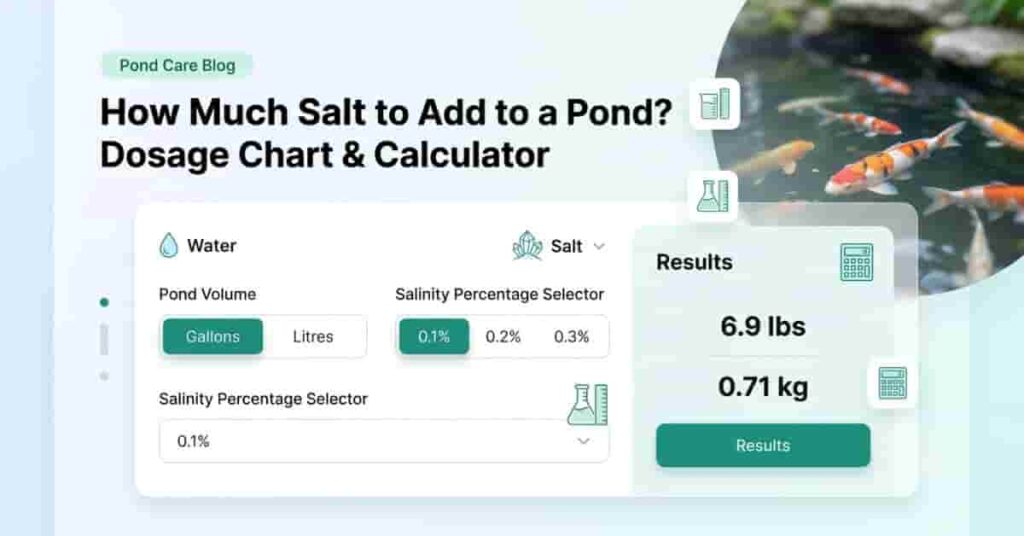
The amount of pond salt you need depends on pond volume and the target salt concentration. For most pond treatments, salt levels between 0.1% and 0.3% are commonly used. The easiest method is to use a pond salt calculator or dosage chart based on gallons or litres.
In this guide, you’ll learn how to calculate the correct pond salt dosage, understand recommended salinity levels, and use a simple pond salt dosage chart for quick reference. You’ll also find a handy calculator to determine exactly how much salt your pond needs.
The amount of pond salt you need depends on pond volume and the target salt concentration. For most pond treatments, salt levels between 0.1% and 0.3% are commonly used. The easiest method is to use a pond salt calculator or dosage chart based on gallons or litres. Once you know the correct dosage, choosing a high-quality pond salt is just as important. Our Best Pond Salt for Koi Ponds guide compares trusted products to help you pick the right option for safe and effective pond treatment.
Pond Salt Dosage Chart
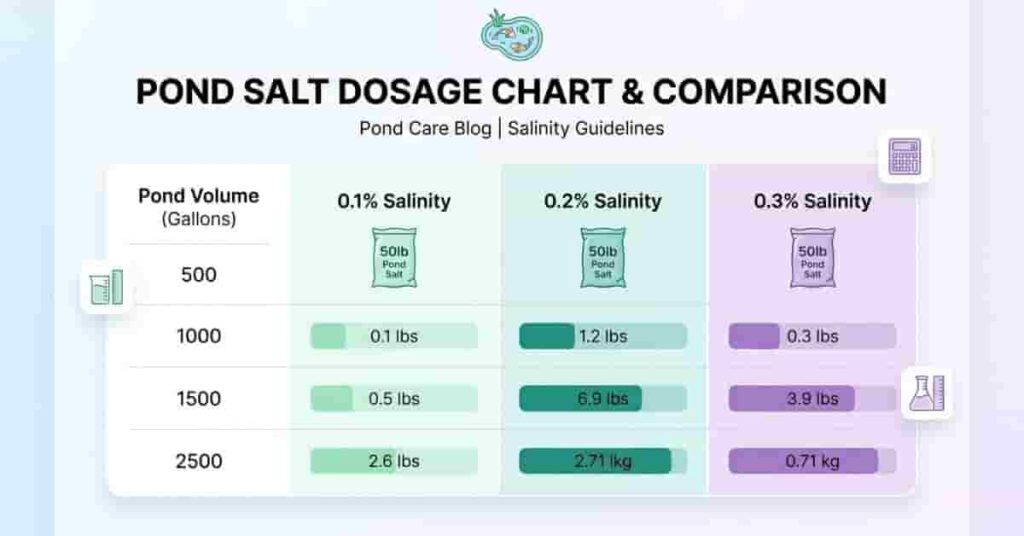
A pond salt dosage chart provides a quick way to estimate how much salt your pond needs. The exact amount depends on your pond volume and target salinity level. Most pond owners use concentrations between 0.1% and 0.3% for maintenance, stress relief, and short-term treatment.
While a pond salt calculator provides the most accurate results, dosage charts are useful for quick planning. Use the tables below to find the approximate amount of salt required for common pond sizes.
Takeaways
- 0.1% is commonly used for light support and maintenance.
- 0.2% is often used during periods of fish stress.
- 0.3% is a common treatment level for short-term use.
- Always verify your pond volume before adding salt.
- Add salt gradually instead of all at once.
Pond Salt Dosage Chart in Gallons
| Pond Volume (Gallons) | 0.1% Salt | 0.2% Salt | 0.3% Salt |
| 100 Gallons | 0.83 lbs (0.38 kg) | 1.67 lbs (0.76 kg) | 2.50 lbs (1.13 kg) |
| 500 Gallons | 4.17 lbs (1.89 kg) | 8.34 lbs (3.78 kg) | 12.51 lbs (5.67 kg) |
| 1,000 Gallons | 8.34 lbs (3.78 kg) | 16.68 lbs (7.56 kg) | 25.02 lbs (11.35 kg) |
| 2,000 Gallons | 16.68 lbs (7.56 kg) | 33.36 lbs (15.13 kg) | 50.04 lbs (22.70 kg) |
| 5,000 Gallons | 41.70 lbs (18.91 kg) | 83.40 lbs (37.83 kg) | 125.10 lbs (56.75 kg) |
Pond Salt Dosage Chart in Litres
| Pond Volume (Litres) | 0.1% Salt | 0.2% Salt | 0.3% Salt |
| 100 Litres | 0.10 kg | 0.20 kg | 0.30 kg |
| 500 Litres | 0.50 kg | 1.00 kg | 1.50 kg |
| 1,000 Litres | 1.00 kg | 2.00 kg | 3.00 kg |
| 5,000 Litres | 5.00 kg | 10.00 kg | 15.00 kg |
| 10,000 Litres | 10.00 kg | 20.00 kg | 30.00 kg |
Pro Tip
If your pond already contains salt from a previous treatment, test the water first. Adding new salt without checking the current salinity can lead to overdosing.
How Much Pond Salt Per Gallon?
Knowing how much pond salt to use per gallon helps prevent both underdosing and overdosing. The correct amount depends on your pond size and the salinity level you want to achieve. Most pond owners use salt concentrations between 0.1% and 0.3%, depending on whether they are performing routine maintenance or supporting fish during stressful conditions.
A simple way to estimate salt requirements is to use the following formula:
Salt Required (lbs) = Pond Volume (Gallons) × Target Salinity (%) × 8.34
This formula provides an estimate based on the water weight in your pond. For the most accurate result, use a pond salt calculator and confirm your pond volume before adding salt.
When adding salt, dissolve it in pond water first and spread it gradually around the pond. This helps fish adjust to the change more comfortably and reduces stress.
Takeaways
- The amount of pond salt needed depends on pond volume and target salinity.
- Most ponds use salinity levels of 0.1% to 0.3%.
- Larger ponds require significantly more salt.
- Always add salt gradually and monitor fish behaviour.
- A pond salt calculator provides the most accurate dosage.
Salt Required for 100 Gallons
A 100-gallon pond requires relatively little salt. At a 0.1% concentration, you’ll need about 0.83 pounds (0.38 kg) of pond salt. At 0.2%, the requirement increases to 1.67 pounds (0.76 kg), while at 0.3%, it is 2.50 pounds (1.13 kg).
Small ponds can experience rapid changes in water chemistry. Measure carefully and avoid estimating by eye. Even a small dosing mistake can have a noticeable effect on fish and plants.
Salt Required for 500 Gallons
A 500-gallon pond needs more precise planning because the total salt requirement increases quickly. At 0.1% salinity, add approximately 4.17 pounds (1.89 kg) of salt. For 0.2%, use 8.34 pounds (3.78 kg); for 0.3%, use 12.51 pounds (5.67 kg).
Many backyard fish ponds fall within this size range. Before adding salt, calculate the actual pond volume rather than relying on estimates from the original pond design.
Salt Required for 1,000 Gallons
For a 1,000-gallon pond, the salt requirement is twice that of a 500-gallon pond. A 0.1% concentration requires about 8.34 pounds (3.78 kg) of salt. At 0.2%, you’ll need 16.68 pounds (7.56 kg), while a 0.3% level requires 25.02 pounds (11.35 kg).
Large ponds often contain more fish, making accurate dosing even more important. Test the water regularly and monitor fish behaviour after any salinity adjustment.
How Much Pond Salt Per Litre?
If you’re wondering how much pond salt per litre to use, the answer depends on your target salinity level. Pond salt is typically measured as a percentage of the total water volume. For most freshwater ponds, common salt concentrations range from 0.1% to 0.3%.
A simple rule is that a salinity of 0.1% requires 1 gram of salt per litre of water. This means a 0.2% concentration requires 2 grams per litre, while a 0.3% concentration requires 3 grams per litre.
Using litres makes salt calculations straightforward because the relationship between water volume and salt weight is easy to understand. However, it’s still important to measure your pond volume accurately before adding salt. Even a small error can affect the final salinity level.
For the most reliable result, use a pond salt calculator to determine the exact amount needed for your pond size and treatment goal.
Takeaways
- A salinity level of 0.1% equals 1 gram of salt per litre.
- A salinity level of 0.2% equals 2 grams per litre.
- A salinity level of 0.3% equals 3 grams per litre.
- Accurate pond volume measurements improve dosing accuracy.
- Use a pond salt calculator for quick and precise results.
Salt Required for 100 Litres
A 100-litre pond requires relatively little salt. At a 0.1% salinity level, you’ll need 100 grams (0.1 kg) of salt. A 0.2% concentration requires 200 grams (0.2 kg), while a 0.3% concentration requires 300 grams (0.3 kg).
Small ponds and quarantine tanks often fall within this size range. Because the water volume is limited, even minor dosing errors can increase salinity beyond expected levels. Always measure salt by weight rather than estimating.
Salt Required for 500 Litres
For a 500-litre pond, you’ll need 500 grams (0.5 kg) of salt for a 0.1% concentration. A 0.2% salinity level requires 1 kilogram, while a 0.3% concentration requires 1.5 kilograms of salt.
Many small garden ponds and fish holding tanks are close to this size. Check your pond volume carefully before treatment, especially if the pond has shelves or irregular shapes that reduce actual water capacity.
Salt Required for 1,000 Litres
A 1,000-litre pond requires 1 kilogram of salt to reach a salinity of 0.1%. For 0.2%, you’ll need 2 kilograms, and for 0.3%, you’ll need 3 kilograms of salt.
This pond size is common among backyard koi ponds and ornamental fish ponds. Before adding new salt, consider whether previous treatments may have left residual salt in the water. Testing salinity can help avoid accidental overdosing.
How Much Salt Should Be in a Fish Pond?
Many pond owners ask, how much salt in fish pond water is actually safe. The answer depends on the type of pond, the fish species, and the reason for adding salt. Freshwater ponds and koi ponds can benefit from pond salt in certain situations, but more salt is not always better.
For routine care, many pond keepers use low salt concentrations or no salt at all. During periods of stress, transportation, or disease treatment, higher levels may be used for a limited time. However, long-term exposure to elevated salinity can affect pond plants and may reduce treatment effectiveness if fish become accustomed to salt.
The key is matching the salinity level to the specific situation. A maintenance dose differs from a treatment dose, and not every pond problem requires salt.
Normal Maintenance Salt Levels
For routine pond management, many pond owners keep salinity levels at 0% to 0.1%. This range may help fish recover from minor stress while minimising risks to sensitive plants and beneficial bacteria.
Koi ponds sometimes experience low salt levels after handling, during transportation, or due to seasonal changes. However, many experienced keepers prefer to reserve salt for specific needs rather than maintaining constant salinity year-round.
Good water quality, proper filtration, and regular maintenance remain more important than routine salt use. Salt should support healthy pond management, not replace it.
Salt Levels During Treatment
During treatment situations, pond salt concentrations often range from 0.1% to 0.3%, depending on the goal and fish species. Pond keepers may use these levels to support fish during periods of stress or when addressing certain external issues.
Higher concentrations should generally be temporary. Prolonged use may affect aquatic plants and can make future salt treatments less effective. Always increase salinity gradually and observe fish closely during the process.
Different fish species have different tolerances, so research your specific fish before raising salinity levels.
When Salt Should Not Be Added
Salt is not the right solution for every pond problem. Avoid adding salt if you do not know the cause of the fish’s stress or poor water quality. In many cases, testing water parameters provides a better first step.
Be cautious if your pond contains salt-sensitive plants. Some aquatic plants may struggle when salinity levels rise. Salt should also be avoided if it conflicts with a specific treatment or medication.
Before adding more salt, check whether previous treatments have left residual salt in the pond. Salt does not evaporate with water and usually remains until removed through water changes.
Pro Tip
Use a salinity meter or test kit before every treatment. Knowing the current salt level helps prevent accidental overdosing.
How to Calculate Pond Salt Requirements
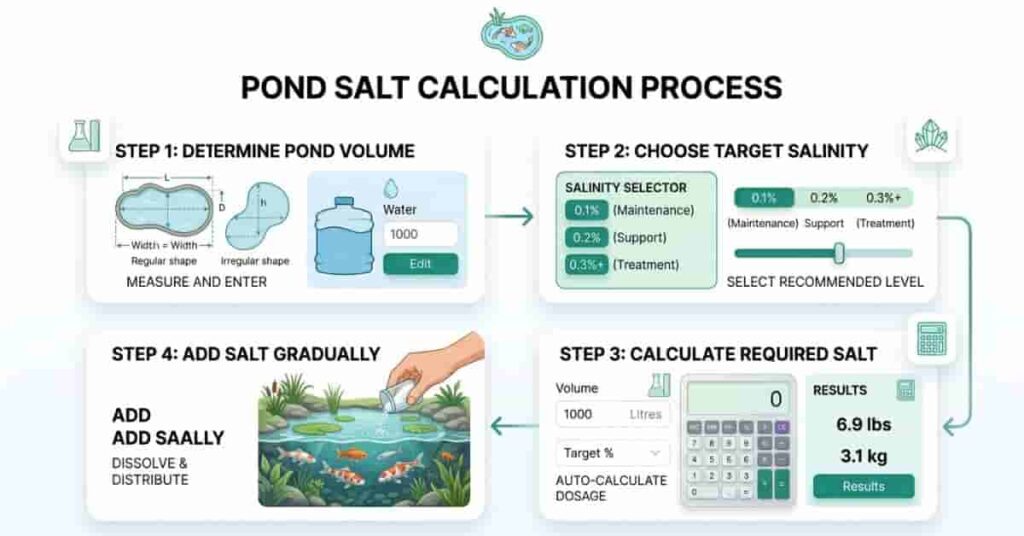
If you’re unsure how much pond salt to use, the process is simpler than it may seem. The key is knowing your pond volume and selecting the correct salinity level for your goal. Whether you’re maintaining a koi pond or supporting fish during a treatment period, accurate calculations help avoid costly mistakes.
Many pond owners add too much salt because they estimate the pond’s size rather than measure it. Others choose a salinity level without considering whether it matches their situation. Following a simple step-by-step method can help you achieve the desired concentration safely.
Once you know your pond volume and target salinity, a pond salt calculator can determine the exact amount of salt required in seconds. You can also use dosage charts for a quick estimate.
Step 1 – Determine Pond Volume
Before calculating salt requirements, find your pond’s total water volume. This is the most important step because every dosage calculation depends on it.
For rectangular ponds, measure the length, width, and average depth. For irregular ponds, estimate the average dimensions as accurately as possible. If you already know your pond capacity in gallons or litres, you can move directly to the next step.
Even a small error in pond volume can significantly affect the final salinity level. Taking a few extra minutes to measure carefully can prevent overdosing later.
Step 2 – Choose Target Salinity
Next, decide what salinity level you want to achieve. Most pond owners use concentrations between 0.1% and 0.3%, depending on the situation.
A lower concentration is often used for light support and maintenance. Higher concentrations are generally reserved for short-term treatment situations. The correct level depends on your fish species, pond setup, and treatment goal.
Avoid selecting a higher concentration simply because it seems more effective. Using more salt than necessary can increase risks without providing additional benefits.
Step 3 – Calculate Required Salt
Once you know your pond volume and target salinity, calculate the amount of salt needed. A pond salt calculator is the easiest option because it performs the calculation instantly and reduces the chance of errors.
You can also use a pond salt dosage chart to estimate the required amount. For example, a 1,000-gallon pond requires approximately 8.34 pounds of salt to reach a 0.1% concentration.
Double-check your measurements before purchasing or adding salt. Correct calculations save time and prevent unnecessary water changes later.
Step 4 – Add Salt Gradually
After calculating the required amount, do not add all the salt at once. Gradual additions allow fish to adjust more comfortably to changing water conditions.
Dissolve the salt in buckets of pond water and distribute it around the pond. Many pond keepers spread the dose over several hours or even a full day when using higher concentrations.
Monitor fish behaviour during and after treatment. If fish appear stressed, test water quality and salinity before making additional adjustments.
Common Pond Salt Concentrations Explained
A pond salinity chart helps pond owners understand which salt concentration is appropriate for different situations. Not every pond requires the same salinity level. The ideal concentration depends on your goals, fish species, pond plants, and overall water conditions.
In most freshwater ponds, salinity levels of 0.1% to 0.3% are most common. Lower concentrations are often used for routine support, while higher levels are generally reserved for short-term treatment situations. Going beyond these levels should only be done with careful planning and monitoring.
The table below explains the most common pond salt concentrations and their typical uses.
| Salinity % | Purpose | Notes |
| 0.1% | Routine support and mild stress recovery | Common starting point for freshwater ponds and koi ponds. Generally considered a low salinity level. |
| 0.2% | Increased support during periods of stress | Often used after transportation, handling, or environmental changes. Monitor fish and plants closely. |
| 0.3% | Short-term treatment situations | Frequently used as a temporary treatment level. Avoid prolonged use unless specifically required. |
| Higher Levels (Above 0.3%) | Specialized treatment situations | May not be suitable for all fish, plants, or pond systems. Requires careful monitoring and research. |
Why Salinity Levels Matter
Choosing the correct salinity level helps protect fish while avoiding unnecessary stress on pond plants and beneficial bacteria. A concentration that works well for one pond may not be suitable for another.
Many beginners assume more salt will produce better results. In reality, excessive salinity can create new problems and may not improve outcomes. Matching the salinity level to the specific situation is usually the safest approach.
Mistakes to Avoid When Adding Pond Salt
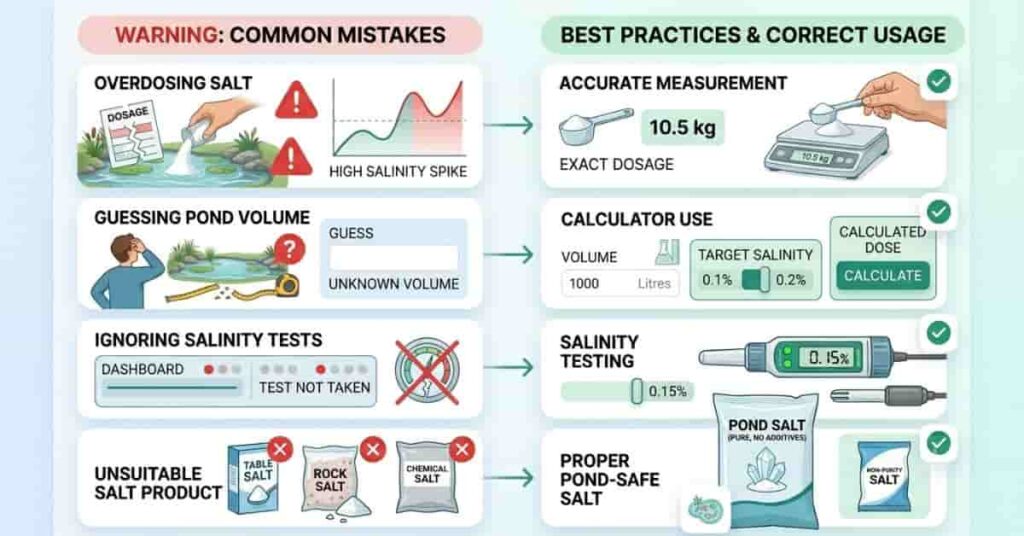
Pond salt can be a useful tool, but mistakes during application can create problems for fish, plants, and water quality. Many issues arise when pond owners rush the process or rely on estimates rather than measurements.
The good news is that most salt-related problems are easy to avoid. By measuring carefully, choosing the correct product, and monitoring salinity levels, you can use pond salt more safely and effectively.
Adding Too Much Salt at Once
One of the most common mistakes is adding the full salt dose in a single application. Sudden changes in salinity can stress fish and make it harder for them to adapt to changing water conditions.
Instead, divide the required amount into smaller portions and add them over several hours. Many pond owners spread larger doses across 24 to 48 hours when raising salinity levels significantly.
Gradual adjustments are usually safer and allow you to monitor fish behaviour during the process.
Guessing Pond Volume
Many pond owners estimate the pond’s size rather than measure it accurately. Unfortunately, even a small error in pond volume can lead to a significant dosing mistake.
Ponds with shelves, irregular shapes, waterfalls, or varying depths often hold less water than expected. Using rough estimates may result in adding too much or too little salt.
Always calculate pond volume before treatment and update your measurements if the pond structure changes.
Ignoring Existing Salt Levels
Salt does not disappear when water evaporates. It remains in the pond until removed through water changes or dilution. As a result, previous treatments may leave residual salt in the water.
Adding a new dose without testing the current salinity can raise salt levels beyond intended levels. This is especially common in koi ponds that receive multiple treatments throughout the year.
Before every treatment, test the water and calculate how much salt is already present.
Using the Wrong Type of Salt
Not all salt products are suitable for ponds. Some household salts contain additives, anti-caking agents, iodine, or other ingredients that may not be ideal for aquatic environments.
Choose a pond-safe product designed for fish ponds, koi ponds, or aquaculture use. Always read the product label before adding it to the water.
Using the correct type of salt helps ensure predictable results and reduces the risk of introducing unwanted substances into the pond.
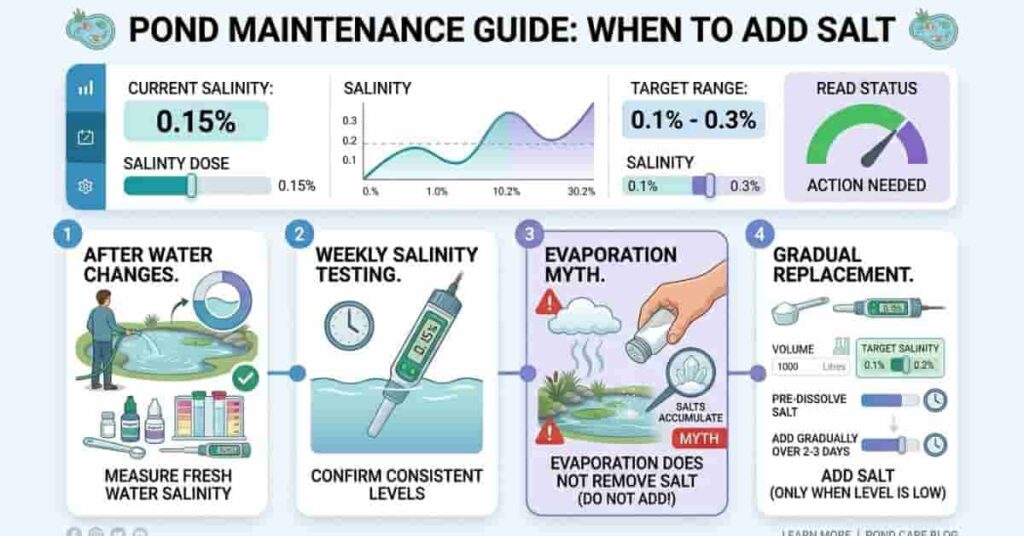
How Often Should You Add Pond Salt?
Many pond owners wonder how often to add pond salt. In most cases, you should not add salt on a fixed schedule. The correct timing depends on water changes, current salinity levels, and the reason you are using salt.
One of the biggest misconceptions is the evaporation myth. When water evaporates, the salt stays behind. Only the water leaves the pond. This means evaporation increases salt concentration rather than reducing it. Simply topping off the pond with fresh water does not remove existing salt.
Salt is usually replaced after partial water changes because some of the dissolved salt leaves with the removed water. The amount you need to add depends on how much water was changed and your target salinity level. This is why testing is important before every new dose.
Regular re-testing helps prevent accidental overdosing. A salinity meter or test kit can confirm the current salt level and show whether additional salt is necessary.
When Should You Add More Salt?
You may need to add more salt after:
- Partial water changes
- Large rain events that dilute pond water
- Specific treatment plans that require a target salinity
- Confirmed low salinity readings from testing
If salinity remains within the desired range, additional salt is usually unnecessary.
Pro Tip
Before adding more salt, test the water and calculate how much salt was removed during water changes. This approach is far more accurate than following a fixed schedule.
Read our guide on How to Use Pond Salt Safely to learn proper dosing methods, testing procedures, and best practices for maintaining healthy pond conditions.
How Much Salt for a Koi Pond?
The amount of salt needed for a koi pond depends on the pond volume and the target salinity level. Most koi keepers use salt only when there is a specific reason, such as supporting fish during stress, transportation, or short-term treatment situations.
For many applications, salinity levels between 0.1% and 0.3% are commonly used. However, the exact amount of salt required varies with the pond’s total water volume. Using a pond salt calculator is the easiest way to determine the correct dosage.
Before adding salt, test the current salinity level and confirm your pond volume. This helps prevent overdosing and ensures a safer environment for koi fish.
For detailed dosage charts, treatment recommendations, and koi-specific guidance, see How Much Salt for a Koi Pond?
Recommended Pond Salt Types
Choosing the right type of pond salt is just as important as using the correct dosage. Look for high-purity salt products that contain few or no additives. Many pond owners use pond salt, aquarium salt, pool salt, or other fish-safe products specifically designed for aquatic use.
Avoid salts that contain unnecessary additives, fragrances, or ingredients that are not intended for ponds. Always read the product label before use and follow the manufacturer’s instructions.
Using a high-quality salt product helps ensure consistent results and reduces the risk of introducing unwanted substances into the pond.
Need help choosing the best option? Read Best Pond Salt for Koi Ponds for a detailed comparison of popular pond salt products and buying tips.
Conclusion
Knowing how much salt to add to a pond is important for maintaining healthy fish and stable water conditions. In this guide, we covered pond salt dosage charts, salinity levels, calculation methods, common mistakes, and recommendations for freshwater and koi ponds.
The correct amount of pond salt depends on your pond volume and target salinity level. Always measure your pond carefully, test existing salt levels, and avoid guessing. Regular monitoring can help prevent overdosing and keep your pond environment balanced.
For the most accurate results, use a pond salt calculator instead of relying on estimates alone. It saves time and helps ensure the correct dosage every time.
Use the Pond Salt Calculator to determine the exact amount of salt your pond needs, then choose a high-quality product for safe dosing. Our Best Pond Salt for Koi Ponds guide compares trusted pond salts so you can confidently select the right one for your pond.

Michael Brooks and Sarah Lane are the co-founders of the Pond Pump Team, a trusted U.S.-based group helping homeowners and landscapers build better ponds and water features. Michael, an experienced pond engineer from Oregon, has worked for over 12 years on pump sizing, flow systems, and water circulation. Sarah, a pond designer from Colorado with nine years of experience, focuses on eco-friendly and easy-to-maintain pond and waterfall designs. Together, they’ve completed more than 180 pond projects and created tools like the Pond Pump Calculator and Pond Liner Calculator to make pond planning simple, accurate, and sustainable.
Need help with your pond setup? Contact the Pond Pump Team for expert advice and reliable solutions.