Introduction
Unsure how many gallons your pond holds? Many owners guess and end up with costly mistakes.
A wrong estimate can lead to:
- Poor pump sizing that fails to circulate water properly
- Too much or too little water treatment
- Stress and health risks for fish and plants
Irregular shapes and sloped sides make things harder. Standard formulas often give inaccurate results, especially when depth changes across the pond.
The good news? You don’t need complex math or guesswork. With the right method, you can measure your pond accurately and avoid common errors. Even better, a simple tool can do the work for you in seconds.
Try our pond volume calculator now and see your results instantly!
Use Our Irregular Pond Volume Calculator (Instant Results)
Our irregular pond volume calculator helps you find accurate gallon estimates in seconds. You don’t need complex formulas or manual calculations. Just enter a few details, and the tool takes care of the rest.
This calculator works well for ponds with:
- Irregular or freeform shapes
- Sloped sides or uneven bottoms
- Varying depth levels across sections
Follow these simple steps to get your result:
- Enter pond dimensions
Simply add the length and width of your pond. For those unique shapes, use your average measurements or divide into easy sections. - Add depth details
Enter the average depth, or include the minimum and maximum depths if your pond has slopes. - Get instant volume. Your total pond volume in US gallons will appear instantly. Enjoy how easy it is! Go ahead.
This quick process helps you avoid common mistakes, such as guessing depth or using the wrong formula. It’s especially useful when setting up pumps, filters, or water treatments.
Microcopy:
Works for irregular shapes, sloped sides, and uneven bottoms.
It’s also useful to understand pond volume by shape methods before calculating.
Why Accurate Pond Volume Matters
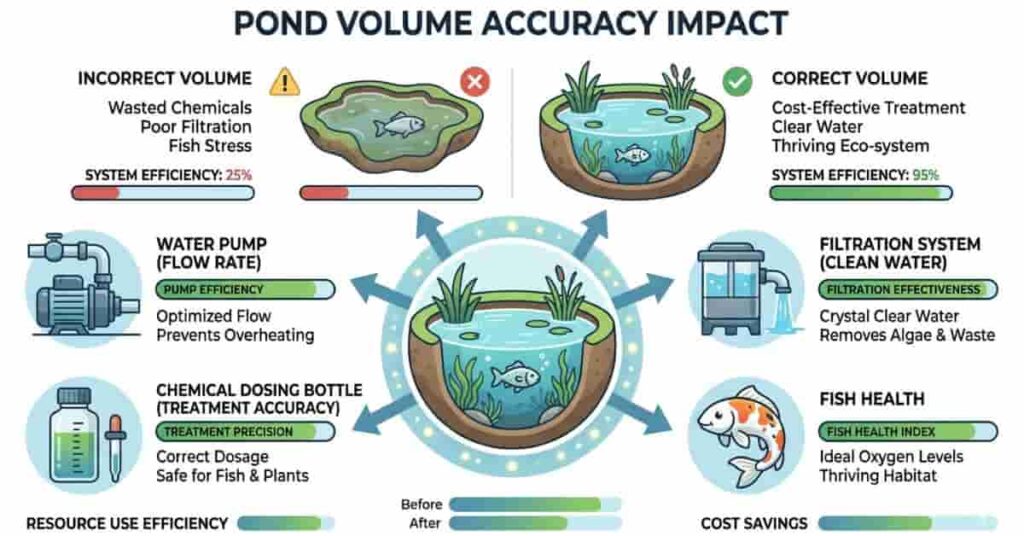
Getting an accurate pond volume is important for your entire system. Small miscalculations lead to expensive, unhealthy water problems.
First, accurate volume helps with pump sizing. Most ponds need full water circulation every 1–2 hours. If your pump is too small, water becomes stagnant. Too large, and you waste energy and stress the fish.
👉 See our pond pump size calculator for exact flow rate guidance.
Water treatment also depends on the correct volume. Products like dechlorinators, algaecides, and beneficial bacteria require precise dosing. Overdosing can harm fish, while underdosing makes treatments ineffective.
Knowing your pond’s volume helps prevent overstocking, promoting good oxygen levels and healthy fish. Proper volume keeps fish stress and water waste low.
Accurate volume helps match your filter to the pond’s size, ensuring clean water and a healthy pond. The right filter maintains proper water quality.
A small backyard pond owner once guessed their pond size and installed a weak pump. Within weeks, algae took over, and fish became sluggish. After recalculating the correct volume, upgrading the pump, and adjusting treatment, the pond cleared up quickly.
Accurate measurement saves time, money, and effort by keeping your pond balanced, healthy, and easy to maintain.
To make things easier, try using a pond volume & gallons calculator guide for quick estimates.
Understanding Irregular Pond Shapes
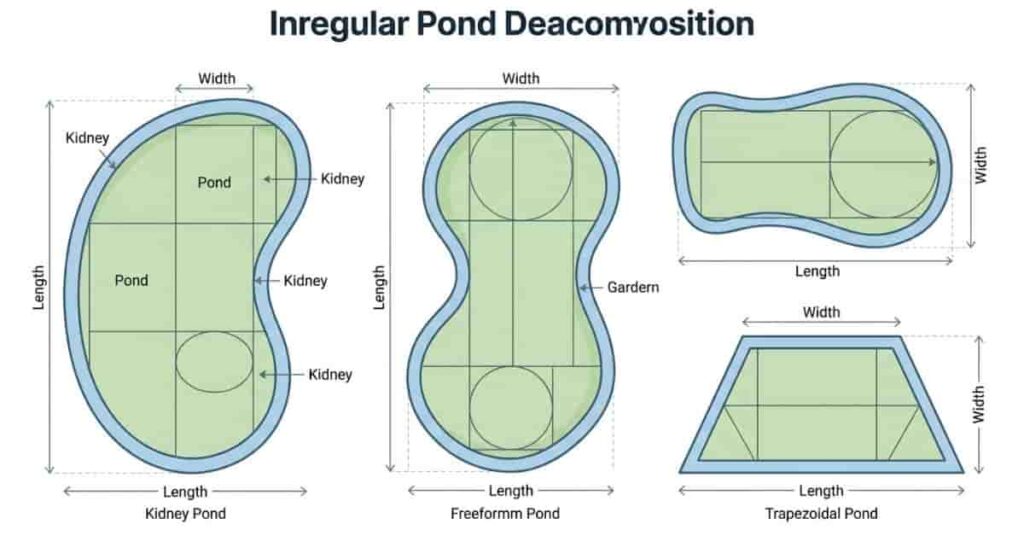
Many backyard ponds feature curves, slopes, and uneven edges, making size calculations more complex, especially with basic formulas.
Common irregular pond shapes include:
- Kidney-shaped ponds with smooth curves
- Freeform garden ponds with natural edges
- Trapezoidal layouts with uneven sides
These designs are attractive, but they do not conform to standard formulas. Estimating volume as a rectangle produces inaccurate results.
Irregular ponds vary in width and surface area, leading to inaccurate gallon estimates that affect pump, filter, and water treatment performance.
The best solution is straightforward and dependable. Divide your pond into smaller, simple sections, treating each as a basic shape, such as:
- Rectangles
- Circles
- Triangles
Calculate each section individually, then sum the results. This method boosts accuracy and supports irregular pond volume calculators.
Dividing a freeform pond into basic shapes, then measuring each, gives a much closer estimate than guessing the full shape.
How to Calculate Pond Volume with Sloped Sides
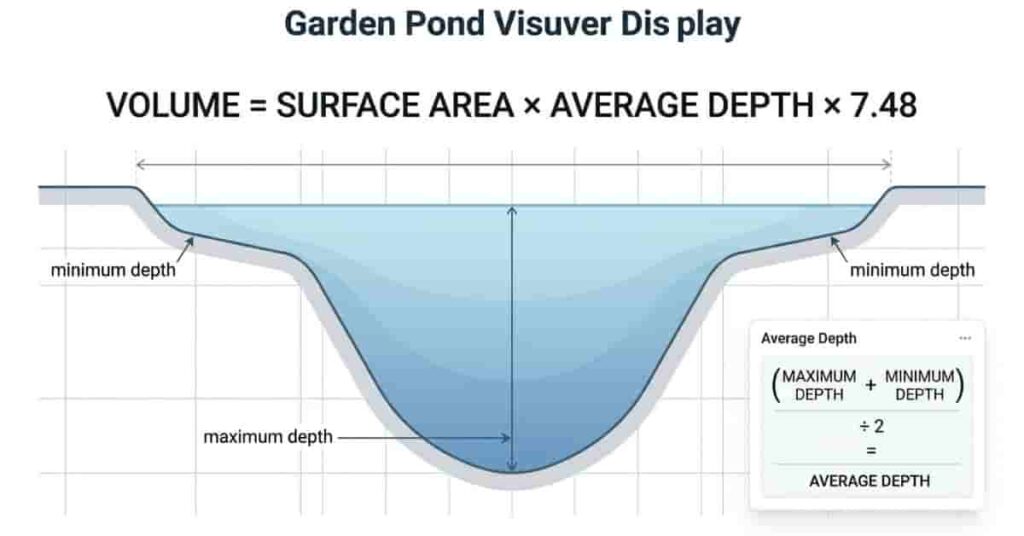
Ponds with sloped sides vary in depth from edge to center, creating both shallow and deep areas.
With these changing depths, a single measurement won’t work. Relying only on the deepest point can mislead you, so a pond volume calculator for slopes or an easy method is your friend here.
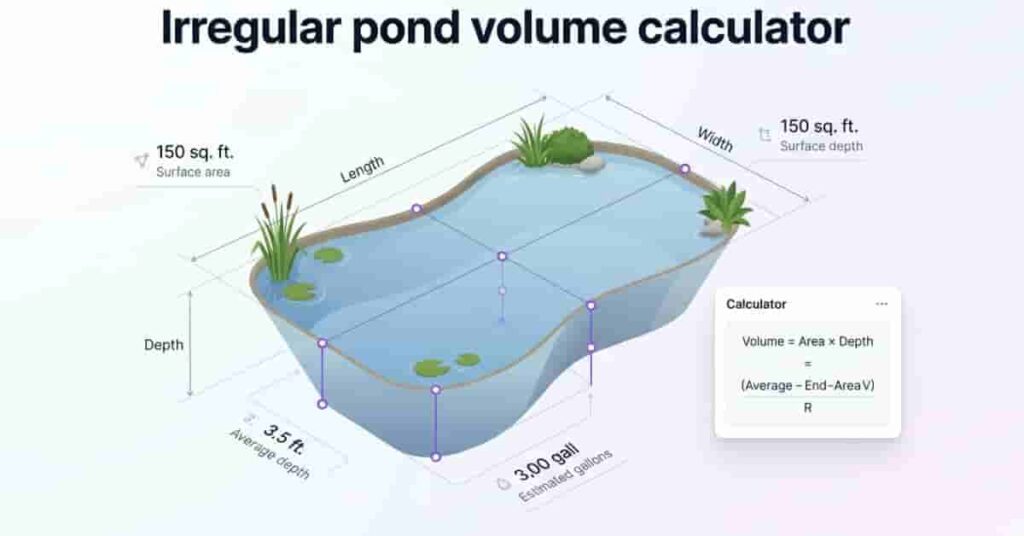
The most reliable approach is the Average Depth Method:
Volume (gallons)=Surface Area (sq ft)×Average Depth (ft)×7.48\text{Volume (gallons)} = \text{Surface Area (sq ft)} \times \text{Average Depth (ft)} \times 7.48Volume (gallons)=Surface Area (sq ft)×Average Depth (ft)×7.48
Here’s how it works in simple terms:
- 7.48 converts cubic feet into US gallons
- Average Depth = (Maximum Depth + Minimum Depth) ÷ 2
This method finds a balance between the shallows and the deep water, giving you a pond estimate you can trust.
Example (Using Feet and Gallons)
Let’s say your pond has:
- Surface area = 120 sq ft
- Maximum depth = 4 ft
- Minimum depth = 2 ft
First, find the average depth:
- (4 + 2) ÷ 2 = 3 ft
Now calculate volume:
- 120 × 3 × 7.48 = 2,692.8 gallons
So, your pond holds about 2,693 gallons.
This method is simple, accurate, and widely used for calculating pond gallons tasks. It works well for most sloped ponds without complex measurements.
Step-by-Step Method for Irregular Pond Volume Calculation
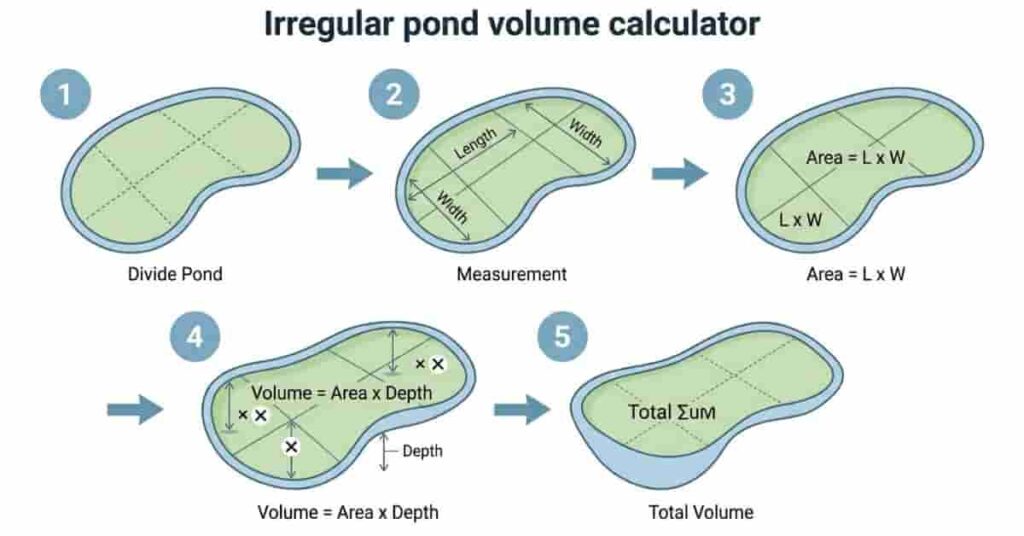
Calculating an irregular pond is easier if you divide it into smaller sections and measure each part carefully. This approach improves accuracy.
Follow these steps:
- Step 1: Divide the pond into sections
Split the pond into simple shapes, such as rectangles, circles, or triangles. Keep sections easy to measure. - Step 2: Measure each section
Measure and record the length and width of each section. Keep measurements in feet for consistency. - Step 3: Calculate surface area
Calculate the surface area of each shape using simple formulas, like length × width for rectangles. - Step 4: Multiply by depth
Multiply each section’s area by its average depth to find the volume. For sections with varying depths, estimate an average depth. - Step 5: Add all volumes to combine the volumes of each section to get the total pond gallons.
This method reduces errors caused by uneven shapes and changing depths. It also provides more reliable results for pump sizing, filtration, and treatment.
A small pond owner confidently divided their freeform pond into three sections. Their final estimate was much more accurate, and their filtration system functioned flawlessly.
Quick Pond Gallon Estimates (Rule of Thumb)
These easy formulas help you quickly guess pond size. They work best for simple shapes and give a rough answer before using a more detailed calculator.
For a rectangular pond, use:
- Length × Width × Depth × 7.48
For a circular pond, use:
- π × radius² × depth × 7.48
Pond Volume Calculation
Volume = Length × Width × Depth × 7.48
Volume = π × r² × Depth × 7.48
7.48 turns cubic feet into gallons. Always measure in feet for correct results.
These quick estimates are useful when:
- Planning a new pond
- Checking rough pump size
- Getting a fast gallon range
These estimates don’t include slopes or odd edges. Use a detailed method or calculator for tricky shapes.
Common Mistakes to Avoid
Small errors with an irregular pond volume calculator can cause big differences. Many pond owners rush and estimate gallons incorrectly. Avoiding these mistakes improves accuracy and helps your pump and filtration system work properly.
Have you ever just used your pond’s maximum depth? That quick shortcut often overestimates volume, leading to pump-sizing headaches. Be sure to consider your full depth range, not just the deepest spot.
Notice those sloped pond sides? Ignoring them changes your water volume results—especially in garden ponds. Treating a sloped pond like a flat one never gives accurate numbers.
Trying to use simple formulas for a freeform pond? Instead, break your irregular pond into smaller sections for much better accuracy. It makes a big difference!
Ever rounded numbers too soon? Precision is everything. Early rounding may seem quick, but it can cause surprising errors in your final gallon calculation.
Finally, mixing units like feet and inches can lead to confusion and incorrect results. Always convert everything to a single unit before calculating.
Pro Tips for Accurate Pond Measurement
Careful pond measurement is key to getting accurate calculator results. Small improvements matter.
Step 1: Measure multiple depth points across the pond. Don’t rely on just one spot. Depth often changes from edge to center, especially in sloped or natural ponds. More measurements give a more realistic average depth.
Step 2: Always use consistent units, preferably feet. Mixing inches and feet is one of the most common reasons for incorrect pond volume results. Convert everything before you start calculating.
Step 3: Double-check your calculations. Even simple math errors can lead to wrong pump sizing or treatment dosing. Rechecking ensures your results are reliable.
Finally, keep a log of pond measurements. Write down dimensions, depth readings, and final volume estimates. This is useful when you upgrade equipment or make changes later.
Maintaining a measurement log can save time and prevent costly mistakes in the long run. It also helps you track changes in pond shape or depth over time.
Conclusion
Calculating pond volume is not as simple as it looks, especially for irregular or sloped ponds. In this guide, we covered practical methods for measuring pond size, handling irregular shapes, and getting accurate gallon estimates with simple steps and formulas.
Use an irregular pond volume calculator to remove guesswork and boost accuracy. This helps with pump sizing and water treatment, ensuring long-term pond health. Small measurement errors can lead to costly setup mistakes, so aim for precision.
Use the calculator now to compare your estimate with your setup. Post your results or questions in the comments, and discover our pond guides to optimize your water system.
Michael Brooks and Sarah Lane are the co-founders of the Pond Pump Team, a trusted U.S.-based group helping homeowners and landscapers build better ponds and water features. Michael, an experienced pond engineer from Oregon, has worked for over 12 years on pump sizing, flow systems, and water circulation. Sarah, a pond designer from Colorado with nine years of experience, focuses on eco-friendly and easy-to-maintain pond and waterfall designs. Together, they’ve completed more than 180 pond projects and created tools like the Pond Pump Calculator and Pond Liner Calculator to make pond planning simple, accurate, and sustainable.
Need help with your pond setup? Contact the Pond Pump Team for expert advice and reliable solutions.